
Before searching for "LFI Coin 2030 Price Prediction," investors must clarify one crucial question: Which LFI are you actually researching?
In the crypto market, the same token symbol can correspond to multiple entirely different projects. The ticker LFI is particularly prone to confusion: some market tracking platforms display it as LienFi, some early content discusses the LFi ecosystem token, and others mix it up with entirely unrelated assets sharing the same name. Therefore, the focus of this article is strictly on the LFI token within the LFi project ecosystem, which revolves around LFi Chain, vLFi, DAO governance, and a decentralized wealth creation network.
This article systematically analyzes the potential price paths for LFI through 2030 across several dimensions: foundational understanding, technical architecture, tokenomics, market cycles, annual price predictions, peer comparisons, and a comprehensive risk outlook.
Disclaimer: All price predictions are interval estimates based on public information, historical price actions, sector cycles, and hypothetical models. They do not constitute investment advice. LFI is a high-risk, micro-to-small-cap crypto asset. Its price may fluctuate wildly, and it carries risks of long-term liquidity shortages or project failure.
I. What is LFI Coin? Essential Fundamentals Before Predicting Prices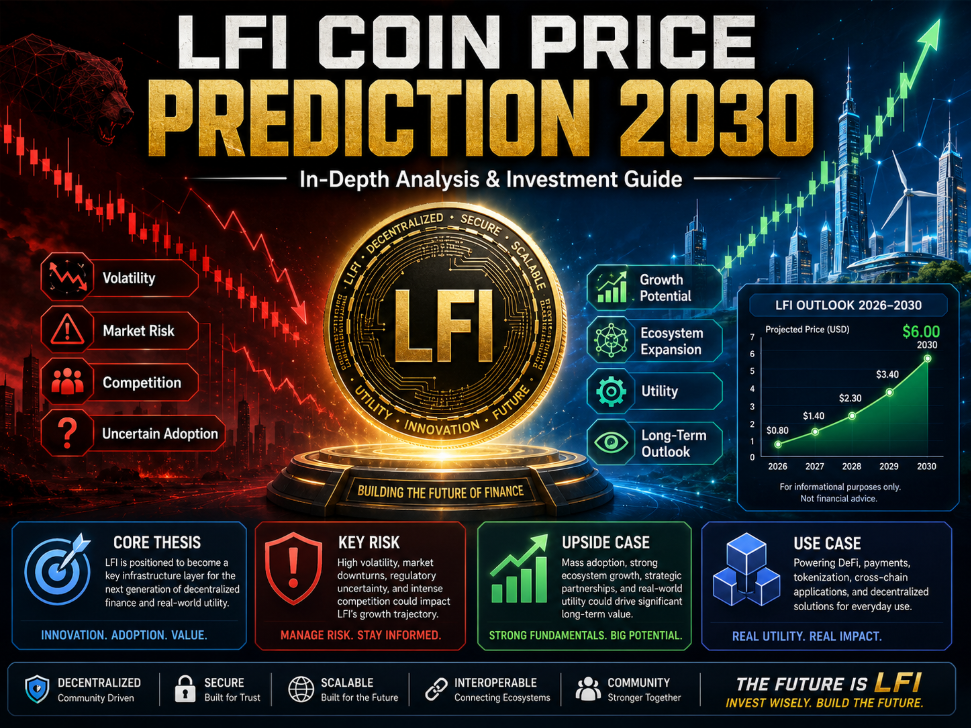
Many price prediction articles jump straight to numbers like "hitting $1 by 2030" or "a 10x return in the future." However, if readers do not understand what the project actually does, such predictions are meaningless. The core fundamentals of LFI can be broken down into several layers:
1. What is the Relationship Between LFi and LFI?
- LFi: Represents the entire ecosystem.
- LFI: Represents the native utility token within the ecosystem.
- vLFi: Represents the equity and governance token obtained by locking or vesting LFI.
- LFi Chain: Represents the underlying blockchain infrastructure planned or under construction by the project.
- L-DAO: Represents the decentralized autonomous organization governing the ecosystem.
Therefore, when discussing the "LFI coin price prediction," we are forecasting the market price of the LFI token, not the valuation of an underlying corporate platform.
2. What is LFi's Market Positioning?
LFi positions itself as a decentralized crypto network built around wealth creation, blockchain infrastructure, DAO governance, and ecosystem applications.
From early project disclosures, LFi aims to construct a complete decentralized ecosystem utilizing its own blockchain, wallet, DEX, lending protocols, Launchpad, DAO, and hardware devices. This is an ambitious scope, which also implies massive execution challenges. Because it is not a single decentralized application (dApp) but a complex suite attempting to combine a foundational chain, application ecosystem, DAO governance, and specific tokenomics.
If executed successfully, LFI's value will be driven by genuine utility within the ecosystem. If execution falters, the project risks stalling out as a venture with a grand roadmap but slow deployment and fading market trust.
3. What are the Practical Utilities of the LFI Token?
According to public project documentation, LFI serves primarily as a foundational utility token within its ecosystem. Its common use cases include:
- Paying for network service fees;
- Covering transaction fees when sending crypto assets;
- Creating or minting secondary tokens;
- Executing smart contract calls;
- Participating in ecosystem dApps;
- Supporting transaction and validation logic on the LFi Chain;
- Converting into vLFi through locking mechanisms to unlock extra privileges.
This indicates that LFI’s long-term value model is ideally driven by authentic network utility rather than pure market speculation. However, a major prerequisite remains: the utility value of LFI can only manifest if the LFi ecosystem secures active adoption. If on-chain dApp activity is low, wallet user retention is poor, DEX trading volume is stagnant, and DAO participation is sparse, sustainable demand for LFI will fail to grow.
4. What is vLFi?
vLFi acts as an equity token received by locking up native LFI. When users commit their LFI to vesting or locking protocols, they receive vLFi. Unlike regular tokens, vLFi cannot be freely transferred or traded on the secondary market. Instead, it unlocks specific ecosystem privileges:
- Ecosystem rewards and distributions;
- Advantages within the tier/ranking systems;
- Voting rights within the L-DAO;
- Direct governance over protocol decisions;
- Farming yields and other short-to-long-term incentives.
The primary structural role of vLFi is to reduce immediate circulating sell pressure by locking up a portion of LFI from the secondary market. If designed properly, this lockup mechanism can provide price support; however, if the lockup yields are unsustainable or if unlock schedules are overly concentrated, it could introduce sudden sell pressure down the line.
5. What is LFI's Current Listing Status?
In its early stages, LFI trading pairs appeared on exchanges like LBank, and project materials have referenced platforms like LBank and LYOTRADE. Certain community pages also mention related assets within the KuCoin ecosystem, such as cLFi.
However, an important caution is necessary: as of 2026, the "LFI" ticker is heavily duplicated across the crypto market. Different tracking platforms display entirely different projects under this symbol. For instance, some trackers show LFI as LienFi rather than the LFi ecosystem token.
Consequently, when looking up LFI market data, do not rely on the ticker alone. You must cross-verify:
- The full name of the project;
- The smart contract address;
- The host blockchain network;
- The verified exchange page;
- The official project website;
- Consistency with LFi's official documentation;
- Whether it is a legacy contract, a migrated token, or an impostor project.
6. What is LFI's Historical All-Time High (ATH)?
According to market data tied to the early LFi ecosystem, the common historical high referenced for the LFI token is approximately $0.94. However, due to ticker confusion, differing exchange data feeds, and potential contract migrations, investors should always verify the source of their price charts against their specific trading venue.
If $0.94 is used as the historical benchmark, LFI currently trades at a significant discount from its ATH. This often leads retail investors to assume they are buying an undervalued asset at a bargain. However, being far below an all-time high does not guarantee a token will ever return to that price. Many altcoins reach peak prices during speculative bull runs, but if the underlying ecosystem fails to scale, liquidity dries up, or the core market narrative shifts, those historical highs may never be seen again.
II. LFi Technical Architecture: The Underlying Logic for a 2030 Price Rally
Predicting the 2030 price of LFI requires looking past short-term chart patterns to answer a foundational question: Can this ecosystem survive until 2030 and generate authentic, structural user demand? If the answer is no, any optimistic price prediction lacks a realistic baseline.
1. What is the LFi Chain?
According to past developer disclosures, the LFi Chain is envisioned as the core blockchain infrastructure supporting the internal ecosystem, designed with the following technical goals:
- Optimizing for native LFi ecosystem applications;
- Full smart contract programmability;
- Integrated DAO management tools;
- Targeting high transaction throughput (TPS);
- Maintaining ultra-low gas fees;
- Leveraging Ethereum Layer 2 or EVM-compatible architectures;
- Providing a back-end for wallets, DEXs, lending, launchpads, and hardware products.
This shows that LFi is attempting to build a standalone blockchain to host its application suite. The benefit of this path is clear: if the ecosystem takes off, LFI captures value across multiple on-chain scenarios. The downside is that the layer-1/layer-2 landscape is intensely competitive. Today's market is dominated by highly mature networks like Ethereum, Solana, BNB Chain, Base, Arbitrum, Optimism, Avalanche, and Polygon. Attracting developers, liquidity, and active users to a new chain is exceptionally difficult.
2. How Does the DAO Governance Work?
LFi emphasizes a DAO-driven network architecture where vLFi holders vote within the L-DAO. In theory, this governance framework allows users to dictate:
- Network parameter adjustments;
- Ecosystem fund allocations;
- Product roadmap directions;
- Incentive program structures;
- Protocol upgrades;
- Community proposal outcomes.
However, the real-world efficacy of a DAO does not depend on having a voting dashboard. It depends on whether proposals genuinely influence the project's direction, whether voting power is overly centralized among a few large wallets, whether the founding team respects voting outcomes, and whether the DAO treasury is transparently managed. If vLFi functions merely as a nominal governance token while core choices remain siloed within an opaque team structure, its long-term value proposition weakens significantly.
3. What Live Applications Exist in the LFi Ecosystem?
LFi’s disclosed roadmap includes a broad array of product modules:
- LFi Wallet
- LFi Dex
- LFi Lending
- LFi PAD (Launchpad)
- LFi Bridge
- LFi DAO
- LFi Trade Dex
- LFi Ghost (Privacy features)
- Hardware and Minting equipment
While these components span across essential Web3 primitives, smart investors must focus on active execution data rather than a list of planned features. Key metrics to monitor include how many of these applications are fully live and functional, daily active users (DAU), Total Value Locked (TVL), verifiable trading volume, protocol fee generation, and independent third-party developer adoption. A massive roadmap is only a benefit if it is consistently shipped.
4. Market Potential for DeFi Infrastructure Through 2030
From a macro view, decentralized finance (DeFi) remains a dominant foundational sector in crypto. By 2030, if stablecoins, on-chain trading, non-custodial lending, Real World Assets (RWAs), cross-chain bridging, and on-chain identity metrics continue to scale globally, the total addressable market for DeFi infrastructure will be immense.
If LFi carves out a sustainable niche, it stands to benefit from macro tailwinds such as the growth of on-chain asset volumes, rising demand for non-custodial asset management, the maturation of DAO models, and the influx of emerging market users into Web3. However, broad sector growth does not guarantee individual project success. Many tokens operate within thriving sectors but get weeded out due to poor execution, drying liquidity, fading trust, or subpar user experiences.
5. Core Advantages and Vulnerabilities of LFi
- Potential Advantages: A comprehensive, all-in-one ecosystem blueprint; integrated native utility and governance tokens; built-in vLFi locking mechanics to curb short-term float; an approach that combines software, hardware, and community governance.
- Obvious Vulnerabilities: Project data and transparency require improvement; historical price data is frequently confused with other tokens; the Layer 1/2 infrastructure space is intensely crowded; exchange listings remain highly restricted; liquidity is much lower than mainstream DeFi blue chips.
III. Five Core Variables Shaping LFI's 2030 Price Action
Price predictions cannot be pulled out of thin air. The actual path LFI takes toward 2030 will be decided by five primary drivers:
1. Tokenomics and Inflationary Pressures
The total supply, current circulating float, lockup ratios, and vesting schedules are the most critical elements governing long-term price appreciation. Investors need to scrutinize:
- The absolute total supply cap of LFI;
- The ratio of current circulating supply to total supply;
- Capital allocations across the team, ecosystem funds, marketing, and user rewards;
- The presence of large cliff unlocks that could flood the market;
- The percentage of circulating float successfully absorbed by vLFi locks;
- The structural sustainability of lockup yields.
If a massive portion of the supply remains unminted or locked in team contracts, future unlocks can act as a heavy ceiling on price. Conversely, if most tokens are already circulating and effectively absorbed by vLFi protocols, upward price mobility is easier to achieve. The success of vLFi depends on why users choose to lock their capital; if lockups provide real, long-term ecosystem value, they help reduce sell pressure, but if they rely on unsustainable short-term yields, unlocks can cause severe cascading sell-offs.
2. The Macro Crypto Market Cycles
As a small-to-micro-cap altcoin, LFI is bound to the broader rhythms of the crypto market. Bitcoin halving cycles heavily dictate global liquidity waves. Following a halving event, capital generally rotates from BTC and ETH into higher-risk sectors like DeFi, Layer 2s, GameFi, and micro-cap ecosystems. The subsequent halving cycles will strongly influence global risk appetites heading into 2029 and 2030.
The optimal scenario for LFI requires Bitcoin to sustain a multi-year secular uptrend, mainstream DeFi tokens to remain strong, and market capital to flow back into infrastructure and DAO narratives. If the macro market enters a prolonged winter, LFI's price will likely remain suppressed regardless of its internal development milestones.
To understand how macro cycles impact ecosystem tokens of a similar capitalization profile, you can reference the framework used for the STX Coin 2030 Price Prediction. The STX analysis methodology offers direct reference value for ecosystem-centric tokens like LFI.
3. The Structural Evolution of the DeFi Sector
LFI’s long-term thesis is inextricably linked to DeFi. If the DeFi landscape expands toward 2030, infrastructure protocols will enjoy natural valuation expansions. However, the sector faces substantial regulatory headwinds globally, particularly concerning:
- How jurisdictions define liability for decentralized protocol smart contracts;
- The implementation of frameworks like Europe's MiCA and their impact on wallet providers;
- Compliance requirements such as KYC/AML and sanction enforcement on non-custodial apps;
- Legal classifications of DAOs as general partnerships, corporations, or unregistered securities issuers.
Clearer regulatory frameworks favor well-capitalized, mainstream projects attracting institutional capital, while smaller, opaque initiatives risk getting marginalized or restricted out of primary liquidity venues.
4. Development Execution and Delivery
For LFI to achieve any upside by 2030, the team must execute continuously. Investors must watch whether:
- The core development team provides public, verifiable updates;
- Milestones are shipped according to scheduled timelines;
- The native blockchain mainnet maintains stable uptime without consensus halts;
- App data shows verifiable growth in user retention and TVL;
- External, independent developers are deploying code on the network;
- Institutional backing or ecosystem grants are secured;
- The network avoids major smart contract exploits or trust crises.
Consistently hitting milestones from 2025 to 2027 makes an optimistic 2030 outlook viable. If core products are repeatedly delayed and exchange volumes wither, the probability of ever challenging historical highs drops to near zero.
5. Exchange Listings and Liquidity Access
Liquidity is the lifeblood of small-cap tokens. LFI's exchange presence is currently limited, relying historically on venues like LBank. Compared to tier-1 platforms like Binance, Coinbase, OKX, or Bybit, lower-tier venues feature shallower liquidity pools and smaller user bases. Securing higher-tier listings generally yields:
- A massive spike in unique trader exposure;
- Substantially higher daily trading volumes;
- Tighter bid-ask spreads;
- Short-term price appreciation driven by listing events;
- Improved market confidence.
However, new exchange listings do not guarantee a permanent uptrend. Many tokens spike upon listing and drift lower if their underlying fundamentals fail to justify the expanded valuation. Genuine liquidity is measured by sustained daily volume and steady buy-side depth.
IV. LFI 2025–2030 Price Prediction: Three Detailed Scenarios
The following projections are interval estimates modeled around historical price baselines, Bitcoin halving liquidity cycles, long-term DeFi sector growth rates, and project roadmap execution models.
1. 2025 Price Projections
- Bearish Scenario (~$0.03): If macro liquidity fails to recover, LFi development stalls, and trading remains isolated on a few low-volume venues, LFI will likely consolidate at these lower bounds.
- Baseline Scenario (~$0.08): If the general altcoin market trends upwards and LFi maintains steady protocol updates while shipping early dApps, the price can begin a gradual recovery from its lows.
- Bullish Scenario (~$0.18): Driven by a synchronized DeFi market expansion and an influx of community attention and trading volume, the token could experience a sharp short-term rebound.
2. 2026 Price Projections
- Bearish Scenario (~$0.05): If macro market forces turn restrictive early, LFI will struggle to sustain an independent uptrend regardless of internal dev updates.
- Baseline Scenario (~$0.15): Supported by post-halving capital rotation into small-cap DeFi projects, LFI could capture steady capital inflows if it aligns with major product launches.
- Bullish Scenario (~$0.40): If LFi Chain metrics, vLFi locking ratios, and wallet active user counts print impressive growth alongside tier-1 exchange listings, LFI’s valuation could expand significantly.
3. 2027 Price Projections
- Bearish Scenario (~$0.04): Mid-to-late cycle macro corrections frequently trigger heavy drawdowns in altcoins. Without an authentic user base to anchor valuation, the price could retest previous lows.
- Baseline Scenario (~$0.12): The ecosystem operates smoothly but remains outside the primary market spotlight, leading to moderate volatility within a stable band.
- Bullish Scenario (~$0.35): If the project's economic loops are validated and the DAO effectively locks up circulating supply, LFI can defend a higher valuation floor.
4. 2028 Price Projections
- Bearish Scenario (~$0.06): As a new halving cycle begins amid cautious global market sentiment, LFI undergoes an extended period of low-volatility accumulation.
- Baseline Scenario (~$0.20): Anticipation for a new market cycle shifts focus back to decentralized infrastructure and governance tokens, driving a steady recovery in valuation.
- Bullish Scenario (~$0.60): If the LFi ecosystem boasts verifiable TVL, strong organic trading volumes, and active global users, the token can close in on its historical high ranges.
5. 2029 Price Projections
- Bearish Scenario (~$0.08): Capital concentrates heavily into mega-cap networks, leaving smaller ecosystem tokens marginalized with limited upside.
- Baseline Scenario (~$0.30): LFi’s native core applications reach operational maturity, expanding the lockup pool and driving a mid-term structural uptrend.
- Bullish Scenario (~$0.75): Supported by a booming global DeFi infrastructure sector and deep exchange order books, a return toward previous all-time highs becomes a realistic target.
6. 2030 Price Projections
- Bearish Scenario (~$0.05): Driven by structural execution failures, intense layer-1/2 competition, and an absolute lack of exchange liquidity, LFI stagnates permanently at the bottom, fading from market view.
- Baseline Scenario (~$0.45): LFi successfully maintains a stable decentralized network, matching average DeFi sector growth rates. The vLFi lockup framework effectively absorbs circulating sell pressure, allowing the token to secure a multi-fold gain from its historical lows.
- Bullish Scenario (~$1.20): If the LFi Chain passes major TVL adoption thresholds, user metrics expand exponentially, and global crypto liquidity surges, LFI could break its historical ATH to print new highs in a hyper-bullish environment.
7. Strategic Summary for 2030
The core focus for LFI heading into 2030 should not be a single static number, but rather three potential structural paths:
- Path A (Full Recovery & Expansion): Requires LFi to not only survive but establish undeniable on-chain utility. Pure market sentiment cannot sustain premium valuations across a multi-year horizon.
- Path B (Steady Operational Recovery): The most realistic baseline outcome. The project remains active, the macro environment is favorable, and the price recovers substantially, though competitive pressures keep it from fully eclipsing legacy highs.
- Path C (Terminal Marginalization): If dev commits drop off, exchange listings contract, and users migrate to alternative DeFi ecosystems, the asset will permanently lose market relevance.
V. Peer Analysis: LFI vs. Comparable Ecosystem Projects
Before deploying capital into LFI, investors must ask a pragmatic question: Why choose LFI over established, highly liquid ecosystem tokens?
1. Structural Nuances: LFI vs. STX & MAGIC
- STX (Stacks): Operates squarely within the Bitcoin Layer 2 narrative, focusing on scaling smart contract functionality and unlocking value directly on top of Bitcoin asset reserves.
- MAGIC (Treasure): Functions as the core economic and governance token for a decentralized gaming and GameFi ecosystem, driven by player communities and cross-game asset utility.
- LFI: Focuses on dedicated DeFi infrastructure, a standalone chain architecture, vLFi staking lockups, and an integrated native application ecosystem.
While all three are native tokens whose valuations depend entirely on internal network usage, their narrative drivers differ: STX is tied to Bitcoin's evolution, MAGIC is tied to GameFi adoption, and LFI is tied to DAO and DeFi infrastructure. LFI carries a higher risk profile because its market mindshare, exchange depth, and network validation metrics are currently softer than the other two.
2. Micro-Cap DAO Infrastructure vs. DeFi Blue Chips
Compared to multi-billion-dollar DeFi blue chips like AAVE, UNI, or MKR, LFI’s primary advantage is its mathematical upside elasticity. If a micro-cap project succeeds, its percentage gains can dwarf established giants. However, its probability of terminal failure is also significantly higher.
DeFi blue chips feature deep order book liquidity, global regulatory recognition, battle-tested codebases, and massive developer networks. LFI counterbalances this with a low valuation baseline, a wide expectation gap, and a supply-side lockup mechanism (vLFi) that can trigger sharper upward price moves if demand turns positive. However, a low unit price does not automatically imply an undervalued project.
3. The Pitfall of "Low Unit Price = Cheap Valuation"
Many retail investors assume a token trading at a few cents is inherently "cheap." This is an algebraic error. Evaluating whether an asset is cheap requires analyzing its market cap and fully diluted valuation (FDV), not its single unit price.
Market Cap= Token Price x Circulating Supply
FDV =Token Price x Total Supply
If a token has a low nominal price but an astronomical supply cap, its overall valuation may actually be stretched. When evaluating LFI, you must compute what its aggregate market cap would look like at various price targets to verify if that valuation is supported by network TVL, protocol revenues, and active user counts.
For another perspective on modeling long-term projections for ecosystem-driven tokens within a comparable market cap class, the MAGIC Coin 2030 Price Prediction provides an excellent blueprint.
VI. Comprehensive Risk Architecture for LFI
The more optimistic a price projection appears, the more critical it is to outline the structural risks involved. LFI’s primary risk vectors include:
1. Project and Team Transparency Risks
Investors must diligently audit whether the founding core team members are fully doxxed with verifiable professional backgrounds, whether the code updates are backed by reputable third-party security audits, and whether the project features genuine product development rather than asymmetric marketing hype. A lack of transparent documentation over time inevitably erodes holder confidence.
2. Secondary Market Liquidity Bottlenecks
LFI does not currently rank as a highly liquid, mainstream asset. If trading volume remains concentrated on a small selection of lower-tier venues, it introduces severe operational hazards:
- Wide bid-ask spreads that increase execution costs;
- Destructive price slippage on mid-to-large market orders;
- Complete volume evaporation during macro bear markets;
- Heightened vulnerability to sudden exchange delistings;
- Extended price deviations caused by thin order books.
For illiquid tokens, paper profits do not match real returns until a position is fully exited into stable collateral.
3. Smart Contract and Technical Execution Risks
Building a custom blockchain infrastructure from the ground up requires navigating intense technical competition. LFi Chain must prove it can deliver tangible advantages in speed, security, gas costs, and developer tooling compared to mature alternative networks. Technical risk vectors include mainnet launch delays, un-audited smart contract vulnerabilities, cross-chain bridge exploits, non-custodial wallet security flaws, and centralized validator concentrations.
4. Global Regulatory Headwinds
DAO structures and decentralized finance modules are entering a highly complex global oversight environment. Regulatory crackdowns could target whether a DAO functions as an unregistered legal partnership, whether utility tokens are classified as unregistered securities, and whether hardware or cloud-minting products violate localized financial service laws. Sudden enforcement actions can rapidly restrict exchange listings and block user access.
5. Cyclical Drawdown Vulnerabilities
As a micro-cap asset, LFI is highly dependent on macro bull market liquidity waves. If a severe crypto winter sets in prematurely, small tokens frequently face cascading price drawdowns, collapsing community interaction, and drying trading volumes. Only protocols generating independent, organic revenue streams can successfully navigate deep bear markets.
VII. FAQ: High-Frequency Questions Regarding LFI
1. Is LFI Coin the same as LunaFi (LFI)?
Not necessarily. The LFI ticker is utilized by multiple independent setups across different blockchains. This analysis focuses strictly on the LFI utility token belonging to the LFi ecosystem. Always verify the unique smart contract address before trading.
2. On which exchanges can I currently trade LFI?
LFI trading records have historically appeared on platforms like LBank. Because exchange listings and supported geographical trading regions change over time, you should always consult live exchange interface lists and official project announcements for current access.
3. Can vLFi be traded on the open market?
Generally, no. LFI is the liquid native token of the ecosystem, while vLFi is a non-transferable equity token obtained by locking up LFI. It is designed explicitly for internal DAO voting, fee rewards, and tier privileges, making it unsuited for open market circulation.
4. What is the maximum risk when allocating to LFI?
The primary risk is not short-term price volatility, but rather long-term execution failure where the team fails to deliver the roadmap. This leads to terminal liquidity flight, exchange delistings, and a permanent loss of market relevance. For small-cap assets, an absolute loss of liquidity is far more dangerous than a single-day price drop.
Summary: Ecosystem Execution is the Ultimate Price Driver
The 2030 price projections for LFI can be framed across three distinct intervals:
- Bearish Case: ~$0.05
- Baseline Case: ~$0.45
- Bullish Case: ~$1.20
None of these metrics function as a guarantee; they represent statistical paths based on explicit execution assumptions. If LFi steadily deploys its custom chain, locks up float via vLFi, fosters an active L-DAO, and expands its wallet and DEX adoption while securing deep tier-1 liquidity, the asset retains a structural path to recovery. If delivery slows and volumes wither, it will likely consolidate permanently at the lower bounds.
Mature investors move past asking "How high can LFI go?" to analyze core operational metrics: Is the chain securing real adoption? Are vLFi lockups holding supply out of the market? Is the DAO transparent? Is exchange depth improving?
For micro-cap ecosystem tokens, the most logical approach is to avoid over-concentrated positioning, maintain strict risk cutoffs, and always prioritize analyzing whether a network can survive until 2030 before projecting its future price.