
If you have been HODLing Bitcoin long-term, you’ve probably asked yourself this question:
Bitcoin is the undisputed king of crypto, so why am I stuck just watching it sit in my wallet? Why can't I use it to participate in DeFi, execute smart contracts, earn staking yields, and interact with on-chain apps the way Ethereum users do?
This is exactly the friction point that STX Coin and the Stacks network are engineered to solve.
STX is the native utility token of the Stacks blockchain. Stacks doesn't try to replace Bitcoin; instead, it acts as a Layer 2 network built directly on top of Bitcoin to bring smart contracts and decentralized applications (dApps) to the network. It transforms Bitcoin from a passive "store-of-value asset" into an active yield-generating engine for DeFi, NFTs, and on-chain financial applications.
Even more compelling for investors is the network's unique Stacking mechanism: by locking up your STX tokens, you can earn rewards denominated in real BTC.
The Reality Check: You aren't earning inflationary platform points, nor are you earning a freshly minted, volatile altcoin. You are earning native Bitcoin.
However, this unique setup does not mean STX is a risk-free investment. It remains a highly volatile crypto asset subject to severe market drawdowns. The Stacks ecosystem simultaneously faces challenges regarding technical execution, liquidity scaling, fierce competition, and shifting regulatory landscapes.
This guide will systematically deconstruct STX across several core dimensions:
- What STX Coin actually is and its architecture with Bitcoin.
- The inner workings of the unique Proof of Transfer (PoX) consensus.
- How everyday investors can stack STX to yield passive BTC.
- Real-world applications driving the Stacks ecosystem.
- A step-by-step tutorial for safely acquiring STX on the HiBT Exchange.
- A strategic evaluation framework for the 2026 market cycle.
⚠️ Risk Disclaimer
This article is for educational and market research purposes only and does not constitute financial or investment advice. Cryptocurrencies are highly volatile assets; investing in STX carries a risk of total principal loss. Please conduct your own due diligence and decide based on your personal risk tolerance.
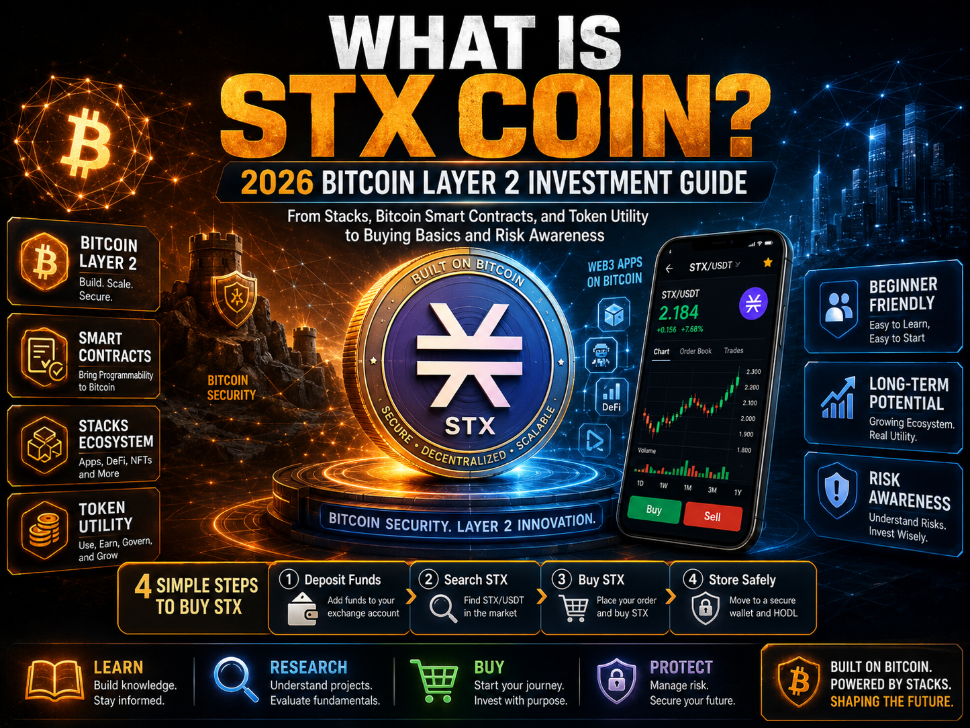
1. What Is STX Coin? How Does It Relate to Bitcoin?
When newcomers first encounter the phrase "Bitcoin Layer 2," it sounds counterintuitive. Bitcoin is already the most secure, bulletproof network in existence—why does it need a secondary layer?
Think of it through a simple architectural analogy:
- Bitcoin is an incredibly massive, ultra-secure granite foundation. It is stable, immutable, and highly decentralized, but it isn't built to support rapid, complex, day-to-day renovations.
- Layer 2 (Stacks) is a modern skyscraper built directly on top of that granite foundation. It handles the dense traffic, complex commercial spaces, and financial activities without compromising the structural integrity of the foundation below.
Bitcoin’s core protocol was intentionally designed to be conservative. Its primary mission is to ensure security, scarcity, censorship resistance, and absolute uptime—not to process thousands of complex, computation-heavy smart contracts. This design ethos created an economic bottleneck: Bitcoin commands the deepest liquidity and strongest asset consensus in crypto, yet its on-chain utility remains restricted.
Stacks bridges this gap. It introduces smart contracts and decentralized apps to the Bitcoin ecosystem without changing a single line of Bitcoin's code.
[Stacks Layer 2]   ---> Processes Smart Contracts, dApps, sBTC, and Scalable Gas (STX)
       |
[Bitcoin Layer 1]  ---> Provides Ultimate Security, Settlement, and Immutability (BTC)
Core Utilities of the STX Token
The STX token serves three primary functions within this ecosystem:
- Network Fuel (Gas): Executing smart contracts, processing transactions, and interacting with dApps on the Stacks network requires execution fees paid in STX.
- Consensus Stacking: STX holders can lock their tokens to secure the network's consensus. In exchange, they receive layout rewards paid out in native BTC.
- L2 Financial Asset: As sBTC (decentralized, 1:1 Bitcoin-backed asset on Stacks) and Bitcoin DeFi protocols mature, STX functions as a foundational collateral asset across the layer-2 financial ecosystem.
Stacks vs. Ethereum: Understanding the Difference
While both are smart contract platforms, they operate on entirely different design philosophies. Ethereum is a self-contained, sovereign ecosystem where ETH is the native asset, the security layer is self-managed, and all DeFi/NFT activities circle back to enrich the ETH economy.
Conversely, Stacks is a specialized extension layer. It doesn't look to compete as a generic "Ethereum Killer." Instead, it is purpose-built to activate and service the dormant multi-billion-dollar Bitcoin economy.
If you want to understand how this differs from earlier Bitcoin-adjacent projects, check out this guide on What is LTC. While Litecoin functions primarily as a lightweight, payment-centric fork of Bitcoin, STX focuses on building a layer-2 smart contract layer atop Bitcoin.
2. The Core Innovation: How Proof of Transfer (PoX) Works
To truly understand STX, you have to look past simple price charts and analyze its consensus mechanism: Proof of Transfer (PoX). This framework answers the fundamental question: Why does locking STX yield native Bitcoin?
PoW vs. PoS vs. PoX
Let’s look at how these consensus models stack up against each other:

PoX is unique because it doesn't waste massive amounts of electricity like Proof of Work, nor does it rely purely on self-referential staking like Proof of Sleep (PoS). Instead, it links the security of an established blockchain (Bitcoin) to a secondary chain (Stacks).
The PoX Economic Cycle
The PoX mechanism operates as a continuous loop between two key market participants:
- Miners: To win the right to author a Stacks block and claim newly minted STX rewards plus network transaction fees, Stacks miners must bid by transferring native BTC to the Bitcoin blockchain.
- Stackers: Everyday STX token holders choose to lock up their STX to participate in network verification. The BTC spent by the miners as bidding capital is distributed directly to these Stackers as an incentive reward.
[Miners] ---> Sends BTC Bids to Bitcoin Network ---> [Wins Block / Receives New STX]
                                                             |
[Stackers] <--- Receives BTC Rewards directly <--- [Locks STX to Secure Network]
The Non-Ponzi Distinction: Most high-yield staking products in crypto pay out yields by printing more of their own native token. This creates an unsustainable inflationary loop and constant sell pressure. Stacks flips this model: your rewards are paid in BTC, which represents a real, unforgeable opportunity cost paid by miners competing for block rewards.
However, sustainability doesn't mean it's a guaranteed profit engine. The actual APY you receive fluctuates based on total miner participation, underlying network velocity, asset price ratios, and global macro cycles.
3. Stacking: How to Earn Passive BTC Income
Participating in Stacking is the primary draw for long-term STX holders. Here is a breakdown of how the process functions for average market participants.
Core Rules of Stacking
When you choose to stack your STX, you must plan around several strict operational parameters:
- Lockup Periods: Your STX is programmatically locked in your wallet for specified cycles (usually lasting roughly two weeks per cycle).
- No Illiquidity Redemptions: During an active cycle, you cannot move, sell, or transfer your STX to capitalize on sudden market pumps or cut losses during major market dumps.
- Minimum Thresholds: Independent Stacking requires a substantial minimum amount of STX that fluctuates dynamically based on total network participation.
Solo Stacking vs. Pooled Stacking
- Solo Stacking: Best suited for high-net-worth individuals and technical operators. You must meet the dynamic minimum token threshold, possess the infrastructure to run a Signer node, and directly manage your wallet cryptographic signatures.
- Pooled Stacking: Tailored for everyday retail investors. You delegate your STX tokens to a collective pool (such as those managed via native Web3 wallets or exchange platforms). The pool aggregates the tokens to cross the solo threshold, handles the technical signature operations, and redistributes the incoming BTC rewards back to you proportionally, minus a small pool fee.
The Impact of the Nakamoto Upgrade
The landmark Nakamoto Upgrade fundamentally altered Stacks' technical footprint. It successfully decoupled Stacks' block times from Bitcoin’s slow 10-minute block times, enabling "fast blocks" that settle in seconds while maintaining full Bitcoin finality.
Crucially for investors, it elevated Stackers (and their delegated pools) to the status of Signers. Signers are now directly responsible for validating and signing blocks. If a pool fails to maintain uptime or fulfill its signing duties, its structural reward yields will drop. This makes choosing a reliable, highly reputable staking pool incredibly important.
Estimating Stacking Yields (Hypothetical Calculation)
Let's look at a static, hypothetical example to see how the math balances out:
- STX Held: 10,000 STX
- STX Price: $1.00 (Total Asset Value: $10,000)
- Estimated Net BTC APY: 6%
- Bitcoin Price: $60,000
Nilai Imbal Hasil Fiat Tahunan= $10.000 X 0.06 = $600
BTC Asli yang Dihasilkan = $600/$60.000 = 0.01BTC
Remember, this calculation is entirely dynamic. Your net return in dollar terms is exposed to shifting asset valuations. If you earn a 6% yield in BTC but your principal STX asset drops 40% in price due to an altcoin bear market, your net portfolio value will still decrease.
Unlike STX’s capital-allocation model, projects like Stepn focus on lifestyle gamification. You can read more about that approach in our guide covering What is GMT Coin. Both represent unique Web3 economic models, but their underlying token value capture drivers are fundamentally distinct.
4. The Stacks Application Ecosystem
A token cannot survive long-term purely on staking mechanics; it requires a thriving network economy. Stacks is actively scaling several use cases designed to tap into Bitcoin's liquidity pool.
Bitcoin DeFi (BTCFi)
Trillions of dollars worth of Bitcoin sit dormant in cold storage wallets worldwide because holders refuse to expose their core wealth to risky centralized platforms or highly experimental cross-chain bridges. Stacks addresses this by building native decentralized finance protocols directly anchored to Bitcoin security. This opens up on-chain borrowing, lending, decentralized exchange trading, and automated yield strategies using Bitcoin as the ultimate underlying collateral.
sBTC: Unlocking the Liquidity Gate
sBTC is the crown jewel of the Stacks application layer. It is a trust-minimized, decentralized 1:1 Bitcoin peg mechanism that allows users to seamlessly send BTC across to the Stacks L2 layer as sBTC, use it within DeFi smart contracts, and easily redeem it back for native BTC on the main chain. If sBTC achieves widespread market trust, it stands to unlock massive capital inflows into the Stacks smart contract ecosystem.
Clarity: Safety-First Smart Contracts
Unlike Ethereum's Solidity, which is a Turing-complete language prone to unexpected runtime errors and exploit vectors, Stacks utilizes a custom programming language called Clarity. Clarity is a decidable language, meaning developers can mathematically predict exactly how a contract will behave and how much gas it will consume before it is ever executed on-chain. This structural emphasis on absolute predictability drastically reduces the risk of catastrophic smart contract hacks—a vital feature for protocols handling high-value Bitcoin assets.
If you want to compare how this ecosystem model stacks up against alternative crypto networks, check out our piece on What is MAGIC Coin. While MAGIC centers its architecture around decentralized gaming and NFT interoperability, STX directs its technical resources entirely toward institutional-grade Bitcoin financial layers.
5. Risk Assessment Matrix: What Could Go Wrong?
STX offers a compelling value proposition, but it is a complex asset exposed to several critical risk vectors. Do not allocate capital without reviewing these variables:
Risk Dimension
Risk Level
Operational Reality & Impact
Market Correlation
High
STX behaves as a high-beta altcoin. If Bitcoin enters a macro bear market, speculative capital flees altcoins, and STX will face severe price drawdowns regardless of its development progress.

6. How to Buy STX on HiBT Exchange: A Step-by-Step Tutorial
For investors looking to build a spot position in STX to participate in Stacking or explore the BTCFi ecosystem, the asset can be securely traded on the HiBT platform.
Step 1: Secure Account Registration
Go to the official HiBT web portal or download the mobile application. Register an account using a verifiable email address or mobile phone number, and implement a complex alphanumeric password.
Crucial: Immediately navigate to your security settings to turn on Google Authenticator (2FA) and configure an anti-phishing code to protect your account against unauthorized access.
Step 2: Pass KYC Verification
Centralized trading regulations require users to complete identity verification to unlock comprehensive spot trading and asset withdrawal privileges. Upload an unblurred image of a government ID card or passport, follow the automated on-screen prompts for a biometric face scan, and wait for the system confirmation email.
Step 3: Deposit USDT Fuel
STX is primary liquid on the platform via the STX/USDT spot trading pair. Go to your spot account overview, click Deposit, select USDT, and choose your network configuration (e.g., TRC-20 for low fees and fast execution). Copy your unique deposit address, paste it into your sending wallet, and execute the transfer.
Step 4: Locate the STX/USDT Spot Pair
Once your USDT settlement clears, enter the main Spot Trading interface. Use the asset ticker search field to type STX and select the official STX/USDT pair. Review the live order book depth, horizontal support levels, and the candlestick charts.
[Wallet Clear] ---> [Spot Trading Terminal] ---> [Search STX/USDT] ---> [Analyze Order Book]
Step 5: Order Selection and Execution
- Market Order: Best for immediate entry. The platform matches your order with the best available limit sell orders instantly.
- Limit Order: Ideal for tactical investors. Specify the exact lower price target where you want to accumulate STX. Your order will sit in the book and only execute if market volatility pushes the price down to your exact target.
Step 6: Post-Trade Custody Strategy
Once the trade fills, your STX balance will update in your account wallet. You have two operational choices:
- Exchange Storage: Leave your tokens on HiBT if you intend to capture short-term price movements or if you don't want to handle private keys.
- On-Chain Self-Custody: If your ultimate goal is to participate in native on-chain Stacking to earn BTC yields, you must withdraw your STX tokens to an extension or hardware wallet that natively supports the Stacks blockchain, such as Leather or Xverse. Always test your withdrawal pathway with a small token fraction before moving large sums.
7. The 2026 Macro Investment Framework
When analyzing whether STX belongs in your portfolio over the 2025–2026 cycle, avoid emotional biases and evaluate the project through three conditional lenses.
1. The Optimistic Bull Trajectory
Bitcoin experiences an institutional super-cycle, driving its price to new highs and locking in structural global adoption. Institutional interest shifts to finding yield on their underlying BTC holdings. sBTC experiences flawless adoption, TVL on Stacks skyrockets into the billions, and STX captures massive fee accruals as the primary gas asset of the dominant Bitcoin L2.
2. The Baseline Trajectory
The Bitcoin ecosystem grows at a steady, moderate pace. Stacks continues to slowly expand its developer count and roll out DeFi applications, but faces friction from emerging L2 competitors. STX performs well, tracking alongside major layer-1 assets, but doesn't completely monopolize the Bitcoin scaling narrative.
3. The Bearish Trajectory
The broader market shifts into an extended risk-off macro environment. Alternative Bitcoin scaling solutions or native solutions like BitVM capture developer attention away from Stacks. sBTC integration sees slow user adoption, leading to capital stagnation on the network. STX experiences a sharp liquidity drain, underperforming relative to core blue-chip assets like BTC.
Strategic Portfolio Allocation Guide
Because STX is fundamentally tied to an early-stage layer-2 smart contract narrative, asset managers typically classify it as an ecosystem satellite holding.
- It should not replace or eclipse your core wealth allocations in Bitcoin or Ethereum.
- The ideal approach is to maintain a modest position sizing (e.g., 1% to 5% of your total crypto portfolio depending on your risk tolerance), scaling into the position via a disciplined, tiered limit order approach rather than market FOMO chasing at local tops.
Frequently Asked Questions (FAQ)
Are Stacks (STX) and Bitcoin (BTC) on the same blockchain?
No. They are distinct networks. Bitcoin is the foundational Layer 1 network, while Stacks is a separate Layer 2 blockchain architecture that runs in parallel and anchors its state to Bitcoin blocks through the PoX consensus mechanism.
Do I need to buy Bitcoin before I can purchase STX?
No. You can purchase STX directly on centralized platforms like HiBT using stablecoins like USDT. You only need to interact with native Bitcoin addresses if you choose to withdraw your STX on-chain to participate in Stacking pools that distribute BTC rewards.
What is the operational difference between Stacking and standard Staking?
Standard proof-of-stake Staking requires you to lock up a token to earn rewards denominated in that exact same token (e.g., staking ETH to earn ETH). Stacks' Stacking is a cross-chain mechanism where you lock up STX to earn rewards paid in a completely different, premium asset: native Bitcoin (BTC).
What is the bare minimum amount of STX required to stack?
To stack independently as a solo node, the minimum threshold is dynamic and typically requires tens of thousands of tokens. However, the vast majority of retail investors bypass this restriction completely by using pooled stacking services inside Web3 wallets, which usually require no minimum or very low token amounts.
Can I withdraw my STX tokens at any time once they are stacked?
No. Once you commit your STX to a Stacking cycle, your tokens are programmatically locked on the blockchain by smart contracts. You cannot unlock, transfer, or sell them until the active cycles you selected are fully completed.
Is it safer to stack on-chain or use an exchange yield product?
Leaving assets on an exchange is simpler for beginners but exposes you to platform custodial risks. Transferring your tokens to a non-custodial wallet and participating in native on-chain Stacking pools gives you full sovereignty over your private keys and interacts directly with the protocol's core code.
What is the biggest fundamental threat to the long-term price of STX?
The greatest structural risk is competition within the Bitcoin Layer 2 sector. If developers and institutional liquidity decide that alternative scaling frameworks offer a more capital-efficient or technically secure user experience, Stacks risks losing its dominant market share.
Disclaimer
This publication is intended strictly for educational and informational purposes and does not constitute investment, financial, or trading advice. Cryptocurrencies are speculative, high-risk assets subject to intense market volatility and sudden price shifts. Investors run the risk of losing their entire initial capital injection. Any financial actions should be taken independently based on extensive personal research, financial standing, and local regulatory laws.