
For many people encountering BTT Coin for the first time, their immediate reaction isn't "Oh, this is a cryptocurrency," but rather, "Does this have something to do with the old BitTorrent downloading?"
The short answer is: Yes, absolutely, and the connection runs incredibly deep.
BTT stands for BitTorrent Token. It isn't a memecoin built on pure hype; instead, it is a crypto token developed atop the world-famous BitTorrent P2P (peer-to-peer) file-sharing protocol. To wrap your head around it easily:
- BitTorrent is a decentralized file transfer network.
- BTT is the native utility token designed to inject economic incentives into this network.
- BTTC (BitTorrent Chain) is the cross-chain infrastructure that was developed later.
Heads Up for Beginners: The most common pitfall for newcomers is getting confused between three core terms: BTTOLD, BTT, and BTTC.
However, just because BTT has a real-world use case doesn't automatically make it a stellar investment. The project faces several uphill battles, including a massive circulating supply, insufficient ecosystem demand, fierce competition, and prolonged price stagnation.
This guide will break down BTT Coin comprehensively—covering its background, token utility, price history, investment risks, a step-by-step purchasing guide on the HiBT Exchange, and an investment evaluation framework to give you a clear, systematic view of the asset.
⚠️ Risk Disclaimer
This article is for educational and research purposes only and does not constitute financial or investment advice. Cryptocurrencies are highly volatile assets; investing in BTT can result in a total loss of your principal. Please make independent decisions based on your personal risk tolerance.
1. What Exactly Is BTT Coin? How Does It Connect to BitTorrent?
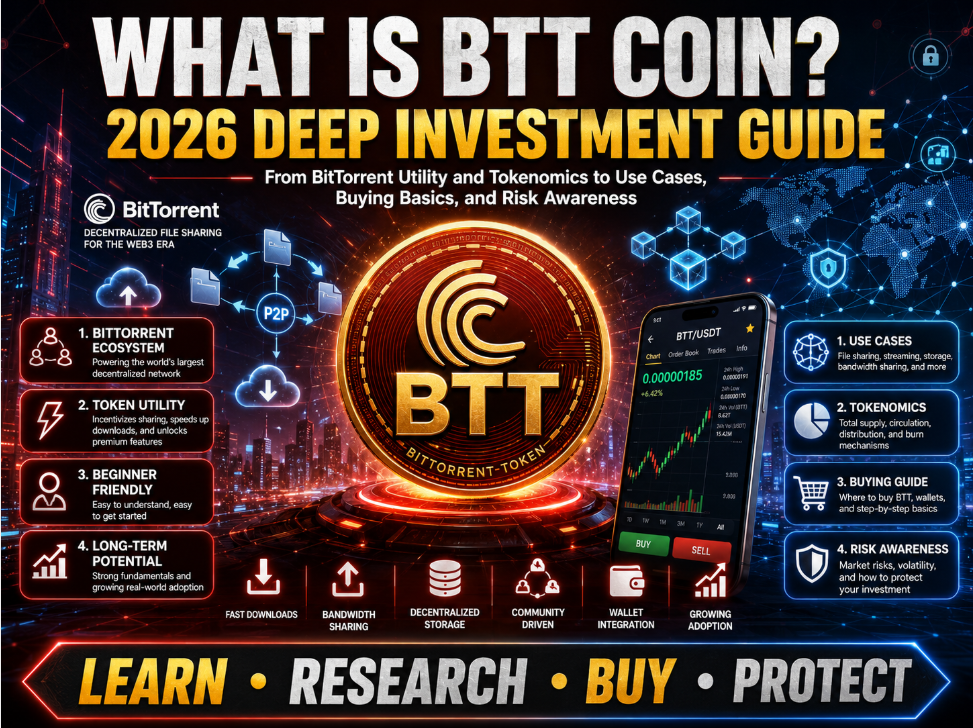
To understand BTT, you first need to understand the mechanism behind BitTorrent.
If you ever downloaded movies, software, games, or large files back in the day, you probably used "torrents," "magnet links," or "BT downloads." The "BT" stands for the BitTorrent protocol.
Traditional Downloads vs. BitTorrent
Traditional downloading usually looks like this:
- Files are hosted on a single centralized server.
- Users pull data directly from that server.
- The more people downloading simultaneously, the more the server chokes under pressure.
- If the central server shuts down, the file vanishes from the internet.
BitTorrent completely flips the script:
- A single file is chopped up into thousands of tiny pieces.
- Different users swap these pieces directly with each other.
- A downloader automatically becomes an uploader (seeder) at the same time.
- The file no longer relies on a single central point of failure.
- Counterintuitively, the more people join the network, the faster and more efficient the download becomes.
Essentially, BitTorrent is the OG decentralized P2P file-sharing network.
[Traditional Centralized Server] ---> Disseminates to Users (Prone to Choking)

[BitTorrent P2P Mesh Network]   <---> Users Share Pieces with Each Other (Scales with Demand)
Why Does BitTorrent Matter?
BitTorrent's historical significance isn't just that it was great "download software." It matters because it proved the viability of decentralized networks decades before Web3 became a buzzword:
- Users didn't have to rely on giant tech conglomerates for data hosting.
- File distribution was crowdsourced across thousands of global nodes.
- Network resources came from the community itself.
- Bandwidth and storage were shared democratically.
This inherent alignment with decentralized philosophy is exactly why the TRON Foundation acquired BitTorrent in 2018, aiming to supercharge the network with blockchain tokenomics.
Why Did TRON Buy BitTorrent?
TRON’s acquisition of BitTorrent boils down to three strategic goals:
- Bootstrapping a Massive User Base: BitTorrent already possessed a massive, active global user base. For crypto projects, the hardest part isn't minting a token; it's getting actual humans to use it. BitTorrent gave TRON an instant gateway to millions of existing users.
- Merging P2P with Tokenized Incentives: In the legacy BitTorrent network, users contributed bandwidth, storage, and seeding time for free out of goodwill. BTT was engineered to financially reward those who seed resources, while allowing users who want faster speeds to pay for them.
- Expanding TRON's Practical Use Cases: TRON needed real-world utility. BitTorrent provided ready-made ecosystems for file distribution, decentralized storage, content delivery, and cross-chain operations. BTT became the bridge connecting these utilities.
The True Position of BTT: Utility Token or Speculative Asset?
Launched in 2019, BTT's core mandate was to build a resource-based economy around bandwidth, storage, and content distribution within the BitTorrent network.
Technically, BTT functions as a utility token with clear-cut applications:
- Paying for download acceleration via BitTorrent Speed.
- Rewarding seeders for their bandwidth.
- Covering gas fees on the BTTC network.
- Staking and validator delegation.
- Powering decentralized storage networks (BTFS).
However, from a market-trading perspective, BTT carries heavy speculative attributes.
Because BTT has an enormous supply, its nominal price per token features a long string of zeros. This often tricks retail investors into the psychological fallacy that "cheap coins are easier to 100x."
The Takeaway: Just because a token has built-in utility does not guarantee its price will go up. And just because a token's price looks mathematically "cheap" does not mean it is undervalued.
2. Navigating the Confusion: BTTOLD, BTT, and BTTC
The number one trap for crypto beginners tracking this project isn't the underlying tech—it's the confusing nomenclature. At various points, three distinct tickers/terms have flooded the market. Let's set the record straight.
1. What Is BTTOLD?
BTTOLD refers to the legacy version of the BitTorrent Token. It was originally launched on the TRON network as a TRC-10 token with a total supply of roughly 990 billion. When BitTorrent later migrated to its own mainnet (BTTC) and introduced a new token scheme, the original token was rebranded to BTTOLD. Most major exchanges have deprecated this token, and it is no longer actively traded.
2. What Is New BTT?
The current BTT traded on the market is the upgraded TRC-20 version. During the migration, the team implemented a 1:1000 denomination split:
- 1 BTTOLD was swapped for 1,000 New BTT.
- The total supply expanded from 990 billion to 990 trillion.
- The overall dollar value held by investors remained identical; you simply owned 1,000 times more tokens, with each token priced at 1/1000th of its previous cost.
Think of it like a traditional stock split. If you own 1 share worth $1, and it splits 1,000-way, you now own 1,000 shares worth $0.001 each. Your total net worth is still $1. Therefore, when you see BTT priced at fractions of a penny ($0.000000X), understand that it is a byproduct of massive supply expansion, not a sudden fire sale.
3. What Is BTTC?
BTTC stands for BitTorrent Chain. It is not a token; it is the layer-2 layer/cross-chain network infrastructure itself. BTTC functions as an EVM-compatible interoperability protocol connecting TRON, Ethereum, and BNB Chain. BTT (the token) is used inside BTTC to pay for gas fees and secure the network via staking. You cannot buy "BTTC" on an exchange; you buy BTT.

3. Tokenomics: Where Does BTT Get Its Fundamental Value?
To assess whether BTT belongs in your portfolio, you have to look at its four primary economic drivers.
1. BitTorrent Speed
In classic torrenting, your download speed depends entirely on the altruism of strangers (seeders) uploading pieces of the file to you. BitTorrent Speed introduces a marketplace dynamic to this relationship:
- Downloaders can spend BTT to bid for higher bandwidth and faster completion speeds.
- Seeders receive BTT rewards proportional to the bandwidth they upload.
While this creates a beautiful micro-economy on paper, it faces real-world hurdles: Are mainstream users in the era of streaming platforms (Netflix, Spotify) still downloading torrents at a rate that drives massive token demand? Furthermore, are casual users willing to set up crypto wallets just to speed up a file transfer?
2. BTFS (BitTorrent File System)
BTFS is the ecosystem's answer to decentralized cloud storage, operating similarly to Web3 projects like Filecoin or Arweave.
- Users with spare hard drive capacity lease out their storage space to earn BTT rewards.
- Those looking to store files securely across a distributed global network pay a fee denominated in BTT.
BTFS acts as a Web3 alternative to Google Drive or AWS S3. BTT serves as the payment medium, node incentive, and collateral asset within this marketplace.
3. BTTC Gas and Staking Ecosystem
With the rollout of the BitTorrent Chain, BTT has transitioned into a network gas asset. Validators and delegators lock up their BTT tokens via staking to secure the cross-chain network, earning a yield in return. If the network experiences high smart contract deployment and cross-chain volume, the demand for BTT gas natively ticks upward.
4. Content Creator Micro-Tips
BTT has been integrated across select live-streaming and content platforms within the TRON umbrella, acting as a low-friction micro-tipping asset for creators.
The Double-Edged Sword of Supply
With a total supply sitting at 990 trillion tokens, the allocation structure plays a massive role in price suppression. While massive ecosystem airdrops and developer incentives are great for kickstarting a network's cold launch, a continuous unlock schedule creates structural sell pressure. If utility adoption doesn't grow fast enough to absorb the circulating tokens hitting the open market, price growth remains naturally capped.
4. Price History and the Realities of Market Capitalization
BTT’s price history serves as a textbook lesson in cryptocurrency market cycles: it is capable of explosive, liquidity-driven rallies, but equally prone to grinding, multi-year drawdowns.
[2019 Launch] ---> [2021 Bull Run Peak] ---> [Token Split (Added Zeros)] ---> [2026 Consolidation]
- The 2019 Era: BTT debuted to massive hype. Investors bought into the narrative: "What happens when hundreds of millions of global torrent users start buying a single crypto token?" However, actual Web3 integration proved much slower than the marketing suggested.
- The 2021 Mania: During the height of the 2021 bull market, BTT experienced parabolic gains alongside the broader altcoin market, largely fueled by retail investors chasing ultra-low unit-bias coins. Unfortunately, those who bought the absolute peak suffered devastating losses when the macro bear market wiped out liquidity.
- The Valuation Reality Check: Today, BTT hovers in the multi-million-dollar market cap range, trading at fractions of a fraction of a cent.
New traders often say, "If it's at $0.0000003, it only needs to hit 1 cent ($0.01) for me to become a millionaire!" Let's do the math to see why that is incredibly unlikely.
Market Capitalization = Current Price x Circulating Supply
With roughly 987 trillion tokens currently circulating, let's map out the required market caps at various price milestones:
- At $0.000001, the market cap would be ~$987 Million.
- At $0.00001, the market cap climbs to ~$9.87 Billion.
- At $0.0001, the market cap jumps to ~$98.7 Billion.
- At $0.01 (1 Cent), the market cap would reach ~$9.87 Trillion.
To put that into perspective, a $9.87 trillion market cap is several times larger than the entire cryptocurrency asset class combined, and multiples ahead of tech giants like Apple or Microsoft. Mathematically, BTT cannot hit 1 cent unless a massive, unprecedented token burn protocol obliterates 99% of the existing supply.
5. Key Structural Risks You Cannot Ignore
BTT is a high-beta altcoin, which means it carries a notable risk profile. Before entering a position, you must be comfortable with the following factors:
- TRON Ecosystem Dependencies: BTT is tied directly to the reputation and performance of the TRON network and its founder, Justin Sun. Regulatory headwinds, shifts in media sentiment, or changes in TRON leadership directly ripple into BTT's market price.
- Fierce Sector Competition: BTT does not operate in a vacuum. In decentralized storage, it goes toe-to-toe with dedicated powerhouses like Filecoin (FIL) and Arweave (AR). In the cross-chain space, it competes with protocols like LayerZero and Cosmos (ATOM).
- Massive Overhead Supply: Without an aggressive, systemic deflationary burning mechanism, the sheer weight of trillions of circulating tokens means any upward move requires a massive influx of capital to sustain itself.
6. How to Buy BTT on HiBT Exchange: Step-by-Step
If you have weighed the risks and want to allocate a speculative portion of your portfolio to BTT, you can acquire it easily on centralized exchanges that support the BTT/USDT pair, such as HiBT.
Step 1: Account Creation
Head over to the official HiBT platform or download their mobile application. Register using a secure email address or mobile phone number, and establish a robust, unique password.
Pro Tip: Immediately activate Two-Factor Authentication (2FA) via Google Authenticator or hardware keys. Never use identical passwords for your exchange account and your primary email address.
Step 2: Complete Identity Verification (KYC)
To open up trading limits and ensure account security, navigate to your user profile and complete the Know Your Customer (KYC) verification. You will need to upload a valid government-issued ID (driver's license or passport) and complete a quick biometric face scan.
Step 3: Deposit USDT
BTT is primarily traded against the USDT stablecoin. Go to your exchange wallet, select Deposit, and locate USDT.
Choose your deposit network carefully. If you are sending funds from an external wallet or another exchange using the TRON network (TRC-20), make sure your HiBT deposit address is explicitly set to TRC-20. Selecting conflicting networks will result in permanent loss of funds.
Step 4: Execute the Trade
Once your USDT deposit clears, navigate to the Spot Trading terminal. In the asset search bar, type BTT and select the BTT/USDT market pair.
[Navigate to Spot] ---> [Search BTT/USDT] ---> [Select Order Type] ---> [Execute Buy]
You will have two main options for executing your order:
- Market Order: Executes instantly at the prevailing market price. Best for smaller, rapid entries.
- Limit Order: Allows you to specify the exact maximum price you are willing to pay. The order will only fill if the market drops to your designated price target. This is highly recommended for larger sizes to avoid bad execution or slippage.
Step 5: Managing Post-Purchase Storage
Once your order fills, your BTT tokens will reflect in your spot account balance. You now have a choices to make regarding storage:
- Keep it on the exchange: Convenient if you plan on actively trading, executing short-term swings, or if you aren't yet comfortable handling Web3 wallets.
- Withdraw to self-custody: If you plan on holding long-term, consider moving your tokens off the exchange to a native TRON ecosystem wallet like TronLink. This gives you full control over your private keys, letting you stake your assets directly on-chain while mitigating counterparty exchange risk.
7. The 2026 Strategic Investment Framework
Is BTT worth your hard-earned capital in 2026? Instead of guessing, let's look at three hypothetical market trajectories to help you build a sound allocation strategy.
Scenario A: The Bull Case (Optimistic)
The broader crypto market enters an extended altcoin expansion phase led by Bitcoin hitting new milestones. Capital flows back down the risk curve into established legacy names. If BTTC achieves a massive breakthrough in cross-chain transaction volumes and BTFS experiences a spike in corporate cloud data storage utilization, BTT could experience strong cyclical upside.
Scenario B: The Base Case (Neutral)
BTT simply tracks the macro altcoin index. The ecosystem ticks along with modest, steady upgrades, but lacks a viral, breakout narrative. The token sees periodic, short-lived spikes driven by TRON ecosystem announcements but ultimately moves sideways against major layer-1 assets like BTC and ETH.
Scenario C: The Bear Case (Pessimistic)
Mainstream utility for P2P file downloads continues to decrease in favor of centralized Web2 cloud networks. Developers choose alternative layer-2 or cross-chain solutions over BTTC. Trading volumes on major exchanges steadily decline, causing BTT to lose liquidity and bleed value over time.
Smart Portfolio Sizing
Given BTT's massive supply structure and dependency on broader ecosystem narratives, it is widely viewed by risk managers as a high-risk, speculative asset line item.
- Avoid over-allocating or making BTT a foundational core holding in your crypto portfolio.
- If using a Dollar-Cost Averaging (DCA) strategy, establish strict capital ceilings so you aren't blindly adding capital into a stagnant asset during down cycles.
8. Final Verdict: Opportunity vs. Caution
BTT Coin sits at a unique intersection of internet history and modern blockchain technology. It possesses a legendary brand name, clear utility pillars within storage and cross-chain routing, and a deeply integrated relationship with the highly active TRON ecosystem.
However, its massive multi-trillion token supply acts as an absolute gravitational pull on its per-token valuation, making viral "penny dreams" mathematically impossible without structural changes.
Approach BTT as a highly cyclical, narrative-driven altcoin play. Use disciplined position sizing, keep expectations anchored in mathematical realities, and constantly monitor the fundamental growth metrics of the BitTorrent Chain and BTFS ecosystems.
Frequently Asked Questions (FAQ)
What is the core difference between BTT and BTTOLD?
BTTOLD is the legacy TRC-10 token that had a max supply of 990 billion. BTT (New) is the upgraded TRC-20 token with a supply of 990 trillion following a 1:1000 denomination split. Modern exchanges only trade the New BTT token.
Can BTT ever realistically hit 1 dollar or 1 cent?
With the current circulating supply of nearly 987 trillion tokens, hitting $0.01 would require an impossible market cap of nearly $9.87 trillion—far surpassing the entire global crypto ecosystem. Barring a monumental, systemic token burn of over 99% of all supply, it is mathematically unrealistic.
Why is the price of BTT so low?
The fractional price tag is a deliberate structural outcome of its 1:1000 token split, which expanded the total supply to 990 trillion tokens. A low token price does not automatically equal a "cheap" market capitalization.
Is BTT identical to TRX?
No. While both reside in the same ecosystem, TRX is the native layer-1 gas token of the TRON blockchain. BTT is an independent utility token designed specifically for the BitTorrent network and the BTTC layer-2 network.
Which order type should a beginner use to buy BTT?
For very small trial amounts, a Market Order is perfectly fine for instant execution. For larger amounts, always utilize a Limit Order to protect yourself against sudden price spikes or liquidity slippage in the order book.