
If you have recently noticed the name COHRON popping up in the crypto market, your first reaction might be confusion: Is it a new coin? A stock? Or some kind of DeFi product?
The answer is: COHRON is not a native cryptocurrency in the traditional sense, but rather a tokenized stock asset.
More precisely, COHRON generally refers to Coherent Tokenized Stock (Ondo Tokenized). It is an on-chain mirrored asset tied to the US-listed company Coherent Corp. (Ticker: COHR), introduced within the product ecosystem related to Ondo Finance.
This means that the investment logic behind COHRON is completely different from Bitcoin and Ethereum, and it is also distinct from native cryptocurrencies like GMT Coin and BTT Coin. Its core value anchor stems from a real-world company: Coherent Corp.
This article will explain clearly from scratch:
- What COHRON actually is;
- The differences between tokenized stocks and regular cryptocurrencies;
- What kind of company Coherent Corp is;
- Why the price of COHRON is tied to COHR stock;
- The opportunities and risks associated with this type of RWA (Real World Asset);
- How regular users can purchase COHRON if it is listed on HiBT;
- Whether COHRON is worth allocating to, and what type of investors it suits.
Disclaimer: This article does not constitute any investment advice and is intended solely for educational and research reference. Tokenized stocks, RWAs, and crypto assets all carry high risks. Please exercise independent judgment and manage your position sizes carefully before investing.
1. What Exactly is COHRON?
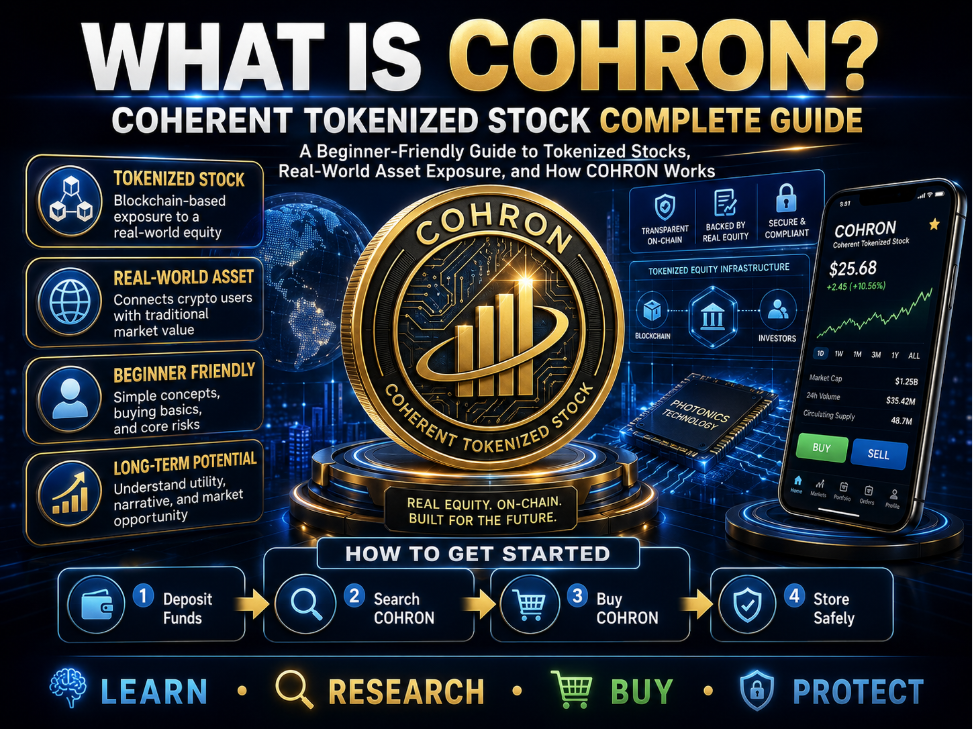
When many people see COHRON, they mistake it for a regular altcoin. In reality, this understanding is inaccurate.
The full name behind COHRON can be understood as:
Coherent Tokenized Stock
In other words, it is a tokenized version of Coherent Corp.'s stock.
The underlying stock it corresponds to is a US-listed company:
- Company Name: Coherent Corp.
- Ticker: COHR
- Listing Market: US Stock Market
- Industry: Photonics, lasers, optical communications, materials, and AI data center infrastructure supply chain.
Simply put, COHRON is not a Meme coin minted out of thin air, nor is it a pure on-chain governance token. It is more akin to bringing COHR stock from traditional financial markets onto the blockchain through a tokenized structure, allowing users to gain exposure to the stock's price movements using crypto asset trading methods.
1. The Difference Between Tokenized Stocks and Regular Cryptocurrencies
Regular cryptocurrencies usually have their own native networks, tokenomics models, or application scenarios. For example:
- BTC represents the native asset of the Bitcoin network;
- ETH is the native asset of the Ethereum network;
- GMT Coin is tied to STEPN and the Move-to-Earn ecosystem;
- BTT Coin is associated with the BitTorrent ecosystem and file distribution narratives.
The value of these assets is primarily driven by on-chain ecosystems, community consensus, utility demand, tokenomics, and market sentiment.
However, COHRON follows a different logic.
The core of COHRON is not "whether the on-chain project itself can scale," but rather:
How much the mirrored real stock COHR is worth, and how much liquidity and premium the market is willing to give this tokenized stock.
That is to say, COHRON is closer to an "on-chain stock price exposure tool" rather than a fully independent crypto project.
2. Which Company's Stock Does COHRON Represent?
COHRON corresponds to Coherent Corp. (Ticker: COHR).
Coherent is a company specializing in photonics, lasers, optical communications, and engineered materials. Its business spans data centers, communication networks, industrial manufacturing, electronic devices, semiconductor equipment, and other sectors.
Why has this company caught the market's attention recently?
The core reason is the rapid expansion of AI computing infrastructure, where high-speed optical communications, optical transceivers, lasers, and optical interconnect technologies are becoming vital links in data center upgrades.
As AI models grow larger, the connections between GPUs, servers, and switches inside data centers require higher bandwidth, lower latency, and lower power consumption. Traditional copper cables hit bottlenecks in certain high-performance scenarios, magnifying the importance of technologies like optical interconnects, optical modules, and lasers.
This is why Coherent is viewed by some investors as one of the "pick-and-shovel" providers in the AI infrastructure supply chain.
3. Is the Price of COHRON Fully Pegged to COHR Stock?
In theory, the price of COHRON should fluctuate around the price of COHR stock.
However, "fluctuating around" does not mean "exactly equal to."
In actual trading, a minor discount or premium may occur between COHRON and the underlying COHR stock due to:
- Insufficient liquidity on-chain or on exchanges;
- Differences in trading hours;
- Limited market-making depth;
- Shifts in market sentiment;
- Redemption and arbitrage mechanisms not being directly accessible to all users;
- Platform fees, slippage, and network costs.
Therefore, do not simply assume that 1 COHRON will always strictly equal 1 share of COHR. A more prudent understanding is that COHRON is a tokenized asset highly correlated with the price of COHR stock, but premiums or discounts may arise in secondary market trading.
4. Who is Ondo Finance? Why Can They Issue This Type of Product?
Ondo Finance is one of the most prominent projects in the RWA sector. Its mission is to bring real-world financial assets onto the blockchain, such as tokenized treasuries, yield-bearing assets, tokenized stocks, and ETFs.
Ondo’s flagship products include:
- USDY
- OUSG
- Ondo Global Markets
- Tokenized stocks and ETF products
The background of Ondo’s team is frequently discussed because the founding team has deep ties to traditional financial institutions; founder Nathan Allman previously worked in digital assets at Goldman Sachs.
However, it is important to note that a strong team background does not mean a product is free of risk. The key to RWA products lies not just in "who issues them," but also in:
- Whether the underlying assets genuinely exist;
- Whether the custody structure is clear;
- Whether legal documents are transparent;
- Whether users possess redemption rights;
- Whether it is restricted by jurisdictional regulations;
- Whether there is adequate secondary market liquidity.
This is why analyzing COHRON requires peeling back the structure and risks rather than just looking at the concept.
II. RWA Sector Background: Why are Tokenized Stocks Suddenly Booming?
COHRON belongs to a broader sector: RWA (Real World Assets).
The core idea of RWA is to port real-world assets onto the blockchain so they can be held, transferred, traded, or composed into DeFi products just like tokens.
Common types of RWAs include:
- Tokenized treasuries;
- Tokenized money market funds;
- Tokenized stocks;
- Tokenized ETFs;
- Real estate assets;
- Private credit;
- Commodities;
- Yield certificates.
1. What is the Logic Behind Holding Stocks On-Chain?
Traditional stock markets are already highly mature, so why do we need tokenized stocks? There are several main reasons:
- No Trading Hour Restrictions: Traditional stock markets are not open 24/7. Regular users can usually only trade during fixed hours. For crypto users, this time constraint is highly inconvenient.
- Lowering Cross-Border Barriers: When users in certain countries or regions want to buy US stocks, they face hurdles opening overseas brokerage accounts, which involve identity verification, funding channels, tax forms, and high remittance costs.
- On-Chain Settlement Efficiency: Crypto users are accustomed to instant settlement, self-custody wallets, and cross-platform liquidity composition, whereas traditional brokerage accounts are relatively closed off.
- DeFi’s Need for Real Yield: In the past, many DeFi yields relied on token emissions, leverage loops, or short-term incentives, which lacked long-term sustainability. The emergence of RWAs allows the on-chain world to tap into treasury yields, stock exposures, and real-world financial assets.
Therefore, tokenized stocks are not just about "hyping a concept." They legitimately attempt to solve real market demands: allowing global crypto users to access traditional financial assets in a manner native to the blockchain.
2. Why Did RWA Gain Explosive Attention Between 2024 and 2026?
The rising popularity of RWA is driven by several forces:
First, traditional financial institutions have begun seriously studying asset tokenization. Institutions like BlackRock, Goldman Sachs, and BNY are actively exploring asset tokenization, digitized money market funds, and on-chain settlements. For the market, this means RWA is shifting from an internal crypto narrative to the actual transformation of traditional financial infrastructure.
Second, the crypto market demands more stable asset classes. After experiencing multiple market cycles, users are no longer solely focused on high-volatility altcoins; they are also looking for products backed by real assets, sustainable yield sources, ties to traditional financial markets, and on-chain tools for asset allocation.
Third, regulatory frameworks are entering pilot phases. The biggest challenge for tokenized stocks in the past was regulatory ambiguity. However, as certain jurisdictions began allowing regulated platforms to pilot tokenized securities trading, the market started believing this path could transition from "grey-area innovation" to "compliant infrastructure."
3. Why are Ondo and BlackRock’s BUIDL Frequently Discussed Together?
The commonality between Ondo and BlackRock BUIDL is that both represent prime examples of "bringing real financial assets on-chain."
The differences lie in their focus:
- BlackRock BUIDL leans heavily toward tokenized funds and institutional-grade capital management;
- Ondo’s product line emphasizes bringing multiple classes of financial market assets on-chain;
- Ondo Global Markets directly targets exposure to tokenized stocks, ETFs, and similar assets.
They are discussed together not because their products are identical, but because they signify the same macro trend: blockchains are moving beyond serving native crypto assets to anchoring traditional financial assets.
4. What Does the ADGM Approval for Ondo Tokenized Securities Imply?
Regulatory approvals related to Abu Dhabi's ADGM—allowing Ondo's tokenized stocks and ETFs to be traded on regulated platforms—are viewed by the market as a vital milestone. It shows that, at least in some jurisdictions, regulators are trying to fit tokenized securities into explicit frameworks rather than outright banning them.
However, this does not mean all users can purchase them without barriers. Tokenized securities are typically subject to:
- Regional restrictions;
- KYC checks;
- Accredited investor requirements;
- Platform access limitations;
- US Securities Laws;
- Secondary market trading rules.
Therefore, users should not simply think, "Since it's approved in one region, anyone globally can buy it." The proper approach is to verify whether your region allows trading such products, relying on platform prompts and local laws.
5. COHRON's Positioning in Ondo Global Markets
Ondo Global Markets hosts more than just COHRON; it may include other tokenized assets tied to US equities, ETFs, or trending corporations.
In terms of positioning, COHRON falls under:
- Non-mega-cap technology stocks;
- AI infrastructure supply chain companies;
- Optical communication, photonics, and data center assets;
- High-growth, high-volatility mirrored tech assets.
It is not as mainstream as mirrored assets of mega-caps like Apple, Microsoft, or Nvidia, but for that exact reason, it carries a stronger thematic attribute: AI Data Center Optical Interconnects. This means the attention COHRON receives is highly likely to fluctuate alongside cycles in AI computing power, optical modules, optical communications, and data center buildouts.
III. Coherent Corp Fundamentals: What is the "Stock Anchor" You Are Buying?
When analyzing COHRON, one cannot just look at the token itself; you must look at the stock anchor behind it: Coherent Corp. This is because the primary price logic of COHRON is derived from the ups and downs of the underlying COHR stock rather than being generated out of thin air by on-chain narratives.
1. What Does Coherent Corp Do?
Coherent Corp is a global photonics and materials technology company whose business spans:
- Data centers and communications;
- Optical modules and optical components;
- Lasers and laser systems;
- Engineered materials;
- Semiconductor-related applications;
- Industrial manufacturing;
- Electronics and instrumentation markets.
The company's operations can generally be categorized into three pillars:
- Networking: This segment is tightly linked to data centers, telecom networks, optical interconnects, and optical modules. As AI data centers expand, the demand for high-speed transmission and low-latency connections spikes, making this business highly attractive to the market.
- Materials: This involves engineered materials, optoelectronic materials, and semiconductor-related materials, forming the bedrock of the company’s foundational technological capabilities.
- Lasers: Laser systems are utilized in semiconductor equipment, display manufacturing, precision manufacturing, and scientific research.
2. Why is Coherent Related to AI Computing Demand?
Scaling AI computing power is more complex than just buying more GPUs. When massive data centers deploy large GPU clusters, high-speed connections are required between servers, between chips, and between racks. Data transmission capacities directly impact model training and inference efficiencies.
This introduces several demands:
- Faster optical modules;
- Advanced optical transceivers;
- Higher bandwidth optical interconnect solutions;
- Lower-power data center connectivity technologies;
- Hardware upgrades tied to Co-Packaged Optics (CPO).
Coherent happens to sit squarely within this supply chain. Consequently, when the market discusses the "AI data center investment cycle," alongside chip and networking giants like Nvidia, AMD, Broadcom, and Marvell, optical communication and photonics companies like Coherent and Lumentum also draw significant attention.
3. How Has COHR Stock Performed in Recent Years?
COHR stock has experienced significant volatility in recent years, but market attention has climbed noticeably driven by demands in AI data centers, optical communications, and optical modules.
It is worth noting that COHR is not a low-volatility blue-chip stock. As a technology manufacturing and infrastructure supply chain company, its stock price is vulnerable to a multitude of factors:
- AI data center capital expenditures;
- Order changes from major clients;
- Price competition in optical modules;
- Gross margin fluctuations;
- Corporate debt and cash flows;
- Semiconductor market cycles;
- Overall valuations of US tech stocks;
- Macro interest rate environments.
As of June 2026, Coherent's market cap sits in the multi-billion dollar range, making it a well-established technology hardware firm. However, a large market cap does not equate to low risk. High-growth tech stocks can still face severe drawdowns if valuations get stretched, earnings miss expectations, or market rotations occur.
4. Do COHRON Holders Receive Dividends and Voting Rights?
This is a critical question.
Regular stock owners typically enjoy:
- Shareholder voting rights;
- Dividend rights;
- Corporate action entitlements;
- Protection under specific securities laws.
Whether tokenized stock holders enjoy these rights depends entirely on the product structure and the issuance documents. For tokenized stock assets like COHRON, regular users cannot simply assume they possess the exact same shareholder rights as someone directly holding COHR stock.
You must explicitly verify:
- Whether a dividend pass-through mechanism exists;
- Whether voting rights are provided;
- Whether it can be redeemed for the actual underlying shares;
- Whether it is merely a price-tracking certificate;
- Who holds the underlying assets in custody;
- The priority of investors if the platform runs into trouble;
- Whether your geographical location permits the purchase.
If the platform documentation does not explicitly guarantee these rights, it should be treated strictly as a "price exposure product" rather than "full stock ownership."
5. What is the Essential Difference Between COHRON and Buying COHR Stock Directly?
While both are tied to the price of COHR stock on the surface, their core natures are vastly different.
Buying COHR Stock Directly:
- Executed via a traditional brokerage account;
- Holds traditional securities;
- Governed by stock market rules and regulations;
- Trading hours are restricted to US market sessions;
- Shareholder rights are clear and legally backed;
- Best suited for traditional equity investors.
Buying COHRON:
- Executed via crypto trading platforms or on-chain protocols;
- Holds a tokenized asset;
- The trading experience matches crypto assets;
- May support extended or continuous trading hours;
- Involves smart contract, custody, platform, liquidity, and compliance risks;
- Best suited for advanced users familiar with crypto markets and RWAs.
Thus, COHRON is not a "risk-free substitute" for COHR stock. More accurately, COHRON is an on-chain vehicle designed to give crypto users exposure to COHR stock prices, but it introduces layer upon layer of structural risks.
IV. COHRON’s Technical Structure and Risks: How Does Tokenization Actually Work?
Tokenized stocks sound advanced, but the questions users care about most are simple: Is this thing actually backed by assets? What happens to my money if the platform goes under? This requires an understanding of COHRON's structural risks.
1. How Does 1 COHRON Stay Close to the Value of 1 Share of COHR?
Tokenized stocks typically maintain a price parity with the underlying equities through specific reserves, custody arrangements, or financial contract structures. This may involve:
- Custody of the underlying security assets;
- Issuance by a compliant entity;
- Registered custody institutions;
- Market maker quotations;
- Redemption or arbitrage mechanisms;
- Handling of corporate actions;
- Platform matching and quotation systems.
In theory, if a significant price deviation occurs between COHRON and COHR stock, institutional players or market makers can execute arbitrages to realign the price.
Note for regular users: Not everyone has the right to directly redeem the underlying stock. If you can only buy and sell COHRON on the secondary market, the closeness of the price to COHR depends heavily on market liquidity and market-making depth.
2. Which Blockchain Does COHRON Run On?
According to public market data, COHRON falls into the category of Ondo Tokenized Assets and is tracked across multiple blockchain ecosystems, including Ethereum, BNB Chain, and Solana.
This indicates that COHRON is not merely a database entry on a centralized server; it possesses genuine on-chain token attributes. However, for everyday users, the critical factor is not "which chain it is on," but rather:
- Whether you buy it via an exchange or an on-chain wallet;
- Whether you must manage private keys yourself;
- Whether network gas fees apply to trades;
- Whether cross-chain transfers are supported;
- Whether smart contract risks exist;
- Whether the exchange supports deposits and withdrawals, or only internal trading.
If you are a beginner, it is highly recommended to prioritize trading on platforms with simpler user experiences rather than jumping straight into managing cross-chain routes, importing contract addresses, and connecting web3 wallets.
3. What Does COHRON’s Small Circulating Supply Imply?
COHRON currently has a small circulating supply, with a market capitalization roughly in the million-dollar range and a circulating volume of only a few thousand tokens. This introduces a major issue: Liquidity Risk.
Assets with thin liquidity often suffer from the following traits:
- Buying easily pushes the price up artificially;
- Selling easily dumps the price down heavily;
- Bid-ask spreads widen significantly;
- Even small orders can cause substantial slippage;
- Execution at ideal prices might be impossible during extreme market volatility;
- They are highly susceptible to short-term capital manipulation.
For an asset like COHRON, you cannot just say "it's backed by a US stock company." You must evaluate the trading depth of the token itself. Even if COHR stock enjoys stellar liquidity, COHRON's liquidity on-chain or on specific exchanges can still be profoundly deficient.
4. Compliance Risks: US Users Can't Buy, What About Others?
One of the biggest differentiators between tokenized stocks and regular cryptocurrencies is that the former are much closer to securities. Consequently, compliance barriers are usually much stricter.
Ondo-related tokenized securities products generally explicitly restrict US users from participating and require users to meet the eligibility requirements of their respective jurisdictions. For international or Chinese-speaking users, things vary based on situation:
- Whether your country or region permits the purchase of tokenized securities;
- Whether the platform opens the product to your jurisdiction;
- Whether you are allowed to trade after completing KYC;
- Whether tax reporting requirements are triggered;
- Whether securities investment limitations are violated;
- Whether cross-border financial regulatory risks exist.
Do not assume you are completely compliant just because an exchange page loads. The correct approach is to rely on actual platform KYC prompts, local laws, and product terms.
5. Compared to Other Tokenized Stocks, is COHRON High Risk?
The risk profile of COHRON can be analyzed across two dimensions:
- Underlying Stock Risk: COHR is a tech stock levered to AI data centers, optical communications, and photonics. It has a strong growth thesis, but it also carries high valuations, high volatility, cyclicality, and earnings uncertainties.
- Tokenized Structure Risk: COHRON has a tiny market cap and limited liquidity, meaning its secondary market depth might pale in comparison to larger tokenized stocks. Tokenized versions of hyper-popular tickers like Nvidia, Tesla, or Apple generally command far greater attention and trading depth.
Therefore, looking at the aggregate risk, COHRON is entirely unsuitable for complete novices to heavily allocate into. Instead, it is better suited for users who:
- Understand stock fundamentals;
- Understand crypto trading mechanics;
- Can tolerate liquidity risks;
- Are willing to study RWA product terms;
- Are looking to make thematic allocations using small position sizes.
V. How to Buy COHRON on HiBT: A Step-by-Step Tutorial
If HiBT has officially listed the COHRON/USDT or related trading pairs, users can complete their purchases following standard spot trading workflows. Because listing statuses can change depending on regions and timing, please rely on HiBT's internal search results and official announcements before attempting to buy.
1. What Kind of Platform is HiBT?
HiBT is a digital asset trading platform providing a wide array of crypto services, including spot trading, futures, copy trading, and Earn products. For users looking to participate in emerging RWA assets, tokenized stock assets, or trending cryptocurrencies, HiBT offers several advantages:
- Supports a diverse range of digital asset pairs;
- Operating workflows closely mimic mainstream crypto exchanges;
- Offers standard USDT trading pairs;
- Well-suited for users already accustomed to standard exchange buying paths;
- New users can check the Activity Center for registration rewards or trading incentives.
On the security front, users should pay attention to whether the platform provides features like KYC verification, 2FA, cold storage, multi-signature mechanisms, risk control systems, anomalous account alerts, and withdrawal whitelists. Even if a platform offers robust security measures, users must protect their accounts by enabling 2FA, setting strong passwords, avoiding suspicious links, and avoiding leaving the entirety of their capital concentrated on a single platform for prolonged periods.
2. Registering a HiBT Account
Before purchasing COHRON, you need a HiBT account. The basic process is as follows:
- Visit the official HiBT website or download the App: Always use official channels to access the platform to avoid entering phishing sites through search ads, community links, or random QR codes.
- Register using Email or Phone Number: Fill in your email or phone number, enter the verification code, and create a login password. Ensure this password is not reused across other platforms.
- Complete Essential Security Settings: It is highly recommended to turn on Google Authenticator, Email verification, SMS verification, Anti-phishing codes, and Withdrawal whitelists.
- Complete KYC Verification: Because COHRON falls under RWA/tokenized stock assets, certain regions may enforce extra requirements on trading permissions. Once KYC is complete, the platform will determine your available features based on your identity information.
3. How to Deposit Funds?
Deposits on HiBT typically fall into two categories:
- Cryptocurrency Deposits: This is the most common path for crypto users. You can transfer assets like USDT, BTC, or ETH from other wallets or exchanges into HiBT. If you plan to buy COHRON, depositing USDT is generally recommended since most tokenized stock pairs are denominated in USDT or stablecoins. When depositing, double-check that you select the right coin, pick the correct network, copy the correct deposit address, and run a small test transfer before sending larger sums.
- Fiat Purchases: If HiBT supports fiat gateways in your region, you can buy USDT using bank cards, credit cards, third-party payment processors, or other supported methods. However, fiat gateways are often constrained by regional rules, payment limits, and KYC conditions. Actual available methods are subject to what appears on the platform page.
4. Searching and Buying COHRON on HiBT
Once COHRON is live on HiBT, you can follow these steps to purchase:
- Navigate to the "Spot Trading" page.
- Type into the search box:
COHRONorCOHRON/USDTorCoherent. - Confirm Trading Pair Details: Before placing an order, ensure the trading pair is indeed COHRON/USDT, check if the current price deviates too drastically from the COHR underlying stock price, ensure the 24-hour volume is sufficient, verify that the bid-ask spread is reasonable, and check the depth chart to ensure it isn't too thin.
- Select Order Type: Beginners are strongly advised to use Limit Orders instead of Market Orders. Limit orders allow you to dictate your execution price, preventing severe slippage when liquidity is thin.
- Input Purchase Amount: Given COHRON's small circulating supply, it is unwise to buy large amounts all at once. Consider scaling in across multiple tranches while observing order book depth and price fluctuations.
- Confirm and Execute Order: Once filled, you can review your COHRON holdings in your Spot Account.
5. Managing Your Position Post-Purchase
COHRON is not an asset designed for mindless, long-term, heavy allocations. It is simultaneously exposed to COHR stock movements, RWA sector sentiment, and the token's own liquidity profile. Consider managing your position through three angles:
- Set a Maximum Loss Threshold: For example, capping single-trade losses at 5%–15% of your allocated principal. If hit, systematically trim positions or stop loss.
- Track the Underlying COHR Stock: COHRON’s core anchor is COHR stock. If Coherent suffers earnings misses, order cancellations, or valuation downgrades, COHRON will likely drop.
- Monitor the Premium/Discount: If COHRON trades at an excessive premium relative to COHR stock, the risk of chasing the top rises significantly. If a massive discount appears, determine if it is a short-term liquidity anomaly or deeper market concern regarding the asset structure.
6. New User Incentive Campaigns
If you are using HiBT for the first time, you can explore the platform after registering for: new user sign-up bonuses, first-deposit campaigns, spot trading rebates, task center rewards, RWA zone events, new token trading competitions, or trading fee discounts.
Campaign rules are subject to change; exact reward amounts, participation criteria, expiration dates, and regional restrictions are determined by the official HiBT event pages. If you are entirely new to HiBT, you might also consider familiarizing yourself with the platform workflows using a highly liquid asset first, such as LTC (Litecoin). The fundamental process of buying LTC is identical to buying COHRON: register, KYC, deposit USDT, enter spot trading, pick the pair, place the order, and manage the position.
VI. COHRON’s Investment Logic & Price Outlook: Is It Worth Allocating to?
Determining whether COHRON is worth buying requires moving past the question of "will it pump?" A more logical approach is asking: What exactly are you betting on? The investment thesis for COHRON relies on three main legs:
1. Betting on Coherent Corp's Fundamentals
If you are bullish on COHRON, you must fundamentally be bullish on COHR stock first. You must believe that:
- AI data center construction will sustain its momentum;
- Demands for optical communications, optical modules, and optical interconnects will keep expanding;
- Coherent can cleanly capture value from the AI infrastructure cycle;
- The company’s revenues, gross margins, and order books can validate its current valuation;
- The market remains willing to accord high multiples to photonics and AI networking hardware players.
If the underlying COHR stock declines, it is highly improbable for COHRON to rally independently over the long haul.
2. Betting on the Continued Expansion of the RWA Sector
COHRON carries distinct RWA sector properties. If more users embrace tokenized stocks down the road, more exchanges list RWA assets, and more regulatory bodies greenlight compliant tokenized securities, the visibility and liquidity of assets like COHRON will naturally improve. This could bring advantages like tighter bid-ask spreads, narrowed premiums/discounts, broader user participation, and higher valuation premiums assigned to RWA assets. Conversely, if the RWA sector faces regulatory crackdowns, platform failures, or systemic trust crises, COHRON will likely be dragged down.
3. Betting on the Elasticity of a Small Floating Supply
COHRON’s small market cap and circulating supply mean it can exhibit far greater price elasticity than large-cap assets. This is a double-edged sword: during uptrends, a thin float can magnify gains; during downtrends, it can severely amplify losses. When the order book is exceptionally thin, a modest sell order can cause a violent downward spike. Therefore, COHRON belongs in tiny thematic allocations, not core holdings.
4. How to Read the Premium/Discount Between COHRON and COHR?
To evaluate the premium or discount, simply track three data points:
- The latest price of COHR stock;
- The latest price of COHRON;
- COHRON’s current bid-ask spread and order book depth.
If COHRON trades significantly above COHR stock, it indicates the market may be pricing in an RWA premium, or it could be a short-term anomaly caused by thin liquidity. If COHRON trades significantly below COHR stock, it typically points to poor market liquidity, heavy selling pressure, or user skepticism surrounding redemptions and structural safety.
5. Core Variables Affecting COHRON's Price
- COHR Stock Price: The most direct variable. COHR up equals a foundation for COHRON to rise; COHR down equals pressure on COHRON.
- The AI Data Center Narrative: The more bullish the market is on AI networking, optical modules, and optical communications, the easier it is for companies like Coherent to attract capital.
- RWA Sector Hotness: If RWA emerges as a dominant market narrative in a crypto cycle, tokenized stocks stand to gain extra momentum.
- Trust in Ondo Products: Ondo’s regulatory strides, custody transparency, platform stability, and ecosystem partnerships all directly impact user confidence.
- COHRON’s Own Liquidity: A critical variable often overlooked. Even if the underlying stock performs beautifully, a razor-thin order book on COHRON will result in a poor buying and selling experience for regular users.
- The Regulatory Landscape: Tokenized stocks occupy a sensitive regulatory category. Any sudden shift in policy can quickly impact exchange listings, user access, and cross-border trading.
6. What Type of Investors Does COHRON Suit?
COHRON is best suited for users who:
- Already understand fundamental stock analysis;
- Are highly familiar with crypto exchange operations;
- Accept the structural risks inherent in RWA products;
- Comprehend liquidity constraints and slippage;
- Are looking to deploy small position sizes into AI infrastructure themes;
- Consistently track COHR earnings reports and industry news.
COHRON is unsuitable for users who:
- Do not understand stocks at all;
- Are entirely unfamiliar with crypto trading mechanics;
- Are hunting for short-term "get-rich-quick" schemes;
- Cannot stomach drawdowns exceeding 20%;
- Are habituated to going all-in on single assets;
- Refuse to read product terms and conditions;
- Reside in jurisdictions barring tokenized securities trading.
7. Position Management Recommendations
For everyday investors, COHRON should not form a core position. A more practical framework includes:
- Conservative Users: Do not participate; observe only.
- Advanced Users: Limit to 1%–3% of your crypto portfolio.
- High-Risk Appetite Users: Allocate no more than 5%.
- Professional Traders: Gauge independently based on order book depth and specific strategies.
If you already hold core allocations in BTC, ETH, stablecoins, and major assets, COHRON can serve as a speculative "AI + RWA" thematic observation tracker. If your account size is small and you have yet to build basic risk management capabilities, prioritizing thin-float assets of this nature is not advised.
8. Three Market Scenario Projections
- Bullish Scenario (AI Computing Continues to Explode): If COHR stock keeps marching upwards while the RWA sector gains major traction, COHRON is highly likely to follow suit, potentially trading at a brief premium. Users must be careful not to chase tops during periods of extreme premiums.
- Baseline Scenario (COHR Chops Sideways): If COHR stock lacks a clear trend, COHRON will likely drift around the underlying stock price. Because liquidity is limited, short-term volatility could still be amplified.
- Bearish Scenario (Tech Stocks Decline): If AI infrastructure equities face an industry-wide correction and COHR stock drops while crypto market liquidity tightens, COHRON’s drawdowns could severely outpace the underlying stock. This happens because tokenized assets are forced to absorb the dual shocks of falling stock equity and evaporating on-chain liquidity.
VII. FAQ: Frequently Asked Questions About COHRON
1. Are COHRON and COHR the exact same thing?
No. COHR is the ticker symbol for Coherent Corp’s stock listed on the US stock market. COHRON is a tokenized stock asset whose value is tied to COHR stock. While COHRON references the price of COHR stock, it is not the actual stock certificate held within a traditional brokerage account.
2. Can COHRON holders receive dividends from Coherent Corp?
Not necessarily. Whether you receive dividends, voting rights, or other corporate entitlements depends strictly on COHRON’s unique product terms and issuance structures. Regular users must never default to assuming tokenized stocks grant identical rights to direct equity ownership. Always read the platform terms and official documents before purchasing.
3. Which exchanges support COHRON trading?
Public market data sources show COHRON appearing on select centralized exchanges and platforms like Ondo Global Markets. Availability varies based on your region, KYC status, trading pairs, and shifting regulatory demands. If HiBT has officially listed the COHRON/USDT pair, users can search for COHRON directly on the HiBT Spot page to view live availability.
4. Is Ondo Finance safe? Are there smart contract risks?
Ondo Finance is an established leader in the RWA sector, but no on-chain financial protocol can ever be deemed absolutely safe. Users must account for smart contract vulnerabilities, custody defaults, structural legal challenges, platform operational risks, liquidity crunches, and localized compliance pressures. When dealing with an asset like COHRON, focus must be placed on the underlying stock, the trading venue, and the product terms alike.
5. What is the fundamental difference between COHRON and Bitcoin/Ethereum?
BTC and ETH are native crypto assets whose values are rooted in blockchain networks, decentralized consensus, security architecture, and ecosystem utility. COHRON is a tokenized stock asset whose value anchor is anchored to a real-world entity: Coherent Corp (COHR). Thus, COHRON is an on-chain proxy for equity exposure rather than an independent public blockchain token.
6. Do I need to open a traditional brokerage account to buy COHRON?
If you buy COHRON via a supporting cryptocurrency exchange, you generally do not need a traditional stock brokerage account. However, you will need to complete registration and KYC steps mandated by the crypto platform. Your eligibility to buy depends entirely on platform rules, your region, and product compliance frameworks.
7. Is COHRON better suited for long-term holding or short-term trading?
This depends entirely on your objective. If you are long-term bullish on Coherent Corp and the AI optical communications industry, COHRON can serve as a small, thematic allocation. If you are aiming to execute short-term trades, you must pay rapt attention to order book depth, slippage, and premiums/discounts. Because COHRON’s liquidity can be thin, it is highly unsuitable for inexperienced beginners to trade frequently with large sizes.
Conclusion: COHRON is an "AI Equities + RWA" Hybrid Asset
The uniqueness of COHRON stems from the fact that it sits precisely at the intersection of two major market narratives:
- The AI data center, optical communication, and photonics supply chain spearheaded by Coherent Corp.
- The RWA and asset tokenization macro trend pioneered by projects like Ondo Finance.
This structure places COHRON closer to traditional equities than standard altcoins, yet imbues it with an extra layer of on-chain liquidity and RWA mechanics compared to regular stocks.
The Opportunities:
- Provides a frictionless way for crypto users to gain exposure to COHR stock prices;
- Handily rides the AI computing infrastructure narrative;
- Benefits from the structural growth of the RWA sector;
- Low circulating supply can offer significant upward price elasticity.
The Risks:
- High volatility inherent to the underlying COHR stock;
- Constrained liquidity for the token itself;
- Susceptibility to premiums and discounts;
- Lack of guaranteed, full shareholder rights;
- Highly complex compliance barriers;
- Reliance on trust regarding trading platforms and custody architectures.
Therefore, for the everyday user, COHRON is best treated as an advanced, thematic asset rather than a foundational portfolio component. If you are a newcomer to the crypto space, it is highly recommended to start with highly liquid, easily understood assets like BTC, ETH, USDT, or LTC to master the basics of deposits, trading workflows, taking profit, stopping loss, and risk containment. Once you thoroughly comprehend RWAs, tokenized equities, premium/discount deviations, and liquidity risks, you can then weigh whether to deploy a small position into COHRON.
True maturity in investing means never rushing in blindly the moment a new concept drops, but rather clarifying first: What exactly are you buying, what risks are you assuming, and can you comfortably survive the worst-case scenario?