
Introduction
- In the crypto market, MASK is a token that is highly prone to misunderstanding.
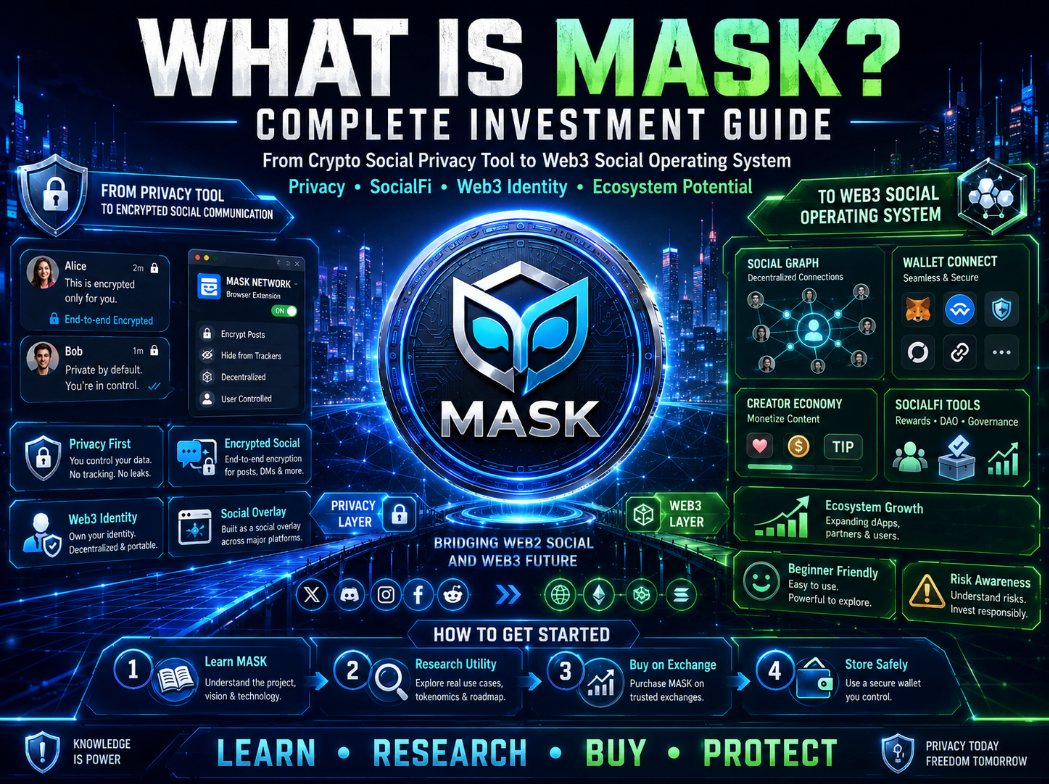
- Many newcomers seeing MASK for the first time assume it is a "facemask-themed meme coin" or a privacy coin akin to Monero or Zcash. In reality, the project behind MASK is Mask Network. It is positioned neither as a standard privacy coin nor a standalone social application, but as an infrastructure project attempting to overlay Web3 functionality onto existing legacy internet social platforms.
- Simply put, Mask Network aims to enable users to utilize crypto wallets, encrypted messaging, on-chain payments, NFTs, DApps, decentralized identities, and Web3 social protocols directly within traditional social media platforms like X (formerly Twitter) and Facebook without leaving them.
- This is its most unique characteristic. Instead of demanding that users migrate to an entirely new Web3 application, it endeavors to open a Web3 gateway inside the Web2 social environments users already know and use daily.
- In 2026, as Mask Network took over the subsequent development of Lens Protocol, its positioning upgraded from a mere "browser extension tool" to a full-fledged "Web3 social operating system." This structural shift has brought MASK right back into the spotlight for investors.
- However, critical questions follow: Does MASK possess genuine long-term value? Is Web3 social functionality an organic demand or a fabricated narrative? Can ecosystem components like Lens, Firefly, Next.ID, and Orb form a self-sustaining loop? After a steep decline from its historical highs, can MASK return to the center of mainstream crypto narratives?
- This article systematically breaks down what MASK is and evaluates whether it deserves a place in your portfolio by examining its project positioning, core functionalities, the Lens event, tokenomics, price forecasting, purchasing procedures, risk checklists, and investor suitability.
- Disclaimer: This article does not constitute investment advice. MASK is a highly volatile, mid-to-tail-end crypto asset. Its price is heavily influenced by product milestones, market cycles, Web3 social narratives, and overall market liquidity. Please thoroughly evaluate your own risk tolerance before investing.
1. What Exactly is MASK? — Not a Privacy Coin, But a Web3 Gateway Layered on Twitter and Facebook
- Correcting Misconceptions
- The first step to understanding MASK is correcting a widespread misconception: MASK is not a privacy coin.
- While it involves encrypted messaging, private communications, and decentralized identities, its core mission is not "hiding transactions" or executing anonymous payments. Mask Network’s primary objective is embedding Web3 utilities seamlessly into legacy social media networks.
- 1.1 What is the Core Definition of Mask Network?
- Mask Network can be conceptualized as a Web3 social middleware layer. It utilizes browser extensions, mobile applications, and aggregated clients to empower users to leverage Web3 functionalities inside traditional social spaces.
- For instance, directly on X/Twitter or Facebook, a user can:
- Send end-to-end encrypted messages;
- Execute direct peer-to-peer cryptocurrency transfers;
- Display and verify NFT ownership data;
- Connect non-custodial crypto wallets;
- Interact directly with decentralized applications (DApps);
- Manage decentralized identities (DIDs);
- Publish and read Web3 social content;
- Complete on-chain interactions without exiting the web page.
- This methodology shifts away from standard Web3 applications. While most Web3 projects tell users to "leave Web2 and migrate to our new standalone product," Mask Network states: "Users are already in Web2 social hubs; let's bring Web3 functionalities straight to their native interfaces." This drastically slashes user migration friction and positions Mask Network as a vital bridge between Web2 and Web3.
- 1.2 Why is Mask Network "Building a New Internet Gateway on the Existing Internet"?
- To use an analogy, Mask Network acts like a Web3 operating system layered over the traditional web. You continue using X, Facebook, Bluesky, Lens, or Farcaster, but through Mask, you gain the ability to handle encrypted communication, wallet payments, identity verification, NFT interactions, and decentralized social operations within those exact pages.
- It acts like opening a portal on an old internet page. Users do not have to completely abandon their familiar platforms or immediately move into an alien Web3 environment. Instead, they can gradually engage with on-chain mechanics within their regular daily social interactions.
- This forms the long-term vision of Mask Network: not to reinvent the internet from scratch, but to embed an open, encrypted, composable, and user-controlled network layer inside the web infrastructure that already commands billions of users.
- 1.3 Who is the Founder, Suji Yan?
- The founder of Mask Network is Suji Yan. Prior to launching the network, he actively explored privacy frameworks, decentralized networks, and encrypted communication systems. The early directions of Mask Network were closely tied to Dimension.im and heavily inspired by Cypherpunk ideology.
- The Cypherpunk ethos underscores that users must own their personal data, digital communications must be encryptable, online identities should not be monopolized by centralized tech giants, financial and information flows must remain open, and technology should serve as a shield for individual liberties.
- These core values have directly steered Mask Network’s product path. Mask was never meant to be a mere "social plug-in." The underlying value proposition is about ensuring that average internet users can retain their data rights, privacy protections, and absolute asset control while navigating legacy Web2 networks.
- 1.4 What is the Relationship Between the MASK Token and the Platform?
- MASK is the native governance token of the Mask Network ecosystem. However, a highly critical distinction must be noted: using Mask Network does not strictly require holding MASK tokens, and buying MASK does not automatically mean you are utilizing Mask Network's products. The relationship is synergistic rather than structurally locked.
- The primary utilities of the MASK token include:
- Participating in the governance of MaskDAO;
- Voting on structural ecosystem proposals;
- Engaging in specific ecosystem incentive initiatives;
- Serving as a value-capture tool for the network;
- Absorbing broader market sentiment regarding the growth of Mask Network.
- From an investment angle, the market price of MASK depends not just on the extension’s active install base, but on whether the broader market believes Mask Network can successfully cement its status as a core gateway to the Web3 social landscape. This explains why MASK's valuation frequently exhibits sharp volatility around major catalysts like Lens developments, Firefly expansions, DWF Labs updates, or general SocialFi narrative shifts.
- 1.5 Mask Network's Strategic Evolution
- The most important fundamental evolution for Mask Network centers on its assumption of a leading role in driving the next phase of Lens Protocol’s development.
- Lens Protocol, originally incubated within the Aave ecosystem, serves as a premier decentralized social graph infrastructure. However, after years of development, Lens ran into a classic structural bottleneck: it created robust infrastructure, but consumer-facing application adoption lagged behind.
- Following Mask Network’s strategic stewardship of Lens, market observers began re-evaluating the project's parameters. Historically seen primarily as a browser plug-in, Mask is now consolidating into a unified Web3 social operating system comprising interconnected components like Lens, Firefly, Orb, Next.ID, and Web3.bio. Mask’s goal has scaled past simply attaching a Web3 extension to Twitter; it is focused on unifying identity layers, content delivery networks, social graphs, secure messaging, wallets, DApps, and multi-protocol clients.
2. The Four Core Functions of Mask Network — What Can Users Actually Do?
- Core Functionalities
- Evaluating a project's validity requires analyzing practical utility over high-level visions. Mask Network’s primary functions can be categorized into four distinct buckets: encrypted communication, on-chain settlement, embedded DApp access, and decentralized identity/storage. In the modern era, the Firefly aggregated client has also emerged as a vital pillar of the Mask ecosystem.
- 2.1 Encrypted Communication
- The foundational feature of Mask Network is content encryption on traditional feeds. Users can post encrypted text or media directly to X/Twitter or Facebook timelines, but the content remains unreadable to the general public.
- It can only be decrypted and viewed by users who fulfill pre-set conditions, such as:
- Matching a specific designated wallet address;
- Holding a required NFT or token balance;
- Belonging to a defined community or DAO structure;
- Possessing explicit cryptographic access rights.
- This utility allows users to take control over public information streams on legacy platforms. You can leverage the network effects of a public platform while restricting readability to verified entities, creating viable use cases for DAOs, gated investor alpha groups, NFT holder networks, and premium creator circles.
- 2.2 On-Chain Payments and Tipping
- Mask Network streamlines the process of executing crypto payments directly within legacy social interfaces.
- The traditional friction points are clear: a user reads a post, opens an external wallet application, copies a cryptographic address, double-checks network choices, executes the transaction, and finally navigates back to the social feed.
- Mask simplifies this sequence: the extension identifies a user's on-chain identity right on the social page, allows the sender to initiate a transfer or tip with a click, and triggers a simple wallet confirmation. This mechanism provides clear benefits to the creator economy, allowing readers to reward high-value insights with crypto assets without routing capital through centralized platform fee deductions.
- 2.3 Embedded DApp Access: The DApplet Ecosystem
- Mask Network pioneered the concept of "DApplets"—miniature decentralized applications embedded directly within legacy social media timelines. This layout brings DeFi protocols, NFT marketplaces, governance voting interfaces, and real-time market metrics right into a user's primary social feed, bypassing the need to constantly bounce out to external URLs.
- For example:
- Spotting a token ticker on Twitter and instantly pulling up its historical on-chain liquidity;
- Viewing an NFT image in a post and accessing its direct marketplace trading page;
- Participating in a DAO governance vote directly below a project's official announcement;
- Interacting with DeFi liquidity pools inside a community discussion thread.
- This design converts Web3 applications from isolated destination websites into functional, interactive components embedded within active daily social streams.
- 2.4 Decentralized Identity and File Storage
- Components like Next.ID, Web3.bio, IPFS, and Arweave form the infrastructure layer of the Mask ecosystem. Next.ID acts as a decentralized identity protocol that bridges a user's various wallet addresses, Web2 social handles, cryptographic domain names, NFTs, and on-chain behaviors into a coherent profile. Web3.bio acts as a unified Web3 personal portal, showcasing verified identities, ENS handles, Lens graphs, and Farcaster statistics.
- Concurrently, IPFS and Arweave integrations manage decentralized storage needs. By decoupling content hosting from centralized servers, they achieve persistent, censorship-resistant data preservation. Together, these features give users a cross-platform, cross-chain Web3 identity that belongs directly to the user rather than being owned by a tech corporation.
- 2.5 Firefly Aggregated Client
- Firefly has become an increasingly central product within the Mask ecosystem. Rather than acting as a standalone niche app, it serves as a multi-protocol, multi-platform social aggregation client. It enables users to track, post, and engage across entirely different social networks—including Lens, Farcaster, X, and Bluesky—from a single interface.
- This addresses a major bottleneck in the Web3 social space: user fragmentation. Lens has its dedicated core base, Farcaster maintains a distinct community, X retains the largest raw attention stream, and Bluesky commands its own growing social graph. Forcing average users to rotate through a dozen separate applications daily is unsustainable.
- Firefly acts as a unified portal. When users can aggregate readings and distributions across diverse networks simultaneously, the decentralized social experience achieves parity with mainstream Web2 product flows. The value of tracking active user growth on Firefly cannot be overstated for MASK investors.
3. The Core Fundamental Pivot — What Mask’s Stewardship of Lens Protocol Implies
- Ecosystem Restructuring
- Mask Network taking over the next evolutionary stage of Lens Protocol is not a basic cross-marketing collaboration; it represents a major structural consolidation within the Web3 social sector.
- 3.1 What is Lens Protocol?
- Launched in 2022 by Aave founder Stani Kulechov, Lens Protocol was engineered to serve as an open, composable Web3 social graph infrastructure.
- On legacy platforms, your social connections, content logs, followers, and profile metrics are strictly controlled by the corporation. If you choose to leave, exporting that data is practically impossible.
- Lens solves this by placing user profiles, social connections, and content distributions onto open protocols and on-chain ledgers. This allows completely different applications to build on top of and tap into the exact same underlying social graph.
- Despite its strong funding profile and deep technical design, Lens faced user acquisition challenges. Reaching weekly active user counts in the 45,000 range is significant for an early Web3 protocol, but it remains a rounding error compared to Web2 giants. This highlights the primary hurdle of the SocialFi space: the bottleneck isn't building a protocol; it's giving everyday users an undeniable reason to utilize it over legacy channels.
- 3.2 Why Did the Aave Ecosystem Hand Over Lens Stewardship to Mask Network?
- The core expertise of the Aave ecosystem centers on deep DeFi primitives and capital efficiency engines, not consumer-facing social growth loops. Lens functioned primarily as a technical infrastructure project: contracts, graph math, and developer documentation.
- However, turning a social protocol into a thriving network requires highly refined consumer products: intuitive mobile clients, creator monetization tools, robust messaging networks, seamless user onboarding flows, and cross-platform aggregation capabilities. This matches exactly what Mask Network has spent years assembling via applications like Firefly, Orb, Next.ID, and Web3.bio. Transitioning Lens into Mask's ecosystem marks a critical shift from an "infrastructure-first" model to a "consumer-product-first" strategy.
- 3.3 The Suite of Mask Network’s Web3 Social Components
- Mask Network has grown past a single plug-in architecture into a diversified ecosystem portfolio:
[Mask Network Ecosystem]
 ├── Identity Layer: Next.ID / Web3.bio
 ├── Messaging Layer: XMTP Integration
 ├── Social Graph: Lens Protocol
 └── Client/Application Layer: Firefly / Orb / mstdn.jp
* * **Orb:** A mobile-first social application built on top of the Lens Protocol designed for smooth content consumption.
* * **Firefly:** The flagship multi-protocol aggregation client mapping feeds from Lens, Farcaster, X, and Bluesky.
* * **Next.ID:** The identity synchronization engine binding on-chain accounts with traditional web profiles.
* * **Web3.bio:** A comprehensive profile tool displaying cross-chain balances and cryptographic identities.
* * **mstdn.jp:** A major instance within the Japanese Mastodon network, aligning with open, federated social movements.
* This stack is why analysts increasingly refer to Mask as a comprehensive "Web3 social operating system."
- 3.4 XMTP Integration and Communication Rails
- The structural integration between Mask Network and XMTP—a prominent decentralized, end-to-end encrypted messaging protocol—addresses a persistent pain point in Web3 social design: fragmented communication silos. Historically, separate applications maintained isolated messaging databases, scattering a user's conversations. Denominating XMTP as a standardized secure messaging layer across Lens, Orb, and Firefly gives users a coherent, unified chat experience, which is necessary to drive the high-frequency daily engagement that social platforms rely on.
- 3.5 Is Mask the "Tencent of Web3"?
- While comparing Mask Network to Web2 giants like Tencent provides a useful mental framework for its ecosystem consolidation strategy, the analogy has clear limits. The comparison holds true regarding its structural layout: unifying identity rails (Next.ID), messaging fabrics (XMTP), aggregation engines (Firefly), social graphs (Lens), and embedded payment gateways. However, Tencent's dominant positioning is secured by billions of highly active daily users, dense gaming moats, and localized real-world dependencies. Mask remains in an early, frontier stage of Web3 network building. Its active user base and monetization channels are a fraction of legacy giants, positioning it as an ambitious candidate for the Web3 social gateway layer rather than an established incumbent.
- Evaluating if the decentralized social narrative will hit an explosive inflection point requires tracking macro crypto cycles. Speeches or developments in this sector are frequently constrained by broader market movements. For a comprehensive overview of macro market positioning, you can study this guide on Is it a Good Time to Buy Bitcoin Now?.
4. MASK Tokenomics — A Fully Circulating Supply of 100 Million Tokens
- Supply Metrics
- Tokenomics govern the long-term structural price behavior of any asset. For MASK, the most notable tokenomics characteristic is straightforward: a maximum supply of 100 million tokens, with 100% already in circulating status.
- 4.1 The Implications of 100% Circulation
- With market data indicating that MASK has hit its 100 million circulation cap, the project features a unique structural configuration:
- There are no massive future unlocking cliffs to dilute existing holders;
- The Fully Diluted Valuation (FDV) matches the circulating market capitalization;
- Investors are shielded from the "low float, high valuation" predatory tokenomics traps common in newer tokens;
- Spot market prices are driven entirely by organic demand, ecosystem milestones, and holder distributions.
- This provides a highly transparent environment for portfolio planning. While newer projects often launch with a mere 5% to 10% of their supply circulating—leaving a massive overhang of investor and team tokens waiting to dump—MASK has fully digested its structural emissions phase. Note, however, that a fully circulating supply does not mean selling pressure is non-existent; existing floats can always be mobilized by foundations, historical buyers, or exchanges during broad market corrections.
- 4.2 Initial Token Distribution Blueprint
- To provide context on historical holdings, MASK’s initial 100 million supply matrix was allocated along the following parameters:
- Foundation Reserve: ~39.55%
- Core Team and Advisors: ~23%
- Early-Stage Backers: ~14.25%
- Public Offerings: ~7%
- The remaining supply was split across community airdrops, liquidity provision pools, and ecosystem grants.
- While the Foundation and Team percentages are concentrated, this structure is typical for complex infrastructure projects requiring deep ecosystem runway. The vital point to track is how transparently the Foundation deploys its reserves for developer grants, app acquisitions, and user acquisition strategies, rather than simply creating persistent market overhead.
- 4.3 MaskDAO Treasury Operations
- Governance of the platform falls under the jurisdiction of MaskDAO. The ecosystem treasury reserves require explicit DAO approval to be deployed for strategic investments, open-source developer grants, product buyouts, or liquidity campaigns. As shown by the consolidation of Lens, the DAO is taking a more assertive approach toward ecosystem building, and the efficiency of this capital deployment directly shapes market confidence in the MASK token. MASK does not employ aggressive automated token burn primitives, so your investment thesis should focus on real product adoption rather than artificial supply deflation.
- 4.4 Governance Lockups and Liquid Supply
- MaskDAO operations follow a baseline "1 MASK = 1 Vote" methodology. Key proposals frequently require users to lock or stake their MASK tokens inside governance contracts for specified intervals to exercise their voting rights. This mechanic functions as an organic supply dampener: it raises the barrier to entry so that decisions are guided by long-term stakeholders rather than short-term momentum traders, while temporarily removing circulating tokens from exchange order books during contentious votes.
- 4.5 Institutional Allocations: DWF Labs
- Ecosystem developments gained notable momentum following strategic funding updates, such as DWF Labs executing a $5 million purchase of MASK tokens to secure an institutional stake in the network. While institutional buys generate strong short-term market attention, their long-term value rests entirely on whether the partnership successfully yields deeper market-making liquidity, international exchange access, and structural cross-project integrations. Investors should remember that institutional involvement provides an ecosystem runway but does not establish a permanent price floor.
5. Historical Price Trends and Scenarios — Analyzing MASK's Market Positioning
- Market Context
- The price chart of MASK highlights an extreme historical trajectory. The asset captured massive speculative mania upon its 2021 debut before experiencing a deep, multi-year correction during the subsequent bear market. Due to varying listing methodologies on early trading venues, different charting platforms display varying historical spikes—some capturing peaks above $40, while others register volatile launch spikes clearing the $90 range.
- Regardless of the tracking source, one conclusion is clear: MASK’s extended correction brought it down roughly 99% from its all-time peak, pointing to an asset characterized by extreme volatility and high price elasticity.
- 5.1 Three Eras of MASK’s Chart History
- Phase 1: The 2021 Launch Euphoria. Propelled by public offerings and a fresh Web3 social narrative, MASK launched into a roaring bull market cycle where investors gladly paid steep premiums for high-concept narratives.
- Phase 2: The Multi-Year Drawdown (Late 2021 - 2023). As macro liquidity contracted and the SocialFi narrative cooled, MASK underwent an aggressive correction phase alongside the broader altcoin market, washing out early overvaluations.
- Phase 3: Ecosystem Consolidation (2025 - 2026). Strategic asset buyouts, the stewardship of Lens, active capital injections from entities like DWF Labs, and the rising adoption of the Firefly aggregator have pushed MASK back to the center of the decentralized social narrative. However, a narrative catalyst requires sustained, verifiable data growth to build a structural uptrend rather than a temporary message-driven pump.
- 5.2 The Four Main Variables Steering MASK’s Price
- The SocialFi Sector Cycle: If decentralized social networks capture a primary capital rotation wave, MASK often benefits as an established ecosystem aggregator.
- On-Chain Data Growth for Lens and Firefly: This is your primary fundamental metric. You must track verifiable on-chain indicators: Monthly Active Users (MAUs), Daily Active Users (DAUs), daily post velocities, cross-protocol profile attachments, and wallet retention rates.
- The Health of the Ethereum Ecosystem: Because MASK is fundamentally anchored to Ethereum's security and standards, scaling or gas cost improvements on Ethereum L2s directly influence the economic feasibility of on-chain social actions.
- Macro Market Liquidity: At its core, MASK trades as a mid-cap altcoin. Regardless of individual milestones, if Bitcoin and Ethereum enter a weak macro cycle, smaller-cap assets face significant systemic headwinds.
- 5.3 Evaluating Current Technical Formations
- On a shorter-term horizon, MASK has established a localized consolidation range, with prices fluctuating around the $0.30–$0.40 zone near key short-term moving averages. From a technical trading standpoint, remaining below the 200-day moving average indicates that a long-term structural trend reversal has not been fully secured. While oversold RSI reads can prompt sharp technical relief rallies, sustained trend reversals require consistent volume expansion to prove institutional accumulation rather than simple news-driven momentum.
- 5.4 Three-Scenario Projections for MASK (2026–2030)
- The following matrix outlines potential pricing paths based on varying user adoption rates, Ethereum ecosystem scaling, and broader crypto market cycles. These are conditional thought experiments, not guaranteed outcomes.

- Analyzing this framework shows that a simple temporary news catalyst can only spark short-term technical bounces. Reaching Base or Bull Scenario valuations requires sustained user acquisition on Firefly and Lens.
- Because MASK operates within the broader ERC-20 framework, its macro cycles are fundamentally correlated with Ethereum's trajectory. For context on the long-term valuation boundaries of the underlying network layer, you can review this research paper on Ethereum Price Prediction for 2030. MASK will likely exhibit high beta correlation with ETH’s macro direction while experiencing amplified volatility waves.
- 5.5 Is Reclaiming the Historic Peak Achievable?
- While extreme bull market manias can create parabolic price action in high-beta altcoins, projecting a clean return to historic peaks requires an exceptional set of structural criteria: SocialFi scaling into a dominant internet paradigm, Lens acquiring multiple orders of magnitude of real users, Firefly transforming into a primary application gateway for mainstream users, and the MASK token establishing highly effective value-capture loops across its ecosystem apps. Absent these fundamental shifts, the historical ATH should be treated as a theoretical outlier rather than a realistic target. Prudent portfolio projections should focus on immediate horizons: Can the token firmly clear and hold $1? Can it validate user retention on its consumer apps? Can the project convert platform growth into real token demand?
6. How to Buy MASK on HiBT — A Comprehensive Onboarding Guide
- Trading Execution
- If you have processed Mask Network's product positioning, evaluated its fully circulating supply, and wish to allocate a small speculative position, you can execute purchases on spot trading venues hosting MASK/USDT pairs. Here is a step-by-step path using the HiBT Exchange.
- 6.1 Prerequisites Before Executing a Trade
- Before executing your first order, verify four operational components:
- Capital Sourcing: Secure liquid USDT or fiat balances. If your home jurisdiction allows direct fiat-to-crypto purchases, buy stablecoins first; if you hold assets elsewhere, execute an external wallet transfer.
- Identity Verification (KYC): Most centralized exchanges require identity verification to unlock comprehensive deposit rails, unconstrained spot trading, and higher withdrawal ceilings.
- Basic Ethereum On-Chain Literacy: Since MASK is an ERC-20 asset, transferring tokens to a self-custodial wallet requires an understanding of Ethereum Gas spikes, contract address verifications, and appropriate network selection rules.
- Order Type Selection: MASK possesses thinner books than major pairings like BTC or ETH. Beginners should avoid executing large market orders to prevent unnecessary slippage.
- 6.2 Operational Profile of HiBT Exchange
- HiBT provides global digital asset trading frameworks across diverse spot pairings. Its corporate and security features include:
- An established corporate registration background in Canada;
- Active MSB compliance status within both Canada and the United States;
- Operational headquarters stationed in Dubai;
- A security architecture routing 90% of user balances into isolated cold-wallet arrays;
- Multi-signature access controls;
- Localized user interfaces and dedicated customer support channels.
- 6.3 Step-by-Step Purchase Flow on HiBT
- Step 1: Account Setup. Access the official HiBT web terminal or mobile application, register using a secure email or phone number, and implement a complex, unique password.
- Step 2: Security Hardening. Instantly tie your profile to Google Authenticator (2FA) and establish a distinct fund password for withdrawal confirmations.
- Step 3: Complete KYC Requirements. Upload copies of your government-issued passport or national ID card according to the automated instructions. Account activation times depend on processing queues.
- Step 4: Deposit Capital. Route stablecoins or crypto assets from your external wallet arrays, ensuring your choice of transaction network (e.g., ERC-20, TRC-20, BEP-20) matches perfectly.
- Step 5: Access the MASK/USDT Trading View. Open the spot market terminal, input "MASK" into the asset lookup panel, and select the MASK/USDT pair. Analyze the active order book depth and current print velocity.
- Step 6: Deploy a Limit Order. Newcomers should use Limit Orders over Market Orders. Limit orders allow you to define your exact maximum acquisition price, protecting your cost basis if order books are thin.
- Step 7: Specify Parameters. Input your desired target entry price and quantity. Avoid deploying your entire cash position at once, particularly during news-driven pumps.
- Step 8: Order Execution and Balance Review. Once order books match your limit parameters, review your active balances inside your spot wallet dashboard.
- 6.4 Post-Acquisition Options
- Once you secure MASK tokens, you generally route down two paths:
- Cold Storage or Exchange Holding: Keeping the assets secure while awaiting long-term price action, absorbing full market volatility.
- Ecosystem Governance Participation: Moving your tokens on-chain to track, debate, and vote on active MaskDAO proposals, shifting your role from a passive speculator to an active ecosystem participant.
- 6.5 Defensive Capital Allocation: The Pyramid Entry Method
- Given MASK’s high beta profile, avoiding single-print max entries is highly recommended. Utilizing a pyramid entry model provides a defensive approach:
- Tranche 1: Allocate 20%–30% of your planned capital as an initial tracking position to establish a cost basis.
- Tranche 2: If the asset experiences a healthy technical correction toward major support floors without fundamental deterioration, deploy another 20%–30%.
- Tranche 3: If the price clears structural technical resistance lines on expanding volume, scale in another portion.
- Final Tranche: Reserve your final capital allocation for clear trend confirmations.
- This defensive scaling prevents buying local peaks, preserves dry powder for corrections, minimizes emotional trading tendencies, and ensures your exposure expands only as the asset confirms technical strength.
7. The Five Core Risks Every MASK Investor Must Face
- Risk Factors
- While Mask Network boasts real working products and an expansive vision, it operates deep within the high-risk altcoin spectrum. Investors must thoroughly evaluate five distinct risk dimensions before deploying capital.
- 7.1 Counterparty and Executive Security Exposures
- Ecosystem dynamics can face sudden shocks from security breaches involving key personnel, such as historical exploits where the personal wallet infrastructure of founder Suji Yan was compromised, resulting in multi-million-dollar capital losses. These black swan events highlight that even veteran Web3 founders are vulnerable to private key leakages, spear-phishing campaigns, social engineering vectors, or physical security risks. While predicting these events is difficult, investors can protect their wealth through defensive portfolio sizing, separating a founder's personal security profile from the project's technical architecture, and monitoring a team's transparent mitigation steps during crises.
- 7.2 The User Acquisition Ceiling
- The single most critical challenge for the entire SocialFi sector is not engineering complex decentralized protocols, but acquiring and retaining regular users. Lens commands substantial institutional backing and robust technical rails, yet its active user metrics remain a fraction of standard Web2 ecosystems.
- This points to a foundational friction point: why should an average internet user migrate from X, Instagram, TikTok, or Facebook over to a Web3 alternative? Relying purely on the ideological argument that "decentralization is structurally superior" is insufficient for mass-market audiences. Mainstream adoption requires consumer-grade parity:
- Is the content delivery loop engaging and fast?
- Are the user's primary social graphs and friends already active on the network?
- Is posting and consuming media completely frictionless?
- Does the recommendation algorithm surface high-value interactions?
- Can creators natively monetize their attention streams?
- If Mask, Lens, and Firefly cannot cross this consumer usability barrier, the Web3 social landscape risks remaining an isolated sandbox for crypto-natives.
- 7.3 Structural Platform Dependencies on Web2 Giants
- Mask Network's early competitive edge relied on its ability to run as an extension layer over existing networks like Twitter and Facebook. This architecture introduces a central vulnerability: if Web2 platforms aggressively restrict browser plug-ins, revoke vital API accesses, execute sweeping interface overhauls, or intentionally block external wallet interactions, core features of Mask can face severe disruption. This structural dependency explains why Mask is aggressively funding and building out independent, open layers like Lens, Firefly, and Orb. The project cannot remain a parasitic extension on Web2 platforms long-term; it must successfully pivot into an autonomous gateway bridging Web2 and Web3.
- 7.4 Value Capture Decoupling Risks
- A glaring reality of the crypto market is that a project can successfully maintain active consumer applications while its native token experiences a prolonged downward drift. Product adoption does not automatically equal token price appreciation. MASK investors face a structural question: how exactly does user expansion across Firefly, Next.ID, or Orb translate into direct structural demand for the MASK token? If MASK’s utility is limited to governance voting weight while everyday users can engage with the entire application stack without ever purchasing or holding the asset, the token's market price can remain decoupled from the platform's technological success.
- 7.5 On-Chain Smart Contract and Operational Frictions
- Navigating the ERC-20 ecosystem exposes users to persistent operational risks: managing elevated Ethereum L1 gas fees during network spikes, evading sophisticated phishing portals replicating Mask extensions to drain wallet permissions, preserving private seed phrases against localized data loss, and avoiding irreversible cross-chain routing mistakes. Beginners who are uncomfortable managing these factors should keep their initial exposure inside secure centralized exchanges until they develop technical confidence.
8. Portfolio Allocation and Investor Suitability — A Strategic Evaluation
- Portfolio Strategy
- MASK is structurally built for participants who believe in the long-term inevitability of decentralized social networks, actively monitor product-level milestones, and can absorb deep equity drawdowns. It is entirely unsuited for individuals chasing overnight wealth or those unwilling to track data metrics.
- 8.1 Three Investor Profiles Tailored for MASK
- Long-Term SocialFi Ideologists: Individuals who believe that internet users will inevitably demand ownership of their data graphs, personal content logs, and digital identities, and want an exposure vehicle tracking that transformation.
- Consumer-Facing Application Application Spotters: Investors who believe that Web3 social lacks intuitive application layers rather than protocol math, and want to back the consolidation of Lens, Firefly, and Orb.
- Active DAO Governance Participants: Advanced users who want to leverage their voting weight to actively shape ecosystem investments and strategic directions via MaskDAO.
- 8.2 Three Investor Profiles Who Should Avoid MASK
- High-Volume Day Traders: Short-term market participants requiring massive order book depth to slide large positions in and out without moving the spot price.
- Conservative Wealth Preservers: Individuals who experience high psychological stress during typical 30% to 50%+ altcoin market drawdowns.
- Pure Momentum Chasers: Speculators who enter positions purely because an asset catches a brief headline or an institutional mention, leaving them highly exposed to downside corrections once the immediate news cycle passes.
- 8.3 Sizing Your Position within a Resilient Portfolio
- A sound allocation framework prioritizes highly liquid, blue-chip networks before taking speculative bets on mid-to-tail-end assets. A standard asset configuration looks like:
- Core Blue-Chips (BTC + ETH): 60%–70% of total crypto wealth;
- Liquid Capital Reserves (Stablecoins): 10%–20% preserved for market drawdowns;
- Large-to-Mid-Cap Altcoins: 10%–20% split across established utility networks;
- Speculative Narrative Assets (MASK): Capped within a strict 5%–8% threshold of your overall digital asset allocation. If your understanding of SocialFi architectures is limited, reduce this allocation to a 1%–3% tracking slice. Never assume a low token price guarantees outsized upside; prices can reflect market undervaluation, but they can just as easily signal that the market is discounting a project's long-term value capture capabilities.
Summary and Actionable Takeaways
- Mask Network represents a highly distinctive entry in the digital asset landscape. It avoids the standard templates of generic privacy assets or basic meme tokens, operating instead as a comprehensive middleware layer connecting legacy Web2 networks with the emerging Web3 paradigm.
- Its core structural strengths include a multi-year track record of product delivery, a clear strategic focus from its core team, an extensive suite of operating social components (Lens, Firefly, Orb, Next.ID, Web3.bio), and a highly transparent, 100% fully circulating token supply that eliminates future venture unlock dilutive cliffs.
- Conversely, its core challenges remain significant: persistent mass-market user acquisition hurdles within the SocialFi space, structural value-capture decoupling risks inherent to pure governance tokens, reliance on broader market liquidity cycles, and a history of deep drawdowns from its speculative peaks.
- If you conclude that the decentralized social sector warrants long-term strategic placement within your portfolio, add MASK to your tracking dashboard and manage small entries via compliant platforms like HiBT. Before deploying real capital, ensure you can clearly delineate the operational boundaries between the platform's application growth and the token's value capture, check that your core BTC and ETH balances are properly established, and verify that your position sizing aligns with a disciplined satellite configuration.
FAQ: Frequently Asked Questions About MASK
- 1. What exactly is the MASK token?
- MASK is the native governance token of Mask Network, a comprehensive Web3 social infrastructure ecosystem engineered to inject encrypted communication, crypto payments, decentralized applications, and identity protocols directly into traditional social channels like X/Twitter and Facebook.
- 2. Is MASK classified as a privacy coin?
- No. MASK is not a privacy asset built for transactional anonymity like Monero or Zcash. While Mask Network integrates encryption features for social content and secure messaging, its core definition is a Web3 social gateway and operating system layer.
- 3. What rights do I secure by holding MASK?
- MASK functions primarily as the governance unit for MaskDAO. Holding the token allows you to submit, debate, and vote on strategic framework proposals, treasury ecosystem investments, and protocol adjustments.
- 4. How are Mask Network and Lens Protocol linked?
- Mask Network has assumed a primary operational role in guiding the next evolutionary phase of Lens Protocol. While Lens provides the decentralized social graph infrastructure layer, Mask deploys its consumer-facing application stack (such as Firefly and Orb) to bridge that protocol infrastructure into active daily user scenarios.
- 5. What is the total supply of MASK?
- The maximum total supply is capped at 100 million tokens. Market logs indicate that MASK is in a 100% fully circulating state, removing the risk of sudden team or private investor unlock dilution cliffs, though open-market movements remain tied to macro liquidity cycles and holder distributions.
- 6. Can MASK return to its all-time high?
- Reclaiming historical peaks is an exceptional hurdle that requires a perfect convergence of fundamental milestones: SocialFi transforming into a dominant web paradigm, verifiable user adoption scaling across Lens and Firefly by orders of magnitude, and a robust macro bull market cycle. Focus on immediate targets like stable consolidations above $1 and $2 before projecting ATH horizons.
- 7. Is MASK appropriate for a beginner?
- Only within highly disciplined, minor allocation limits. Beginners who are unfamiliar with mid-cap altcoin volatility, decentralized governance dynamics, and Web3 wallet management should prioritize building out foundational holdings in BTC and ETH before taking positions in tail-end narrative assets.
- 8. Where can I purchase MASK tokens?
- MASK is listed across major global spot exchanges. When trading via platforms like HiBT, complete your identity verification (KYC), fund your spot account with stablecoins, locate the MASK/USDT trading interface, and deploy limit orders to protect your execution cost basis.