
Introduction
- In the crypto market, many token names can easily mislead newcomers. Take CBK as an example: if you only look at the three letters, you might mistake it for an exchange utility token, a new meme coin, or confuse it with entirely different projects sharing a similar ticker.
- In reality, the CBK discussed in this article refers to Cobak Token, the native ecosystem asset of Cobak, a prominent South Korean cryptocurrency community platform.
- What makes CBK unique is that it is neither an exchange token backed by transactional buybacks nor a hype-driven meme coin relying on community shilling. Instead, it is backed by an active, multi-year-old South Korean crypto community platform. Its utility revolves around content creation, membership perks, rewards, governance, staking, and platform services.
- Simply put, CBK is best understood as a "community economy token."
- Its core value logic does not rely on backing from a massive exchange, but rather on whether the Cobak community possesses users, quality content, active events, and real utility scenarios.
- This article systematically explains what CBK is and whether it deserves the attention of everyday investors by analyzing the Cobak platform background, the CBK and CC dual-token system, token utility, tokenomics, historical price trends, purchasing methods, investment risks, and portfolio allocation.
- Disclaimer: This article does not constitute investment advice. CBK is a small-to-mid-cap crypto asset characterized by high price volatility, concentrated liquidity, and strong regional attributes. Please evaluate your own risk tolerance before investing.
1. What Exactly is CBK? — Not an Exchange Token, Nor a Typical Meme Coin
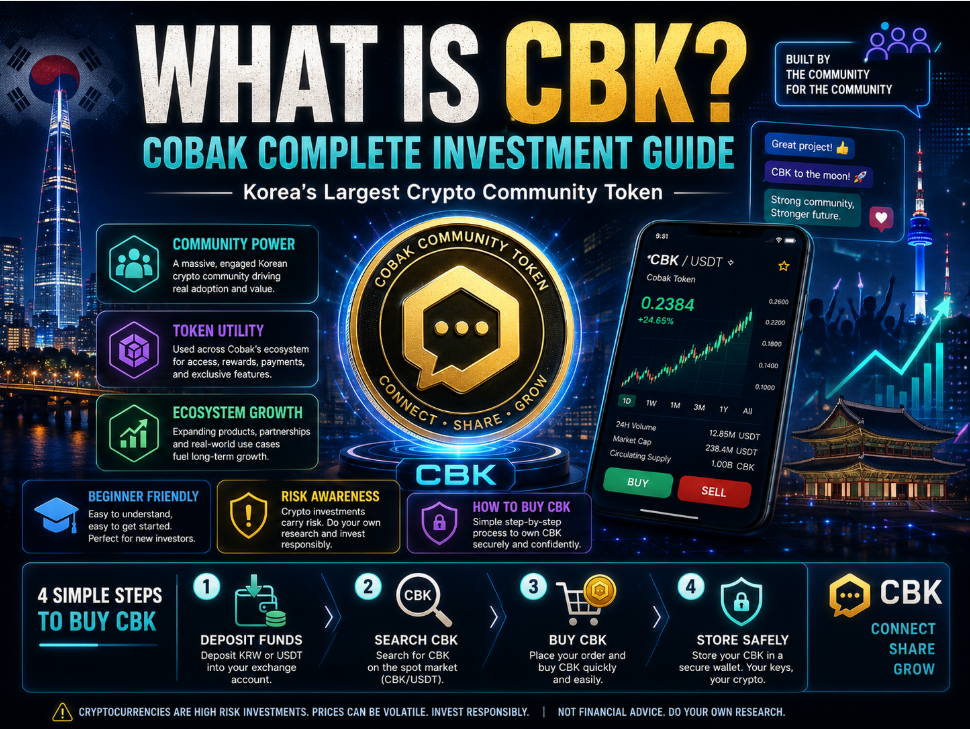
- The Identity of CBK
- To understand CBK, you must first place it in the correct asset category.
- CBK is not a layer-1 public chain asset like Bitcoin or Ethereum.
- CBK is not a classic exchange utility token like BNB or OKB.
- CBK is certainly not a productless meme coin propelled entirely by community sentiment.
- Instead, it serves as an ecosystem utility token designed for the Cobak platform, focusing on content incentives, membership perks, platform payments, governance voting, and staking systems within the South Korean crypto community.
- 1.1 What Kind of Platform is Cobak?
- Cobak is one of South Korea's earliest cryptocurrency communities and investment information platforms. It offers real-time market data, news, community discussions, project campaigns, Q&A sessions, content creation tools, and investment-related services tailored to Korean crypto users.
- You can think of Cobak as a "community-driven gateway" to the South Korean crypto market. It is not just an exchange or a media site, but a hybrid platform combining:
- Crypto news and data aggregators;
- Investor communication hubs;
- Project marketing and campaign launchpads;
- User-generated content platforms;
- Tokenized rewards and membership perk systems;
- A central gathering hub for local South Korean Web3 users.
- According to platform disclosures, Cobak has previously reported roughly 500,000 registered users, around 60,000 daily active users (DAUs), and over 300,000 cumulative app downloads. For a regional crypto community, these metrics indicate a solid user base and brand recognition within the South Korean market.
- This highlights the primary difference between CBK and purely speculative low-cap tokens: it is backed by a concrete, operating community product rather than a hollow concept.
- However, a solid user base does not guarantee that the token price will rise. The long-term value of CBK hinges on whether these users remain active, whether they are willing to utilize the token, and whether the platform can effectively convert community traffic into economic activity.
- 1.2 Full Name and Basic Attributes of CBK
- The full name of the asset is Cobak Token.
- Architecturally, CBK is an ERC-20 token running on the Ethereum network with a hard capped total supply of 100 million tokens.
- Its core positions include serving as:
- The utility token for the Cobak platform;
- A community governance token;
- A reward mechanism for content contributors;
- A medium of exchange for platform services;
- A key to unlock tiered membership privileges;
- The foundational asset within the Cobak Finance staking architecture.
- Data from market trackers like CoinMarketCap and CoinGecko shows that CBK's circulating supply is nearing its total cap, meaning the vast majority of tokens are already circulating in the open market. Because live prices, market caps, and volumes fluctuate dynamically, it is recommended to verify the latest metrics directly on trusted tracking sites.
- From an investment standpoint, a high circulating-to-total-supply ratio offers a notable benefit: future sell pressure from unlocking schedules is relatively minimal. However, it also presents a challenge: if the platform fails to generate new user growth and utility demand, a "low unlock pressure" status alone will not sustain long-term price appreciation.
- 1.3 Who Founded Cobak?
- Public records indicate that Cobak’s core team and founders have long been focused on the South Korean crypto community and blockchain application services, with industry sources noting Kim Kyeong-ik's involvement in the founding of the Cobak project.
- The platform was built to address the specific needs of South Korean crypto users regarding localized information, community interaction, project discovery, and incentive structures.
- In traditional internet forums, users who post, comment, answer questions, or share project updates generally only earn reputation points or visibility, rarely capturing direct economic rewards. Cobak's architecture integrates community contributions with tokenized incentives, transforming users from mere content consumers into active stakeholders in the platform's economy.
- This is the environment that birthed CBK. It was not designed as a purely speculative asset, but as a mechanism to power user behaviors, content generation, memberships, and governance within the Cobak ecosystem.
- 1.4 How Does CBK Differ from Exchange Tokens Like BNB or OKB?
- While comparing CBK to exchange platform tokens makes sense on the surface, they are fundamentally distinct.
- The core value drivers of exchange tokens like BNB and OKB typically stem from:
- Trading fee discounts on the exchange;
- Exclusive access to Launchpads and Launchpools;
- Systematic platform buybacks or token burns;
- Broad exchange and native layer-1 ecosystem expansion;
- Organic demand generated by massive global trading user bases.
- Conversely, CBK's value drivers rely on:
- On-platform content contributions;
- Participation in community events and marketing tasks;
- Settlement for internal Cobak services;
- Tiered member privileges;
- Governance voting weights;
- Staking and conversion dynamics within its dual-token model;
- Overall user engagement within the South Korean crypto space.
- Thus, the core distinction lies in their drivers: exchange tokens are propelled by transaction volumes and exchange revenues, whereas CBK is powered by community retention, content quality, and user engagement. If the Cobak community grows, real utility demand for CBK scales. If community traction slows, demand for the token weakens significantly.
- 1.5 The Origin of the Name "Cobak"
- The name Cobak is widely understood to be a play on the phrase "Coin Back."
- This naming philosophy directly reflects the platform's tokenomics loop: users who add value by posting content, answering questions, or completing tasks receive rewards back from the platform. It creates a defined loop:
Participate in Community → Contribute Value → Earn Rewards → Spend or Stake Tokens → Re-engage Ecosystem.
- This loop separates Cobak from traditional media platforms. Standard portals rely on a one-way model where the platform produces content and the user consumes it. Cobak aims for a circular model where users produce content and the platform rewards them with ecosystem assets.
- However, for an investor, the validity of this model ultimately depends on three metrics: user acquisition trends, content quality control, and whether the tokens are actually utilized on-platform or simply dumped on the market.
2. CBK's Dual-Token System — What Are CBK and CC?
- The Dual-Token Framework
- The most confusing aspect of Cobak for newcomers is the existence of two distinct assets: CBK and an internal credit/token system called CC.
- To accurately evaluate Cobak's economic model, one must understand how these two systems interact.
- In short:
- CBK is the external, tradable digital asset.
- CC is the internal utility token or points asset circulating exclusively within the Cobak app.
- This dual-token framework represents Cobak's attempt to balance external market liquidity with internal community stability.
- 2.1 What is the CC Token?
- CC functions as a tokenized points or internal utility token used within the Cobak platform. It powers in-app consumption, reward allocations, quiz events, and service fees, rather than being freely traded on global secondary exchanges like CBK.
- The reason for creating CC is straightforward: if all internal community rewards and service pricing were denominated directly in CBK, the in-app economy would be entirely at the mercy of open-market crypto volatility. For example, if CBK surges violently on global markets, users might hoard it instead of spending it on platform services. If CBK crashes, platform rewards lose their appeal, disrupting community growth.
- CC acts as an internal insulation layer, ensuring that when users post, interact, or purchase digital goods, they are shielded from the direct price fluctuations of the broader crypto market.
- 2.2 The Exchange Mechanism Between CBK and CC
- A cornerstone of the Cobak ecosystem is the fixed conversion rate between CBK and CC. The platform architecture establishes a standard ratio:
- $\text{1 CBK} = \text{1,000 CC}$
- This ratio builds a bridge connecting open-market liquidity with localized utility: CBK anchors external market value, while CC absorbs internal platform use cases. The 1:1,000 conversion rate maintains a predictable valuation anchor between the two environments, keeping the internal community economy running smoothly regardless of short-term market noise.
- 2.3 The Economic Logic Behind the Dual-Token Model
- Why not just use CBK for everything? Single-token models often struggle because speculative open-market trading demands inevitably clash with daily utility operations. When a token's price swings wildly, it can ruin the user experience on-platform.
- The dual-token system addresses this friction: CBK handles external price discovery, CC manages internal ecosystem micro-transactions, and staking/conversion mechanics bind them together. For an everyday observer, this implies:
- If you want to invest or trade, your focus should be on CBK.
- If you want to earn rewards by completing tasks or playing quizzes, your focus should be on CC.
- If you want a long-term stake in the ecosystem, you can utilize the conversion and staking pathways between both assets to maximize your benefits.
- 2.4 Why This Suits Long-Term Community Growth
- Internet communities thrive on sustained, predictable engagement, not volatile pump-and-dump cycles. If the underlying unit of reward is too unstable, user behavior warps: during uptrends, users hoard assets instead of spending them; during downtrends, users dump tokens and stop creating quality content. The existence of CC dampens these wild behavioral shifts by decoupling daily platform micro-rewards from global market sentiment.
- 2.5 Primary Methods to Acquire CC
- Users can accumulate CC via three primary avenues:
- Community Contribution: Creating top-tier posts, answering user inquiries, filling out daily surveys, or winning platform quizzes.
- CBK Staking: Locking up CBK tokens via the platform’s staking portals to generate passive yields paid out in CC.
- In-App Conversions: Converting CBK directly into CC at the designated 1:1,000 ratio to fund platform purchases or join premium campaigns.
- Ultimately, CBK and CC are complementary assets rather than competitors. CBK represents the external value capture layer, while CC acts as the internal transactional engine.
3. What Can CBK Be Used For? — The Six Core Utility Scenarios
- Token Utility
- Evaluating a token's longevity requires looking past its marketing narrative and scrutinizing its actual utility. If a token lacks real-world use cases and relies solely on exchange speculation, its long-term risk profile expands. CBK’s value proposition is integrated directly into several core scenarios on the Cobak platform.
- 3.1 On-Platform Payments
- CBK can be deployed as an internal payment asset within the Cobak app to purchase premium analytics services, specialized content creation tools, or upgraded platform features. While this may feel less immediate than trading fee discounts on a major exchange, it is vital for community platforms. Building a functional "content-service-payment-reward" cycle transitions CBK from a speculative ticker into a utility asset with organic consumption.
- 3.2 Unlocking Membership Tiers
- Holding and utilizing CBK unlocks distinct membership privileges on Cobak. These perks include:
- Access to exclusive premium market insights and research.
- Priority access to early-stage launchpad campaigns.
- Dedicated allocations for project airdrops and task rewards.
- Unique community badges and identity verification.
- First-look testing pools for platform partner integrations.
- Membership mechanics are crucial for community tokens because they transform asset holding into a status symbol. When users hold CBK for platform perks rather than just selling it at the next peak, token velocity slows down in a healthy manner.
- 3.3 Rewards for Community Contribution
- Cobak's foundational thesis is giving users a share of the value they generate. Users earn rewards by writing articles, engaging in comments, participating in interactive Q&As, and validating project information. In legacy web forums, these actions merely yield likes or karma points. In Cobak, these actions connect to real economic rewards via the CBK/CC engine.
- However, this mechanism carries an operational risk: if reward thresholds are too generous, the platform will attract sybil bots and low-quality farming; if rewards are too small, users lose motivation to produce high-value content.
- 3.4 Governance and Voting Rights
- CBK functions as the governance unit for the platform. Token holders can vote on key initiatives, including platform feature rollouts, choosing project partnerships, updating community moderation guidelines, vetting specific project airdrop campaigns, and directing ecosystem reward distributions. This shifts CBK from a simple points metric into something resembling community co-ownership.
- 3.5 Staking and Yield Generation
- Within the Cobak Finance framework, users can lock up assets across distinct staking configurations outlined in the project's updated documentation:
- CBK Single Pool: Locking up CBK to earn native rewards, tailored for long-term believers in the token's value.
- CC Single Pool: Depositing CC to capture internal platform yields, suited for power users embedded in the app's daily economy.
- CBK/CC Pair Pool: Providing dual-asset liquidity to earn farming yields. This configuration typically offers higher yield potentials but exposes the user to impermanent loss and heightened volatility.
- When assessing staking yields, you must look beyond the advertised APR. You should account for token price drawdowns, lock-up duration constraints, liquidity exit penalties, and whether the yield effectively covers the asset's underlying market risk.
- If you want to understand how this compares to foundational crypto allocations, you can review this analysis on Is it a Good Time to Buy Bitcoin Now?. No matter how high a small-cap token's staking yield appears, it must always be measured against the risk-adjusted returns of blue-chip assets like BTC and ETH.
- 3.6 Cobak Pay and Cobak Swap
- Cobak is building out its ecosystem loops around Cobak Pay (for seamless in-app checking and real-world merchant integration potentials) and Cobak Swap (an integrated conversion interface or internal DEX designed to streamline asset swaps). This architecture forms a closed loop where users earn rewards via content creation, consume premium services via Cobak Pay, secure membership benefits, earn yield via staking, and swap pairs via Cobak Swap. The viability of this loop depends entirely on user acquisition and app retention metrics.
4. CBK Tokenomics — How the 100 Million Total Supply Impacts Long-Term Value
- Supply Dynamics
- Tokenomics is a critical module when deciding if a project is worth a long-term position. Many newcomers focus entirely on nominal token prices while ignoring circulating supplies, lock-up periods, emissions, and organic demand, mistakenly assuming a low price means an asset is cheap without realizing massive unlock cliffs are ahead. CBK maintains a clear supply cap of 100 million tokens.
- 4.1 What is CBK's Current Circulating Supply Ratio?
- On-chain data from platforms like CoinMarketCap and CoinGecko indicates that CBK's circulating supply sits near its maximum cap, hovering around the 99 million to 100 million mark (slight variances exist based on tracking methodologies). This indicates that CBK has moved past its heavy token emission and venture unlock phases.
- From a pure supply perspective, this is structurally healthier than projects where only 10% of the supply circulates while the remaining 90% waits to be unlocked and sold. However, this does not mean selling pressure is non-existent; existing circulating supplies can still be sold by early backers, traders, or historical buyers. Real price support depends on who holds the asset, staking lockup ratios, exchange depth, and structural buy pressure from platform utility.
- 4.2 What to Note Regarding the Token's Initial Allocation
- The initial distribution of CBK tokens covered the core team, ecosystem incentives, community rewards, institutional private backers, platform operations, and marketing development pools.
- Investors must look for concentration risks: are team allocations overly dominant? Are private investor vestings fully cleared? Are community rewards reaching real users? If a token's supply is highly concentrated in a handful of large wallets, it can trigger sudden cascades of selling pressure during market drawdowns regardless of the 100 million cap.
- 4.3 Does CBK Have a Deflationary Burn Mechanism?
- Unlike assets like BNB, CBK does not rely on systematic quarterly token burns as its primary narrative. Instead, its tokenomics favor community utility, staking locks, and dual-token conversions. Its valuation is sustained by network growth rather than artificial deflation. If Cobak implements structured buybacks or fee-burn mechanics in the future, its value capture capabilities could expand, but investors should not buy the asset expecting a deflationary supply squeeze under its current rules.
- 4.4 How Staking Impacts Market Float
- Staking effectively locks up circulating tokens, removing them from the immediate market float. When a significant percentage of users lock their CBK in staking smart contracts, the liquid supply available on order books drops, meaning any spot buy pressure can move the price upward more efficiently.
- However, staking is not a one-way benefit. If staking rewards are overly inflated and simply sold upon receipt, they generate constant sell pressure. Similarly, when massive staking lockup periods expire simultaneously, they can create temporary supply shocks on exchanges.
- 4.5 How Cobak Finance Aims to Enhance Token Liquidity
- Cobak Finance leverages its dual-token architecture and automated liquidity pools to improve internal token velocity and liquidity. A common failure mode for community tokens involves users instantly dumping rewards on external exchanges due to a lack of in-app use cases, causing liquidity to dry up. Cobak's architecture routes localized micro-transactions through CC while keeping CBK as the external value layer, connecting them through staking rails to preserve orderly liquidity depth.
5. Historical Price Trends and Future Projections — From a $16 Peak to Current Levels
- Price Analysis
- CBK's historical chart exhibits a classic crypto cycle pattern: explosive upside during bull markets followed by deep retracements during prolonged bear markets.
- According to price history aggregators like Crypto.com and CoinMarketCap, CBK reached its all-time high (ATH) near $16 during the 2021 market peak, before entering a long-term multi-year correction. Its current trading range represents a steep drawdown of over 90% to 98% from its historical peak, underscoring both its past market popularity and its high volatility profile.
- 5.1 Why Did CBK Decline Significantly From Its All-Time High?
- The long-term correction of CBK from its peak stems from several structural shifts:
- The Expiration of the 2021 Bull Cycle: The macro crypto market peaked in 2021, and small-to-mid-cap assets corrected sharply as global liquidity tightened.
- A Shift in Community Token Narratives: During the 2021 market peak, investors assigned high premiums to "SocialFi, community, and platform ecosystem" stories. In subsequent corrections, capital rotated back toward tangible cash flows, active user metrics, and revenue capture.
- Concentrated Regional Market Dependencies: CBK possesses a strong South Korean regional profile. When local speculative interest in altcoins cools down, trading volumes and buying interest for CBK contract rapidly.
- Global Expansion Hurdles: Because Cobak's primary user base remains concentrated within South Korea, its market valuation ceiling faces geographic limitations. Successful globalization remains a key variable for any major valuation adjustment.
- Liquidity and Order Book Depth Vulnerabilities: Low-and-mid-cap assets lacking constant institutional bid support face persistent downward drift during prolonged market corrections.
- 5.2 Reading the Technical Charts
- Under its current price structures (e.g., hovering around $0.26 and trading below its 200-day moving average of approximately $0.41), CBK exhibits a weak technical posture over the medium-to-long term. Technical traders typically view an asset trading below its 200-day moving average as a sign that a structural trend reversal has not yet been confirmed.
- However, trading beneath the 200-day moving average does not mean an asset should be completely ignored; it can indicate two distinct market realities:
- The trend remains weak, necessitating patience for a verified accumulation base or breakout confirmation.
- If the project's underlying fundamentals are improving, low price ranges can present an asymmetric risk-reward setup.
- Crucially, an asset should never be bought simply because it has experienced a deep drawdown. A token that drops from $16 to $0.26 does not automatically possess a right to return to $16; it can easily correct further if its underlying ecosystem fails to retain users. Technical metrics must always be paired with fundamental indicators: active user acquisition trends, new utility rollouts, South Korean exchange volumes (e.g., Upbit), and capital inflows into the Web3 community sector.
- 5.3 Three-Scenario Price Projections (2026–2030)
- The following projections are scenario-based models driven by assumptions around user growth, regional regulations, SocialFi narratives, and market cycles. They are not absolute guarantees.

- The utility of this projection table is to identify the milestones required to unlock different valuation tiers. For CBK to reclaim levels above $1, the market must see a verified return of user acquisition momentum, widespread utilization of the dual-token architecture, healthy volume expansion on major exchanges, and proof that Cobak can appeal to users beyond its domestic base.
- If you want to compare this growth potential with highly established digital assets through 2030, you can read this comprehensive analysis on Ethereum Price Prediction for 2030. While the same multi-scenario modeling applies, note that CBK carries significantly higher execution risks and volatility than blue-chip networks like ETH.
- 5.4 Can CBK Reclaim Its Historic High of $16.31?
- While high-volatility, lower-cap tokens can stage massive rallies during manic bull markets, expecting CBK to easily clear $16 requires an exceptional convergence of factors: Cobak scaling into a premier global Web3 social portal, massive real-world adoptions of its dual-token model, robust sustainable staking lockups via Cobak Finance, widespread liquidity expansion on international tier-1 exchanges outside of Upbit, and a powerful structural bull market cycle.
- Absent these developments, treating the historical ATH as a primary target is imprudent. Realistic targets should focus on closer technical resistance levels: Can the asset reclaim and hold the $0.50 mark? Can it clear the $1 threshold? Can it prove it is more than a regional asset dependent on localized market trends?
6. How to Buy CBK on HiBT — A Beginner's Step-by-Step Operational Guide
- Trading Guide
- If you understand Cobak's platform dynamics, its token mechanics, and its risk parameters, you can acquire the asset via exchanges that list CBK trading pairs. Here is an execution roadmap using the HiBT Exchange.
- 6.1 Prerequisites Before Buying CBK
- Before executing a trade, ensure you complete four preparatory steps:
- Fund Allocation: Prepare trading capital in liquid assets like USDT, BTC, or ETH. If you are starting with fiat, utilize the platform's fiat gateways to source stablecoins first.
- Identity Verification (KYC): Most centralized compliance platforms require verified identities to unlock full deposits, trading limits, and withdrawal privileges.
- Understand Ethereum Transacting Basics: Since CBK is an ERC-20 token, moving your assets to a personal cold wallet requires basic familiarity with ETH Gas fees, contract address verifications, and proper network routing.
- Order Book Awareness: CBK is a mid-to-small-cap asset with thinner books than major pairs. Prioritize Limit Orders over Market Orders to protect yourself against excessive slippage.
- 6.2 Operational Features of HiBT Exchange
- HiBT is a global digital asset platform featuring multi-token support, user reward frameworks, and localized interfaces. Its operational profile includes:
- A corporate registration background in Canada.
- MSB compliance registrations within both the United States and Canada.
- Operational headquarters set in Dubai.
- A security focus utilizing 90% cold-wallet asset storage protocols.
- Multi-signature security access controls.
- Transparent fee schedules and active spot pairs like CBK/USDT.
- 6.3 Step-by-Step Purchase Process on HiBT
- Step 1: Account Registration. Head to the official HiBT platform or download their app, register via a secure email or mobile number, and set up a robust password.
- Step 2: Complete KYC Identity Verification. Submit your government ID or passport as prompted by the portal. Passing verification unlocks complete trading access.
- Step 3: Turn on Security Enhancements. Activate Google Authenticator (2FA), set an independent withdrawal/fund password, and turn on anti-phishing codes.
- Step 4: Deposit Capital. Deposit crypto assets or stablecoins from an external wallet, or leverage fiat-to-crypto on-ramps. When depositing USDT, ensure you match your networks (e.g., TRC-20, ERC-20, BEP-20) perfectly.
- Step 5: Navigate to CBK/USDT. Open the spot trading interface, enter "CBK" in the asset lookup bar, and select the CBK/USDT pair. Take a moment to analyze the order book spread and recent prints.
- Step 6: Select Your Order Type. Beginners should utilize Limit Orders, which allow you to define your exact maximum buy price. Market orders execute instantly but can suffer from slippage if liquidity is thin at that exact second.
- Step 7: Order Submission. Enter your desired quantity, verify the total cost basis and associated exchange fees, and click buy.
- Step 8: Confirm Balance. Once the order fills, verify your token balance within your spot wallet profile. Decide whether to keep the assets on the exchange or move them to a self-custodial Web3 wallet for staking.
- 6.4 Comparing CBK's Primary Trading Platforms
- The vast majority of CBK’s organic liquidity is concentrated within the South Korean market, specifically on Upbit via the CBK/KRW fiat pair. This means domestic Korean users have native trading advantages, while global participants typically route through international USDT pairs:
- Upbit: The central liquidity hub for the asset. Excellent depth via the KRW pair, but features high entry barriers and strict verification rules for non-Korean residents.
- HTX: A global alternative offering altcoin pairs, suitable for experienced international traders.
- HiBT: Well-suited for users seeking clean USDT pairs, localized multi-language layouts, and straightforward registration paths. Always check the active book depth before placing large orders.
- 6.5 Practical Rules for Your First Entry
- When allocating capital to an asset like CBK for the first time, scale in defensively: start with a small test allocation, avoid using any leverage or margin options, never chase sudden green candles, and never make a small-cap platform token a foundational piece of your portfolio. If you use technical support floors (such as the $0.20 area) as a risk guide, a clean breakout below that level on high volume could signal that the market requires further consolidation before finding a true bottom.
7. Four Systemic Risks of Holding CBK — Understand These Before Buying
- Risk Evaluation
- While CBK has an operating platform and real community use cases, it remains a highly speculative, volatile digital asset. Newcomers must review several core risks before building a position.
- 7.1 Extreme Liquidity Concentration Risk
- Because the vast majority of CBK’s trading volume occurs on South Korean exchanges via fiat KRW pairs, international investors trading via USDT can face specific hurdles: fragmented order books across smaller exchanges, noticeable bid-ask spreads, and slippage on larger block orders. This concentration means that if speculative interest cools down within South Korea, global liquidity for the token can dry up rapidly.
- 7.2 Platform Retention and User Growth Dependencies
- The fundamental value of CBK is tied directly to the health of the Cobak application. If user retention drops, content quality degrades, or sybil bots exploit reward activities, the platform's tokenomics engine stalls. A community token’s worst enemy is not a short-term market correction, but a long-term loss of active users. If user engagement vanishes, the token loses its utility foundation, turning into a purely speculative asset with weak price support.
- 7.3 Regulatory Shifts Within South Korea
- Given its concentration in South Korea, CBK is exposed to local regulatory updates. South Korean watchdogs maintain strict oversight regarding Virtual Asset Service Providers (VASPs), anti-money laundering (AML) compliance, real-name banking links, and local exchange listing standards. Any adverse policy shifts targeting altcoins or platform incentives can instantly impact CBK's listing status and local trading volumes.
- 7.4 Long-Term Downward Drift and Capital Risks
- An asset correcting from $16 down to the $0.20–$0.30 range indicates that the market has fundamentally re-evaluated its growth premium. If Cobak cannot trigger a new phase of active user adoption, the token can trade sideways in low ranges indefinitely. Total capital loss scenarios are a real factor for lower-cap projects if a platform loses its core traffic, key exchanges de-list the pair, or team development halts.
- 7.5 Web3 Wallet and On-Chain Operational Complexities
- Withdrawing your tokens to a self-custodial wallet introduces pure operational liabilities: miscalculating Ethereum Gas fees during high network congestion, sending assets to incorrect addresses, routing tokens through unsupported networks, interacting with malicious look-alike smart contracts, or losing your private seed phrase—which results in a permanent loss of your funds.
8. What Role Should CBK Play in Your Crypto Portfolio?
- Portfolio Architecture
- CBK belongs strictly in the high-risk, satellite asset tier rather than your portfolio's core foundation. While its dual-token model and local brand presence are compelling, it carries significantly more risk and less liquidity than blue-chips like BTC and ETH.
- 8.1 Three Investor Types Well-Suited for CBK
- Long-Term SocialFi and Web3 Economy Bulls: Investors who believe decentralized platforms will successfully monetize attention and content via token incentives, using CBK to gain exposure to that sector.
- Regional Market Specialists: Traders who understand South Korean exchange mechanics, local investor psychologies, and domestic community trends.
- Active Platform Participants: Users who intend to actively post on Cobak, utilize CC, and lock up tokens in governance and staking pools to extract ecosystem value.
- 8.2 Three Investor Types Who Should Avoid CBK
- High-Volume Day Traders: Individuals requiring deep, liquid order books to execute large short-term positions without slippage.
- Conservative, Low-Risk Investors: Anyone who cannot tolerate sudden 30% to 50%+ drawdowns in their portfolio balance.
- Pure On-Chain Beginners: Individuals who have not mastered the concepts of gas management, contract addresses, public keys, and exchange withdrawal network options.
- 8.3 Designing a Resilient Allocation Framework
- A sound portfolio strategy prioritizes established, liquid digital assets before exploring mid-to-small-cap themes. A classic framework looks like:
- Blue-Chip Foundation: Allocating 70%+ of your crypto capital into BTC and ETH.
- Opportunistic Cash: Keeping 10%–20% in stablecoins to deploy during market corrections.
- Speculative Satellite Tier: Limiting total exposure to mid-to-small-cap assets within a 5%–15% bracket, ensuring individual tail-end assets like CBK do not exceed 5% of your total portfolio.
- This sizing ensures that even if a small-cap project suffers an adverse event, your core wealth remains intact, while preserving upside potential if the project executes its roadmap successfully.
Conclusion: CBK Merits Deep Research, But Avoid Speculative Over-Concentration
- CBK stands out as a unique project in the crypto ecosystem. It is not an unbacked meme coin or a standard exchange token, but an ecosystem asset built into an operating South Korean community platform. Its strengths lie in its real-world content reward loops, its protective dual-token structure, clear utility across staking/membership tiers, local brand recognition, and a fixed supply cap that is almost entirely circulating.
- However, its challenges are equally prominent: a massive drawdown from historical peaks, heavy reliance on a single regional market, global expansion hurdles, and high small-cap volatility.
- If you decide to allocate capital to CBK, start with a conservative test size, understand the platform's inner mechanics, and ensure your position is sized appropriately relative to your blue-chip holdings. A mature investor doesn't buy a token simply because it is down 95% from its ATH; they analyze user growth trends, verify dual-token utility, check order book depth, and ensure they can comfortably absorb the downside if the investment thesis takes longer to play out.
FAQ: Frequently Asked Questions About CBK
- 1. What exactly is CBK?
- CBK stands for Cobak Token. It is the utility and ecosystem asset for Cobak, South Korea's largest cryptocurrency community and information portal. It powers in-app payments, membership tiers, user rewards, governance, and staking.
- 2. Is Cobak a centralized cryptocurrency exchange?
- No. Cobak is not a traditional exchange platform. It operates as a Web3 social community, data aggregator, and project marketing hub where investors gather to share insights and participate in project launches.
- 3. What is the difference between CBK and CC?
- CBK is the external, ERC-20 asset tradable on public secondary exchanges. CC is an internal, non-tradable utility credit used exclusively within the Cobak app to reward users and pay for micro-services, insulating the app's community from open-market volatility. 1 CBK can be converted into 1,000 CC.
- 4. What is the total supply of CBK?
- The total supply is capped at 100 million tokens. On-chain trackers indicate that circulating supply is near 100%, meaning there are no large hidden inflation schedule cliffs ahead.
- 5. Can CBK ever return to its $16 all-time high?
- While possible in a crypto bull market, it represents an uphill climb requiring exceptional milestones: scaling its user base internationally, widespread adoption of its Cobak Finance staking modules, securing deep liquidity on global tier-1 exchanges outside of South Korea, and a structural wave of capital entering the SocialFi sector. Focus on nearer targets like $0.50 and $1 before eyeing the ATH.
- 6. Is CBK a suitable buy for absolute beginners?
- Not for large allocations. Beginners unfamiliar with order book slippage, low-cap volatility, and Ethereum network transacting should stick to learning foundational assets like BTC and ETH before exploring smaller community tokens.
- 7. What is the biggest risk associated with CBK?
- Its primary risks are extreme liquidity concentration on South Korean venues, localized regulatory actions, user retention dependencies within the app, and the general volatility risks inherent to mid-to-small-cap altcoins.
- 8. Where can I buy CBK tokens?
- CBK can be purchased on select platforms that host its pairs, notably Upbit for local KRW transactions, and international venues like HiBT for clean USDT pairs. Always check order book depth and withdrawal rules before transacting.