
Introduction
- For many newcomers in the crypto market, seeing the name SMCION for the first time sparks a common question: Is this a coin or a stock?
- It looks like an ERC-20 token that can be transferred on-chain and appears in trading pairs on exchanges; however, its price is clearly highly correlated with the US-listed company Super Micro Computer, Inc. (ticker: SMCI). To add to the confusion, SMCION is neither a cryptocurrency in the traditional sense nor the actual SMCI stock you would buy directly through a Nasdaq brokerage account.
- More accurately, SMCION is a tokenized stock asset. It attempts to bring the economic exposure of traditional US equities on-chain, allowing users to gain exposure to stock-like price performance using crypto wallets or exchange accounts.
- However, buying SMCION does not mean you genuinely become an SMCI shareholder.
- This article systematically explains what SMCION is and whether it suits retail investors by analyzing its underlying company, tokenization mechanism, asset backing, price predictions, purchasing process, and core risks.
- Disclaimer: This article does not constitute investment advice. SMCION simultaneously involves US stocks, RWA, crypto assets, smart contract risks, and regulatory risks. You should assess your own risk tolerance before investing.
1. What Exactly is SMCION? — Not a Normal Cryptocurrency, Nor a Real Stock
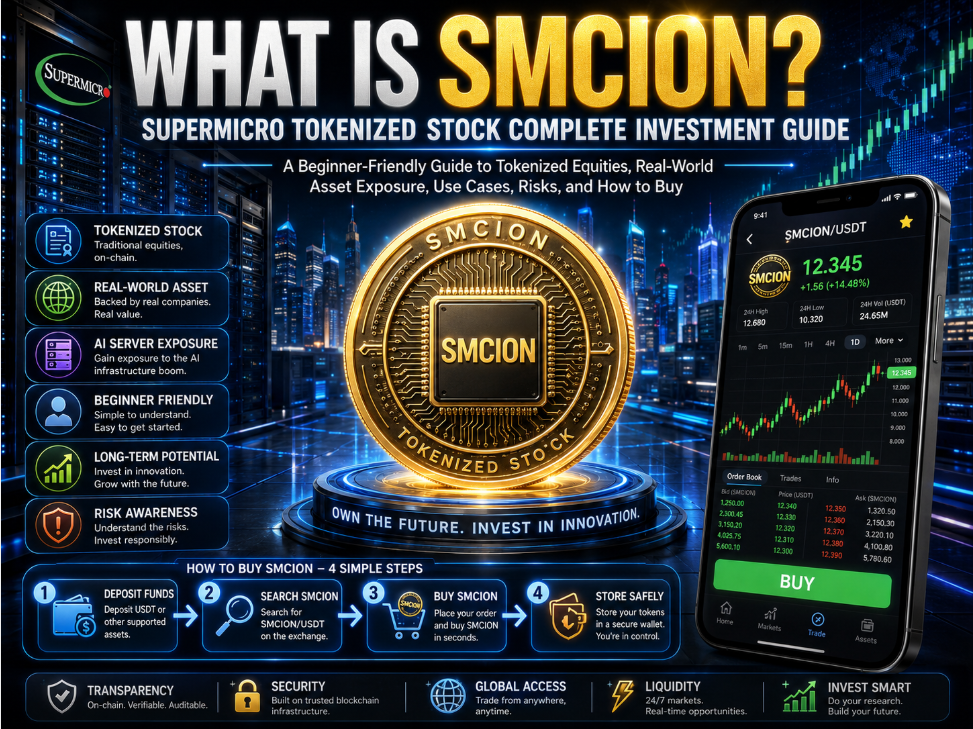
- The Concept of SMCION
- The full name of SMCION is generally understood as Super Micro Computer Tokenized Stock (Ondo), which is a tokenized equity product of Super Micro Computer launched within the Ondo ecosystem.
- It is not a native crypto asset like Bitcoin or Ethereum, nor is it a meme coin, governance token, or public chain token. Its core value does not originate from an on-chain ecosystem itself, but rather from a real-world US stock: Super Micro Computer, Inc. (SMCI).
- Therefore, to understand SMCION, you must first grasp two concepts:
- First, its underlying target asset is SMCI stock.
- Second, it is an on-chain tokenized asset, not a stock held in a traditional securities account.
- 1.1 What Kind of Company is Super Micro Computer (SMCI)?
- Super Micro Computer, often referred to as "Supermicro," is a server and data center hardware company headquartered in California, USA.
- Its core businesses include:
- AI servers
- High-performance computing (HPC) servers
- Data center solutions
- Storage systems
- GPU servers
- Hardware solutions for cloud service providers and enterprise clients
- Over the past few years, large AI models, cloud computing, and data center construction have driven global demand for servers. In particular, since Nvidia GPUs became highly supply-constrained, manufacturers capable of rapidly delivering AI servers have attracted significant attention from capital markets. Consequently, SMCI became one of the representative companies riding the wave of AI infrastructure.
- Put simply, Nvidia provides the GPUs, cloud providers and enterprises need the computing power, and SMCI’s role is to integrate the GPUs, motherboards, cooling systems, power supplies, chassis, and server architecture into deliverable data center products. This explains why SMCI’s stock price surged dramatically during the AI boom.
- However, it is crucial to note that SMCI is not a risk-free "AI miracle stock." It faces pressures regarding auditing, governance, financing, profit margins, supply chains, compliance, and competition. Since the price of SMCION is pegged to SMCI, these company-level risks will indirectly transfer to SMCION.
- 1.2 What Does "Tokenized Stock" Mean?
- Tokenized stock refers to an asset form where traditional shares or their economic exposure are mapped onto a blockchain.
- Its goal is to enable users to obtain exposure to stock-like price fluctuations via on-chain tokens.
- Traditional Stock Ownership: You buy shares within a securities account, and clearing and custody are handled by stock brokers, exchanges, clearinghouses, and custodial systems.
- Tokenized Stock Ownership: You hold an on-chain token whose value is backed by real assets, cash equivalents, or other financial arrangements structured by the issuer or related entities.
- While both models can reflect the price of the same stock, their legal relationships, holder rights, asset custody structures, trading hours, and compliance requirements are completely different. Therefore, tokenized stocks are best understood as an on-chain stock price exposure tool rather than a traditional certificate of stock ownership.
- 1.3 Are SMCION and SMCI Stock the Same Thing?
- No. While the price of SMCION may track SMCI stock closely, the two are not equivalent.
- If you buy SMCI stock directly, you hold equity rights under a traditional securities account. Depending on the market and brokerage arrangements, you may enjoy traditional shareholder rights such as voting, dividends, and corporate action processing.
- If you buy SMCION, you hold a tokenized asset. You get economic exposure tracking the price performance of SMCI, rather than being registered on the traditional shareholder roster.
- The biggest differences include:
- SMCION does not necessarily provide shareholder voting rights.
- The rights of SMCION depend entirely on the issuer and product terms.
- Trading and custody of SMCION happen on-chain or within crypto platforms.
- Compliance restrictions for SMCION may vary heavily by country and region.
- The liquidity of SMCION may be significantly lower than the actual shares traded on Nasdaq.
- Thus, SMCION is more like an "on-chain version of SMCI economic exposure" rather than "real SMCI stock."
- 1.4 Who is the Issuer Behind SMCION? What is Ondo Finance?
- SMCION belongs to the tokenized asset framework associated with Ondo Global Markets. Ondo Finance is one of the most prominent platforms in the RWA (Real World Asset) tokenization sector.
- The core logic of RWA is to introduce real-world financial assets—such as US Treasuries, funds, stocks, ETFs, and commodities—into the crypto world using compliant structures and on-chain tokens.
- Ondo’s tokenized stock products typically highlight several features:
- Providing users with price exposure to US stocks or ETFs.
- Tokens can circulate across supported chains and platforms.
- Underlying assets are backed by compliant custodial structures.
- The price target is to track the performance of the corresponding stock or ETF.
- Corporate actions like dividends are reflected in the token's value through product mechanisms.
- According to market tracking platforms like CoinMarketCap, SMCION belongs to the Super Micro Computer Tokenized Stock (Ondo) asset class and runs on chains like Ethereum. Its market cap, circulating supply, and trading volume change in real-time. Therefore, when evaluating the asset, you should always rely on the latest live data from CoinMarketCap, CoinGecko, the official Ondo Finance website, and on-chain explorers rather than treating a historical data point as a permanent conclusion.
2. How SMCION Works — What is Actually Locked Behind Each Token?
- Asset Backing
- The biggest concern for newcomers is usually not whether SMCION will go up, but rather: Is there a real asset backing the token I am buying?
- This is the most critical differentiator between tokenized stocks and typical "aircoins." If a tokenized stock is issued simply under a name resembling a stock without any real assets, compliant custody, redemption mechanisms, or transparent disclosures, its risk is extremely high. RWA platforms like Ondo try to solve this by creating a verifiable bridge between on-chain tokens and real-world assets.
- 2.1 How Does Ondo Global Markets' "Digital Twin" Mechanism Work?
- The core concept of Ondo Global Markets can be understood as a "digital twin." This means that while a stock or ETF exists in the real world, a corresponding token is issued on-chain. This token does not directly equal the stock itself, but it aims to replicate the price movement of the underlying asset in terms of economic performance.
- Taking SMCION as an example:
- Underlying Asset: SMCI Stock.
- On-chain Asset: SMCION.
- The issuer uses custody, asset backing, pricing mechanisms, and redemption arrangements to ensure SMCION tracks the market price changes of SMCI as closely as possible. Theoretically, when SMCI goes up, SMCION should rise simultaneously; when SMCI drops, SMCION falls as well.
- However, a key point must be emphasized: SMCION's "tracking" does not mean risk-free replication. It still carries issuer risk, smart contract risk, liquidity risk, market spread risk, and regulatory risk.
- 2.2 How is the Token Price Pegged to the SMCI Stock Price?
- The price peg of tokenized stocks generally relies on three mechanisms:
- Underlying Asset Backing: If the issuer or partner custodian holds the corresponding stock or equivalent assets, the market maintains confidence that the token has a solid asset foundation.
- Subscription and Redemption Mechanism: When the token price becomes noticeably higher or lower than the underlying stock value, eligible market participants can close the spread through minting, burning, and arbitrage.
- Market Trading: Traders price SMCION based on the spot price of SMCI, pre-market/after-hours prices, news events, crypto market liquidity, and on-chain transaction costs.
- For example, if SMCI shares surge in the US stock market while SMCION remains noticeably undervalued, arbitrageurs will buy SMCION. Conversely, if SMCION becomes overpriced, traders might sell it or hedge through relevant methods.
- In the actual market, however, spreads are not always instantly eliminated due to:
- Mismatched trading hours between the crypto market and the US stock market.
- On-chain Gas fees affecting smaller transactions.
- Insufficient liquidity depth on exchanges.
- Regulatory constraints preventing certain arbitrageurs from participating.
- Short-term market sentiment deviating from fundamentals.
- Therefore, SMCION can reference the SMCI stock price, but you cannot mechanically assume the two will always remain perfectly synchronized.
- 2.3 How are Dividends Handled?
- SMCI is currently not a typical high-dividend stock, but tokenized equity products must handle a universal rule: If the underlying stock pays a dividend, do token holders get a share?
- Ondo’s tokenized stock products usually adopt a "total return tracking" approach. This means factors like dividends, reinvestments after tax withholding, and corporate actions are reflected in the token price or asset value through the product design.
- This differs from holding shares directly. When holding stocks directly, dividends enter your brokerage account as cash; when holding tokenized stocks, dividends may not be paid out in cash but are instead reinvested or accounted for via net asset value (NAV) adjustments. Investors must review the specific product terms to see:
- Whether dividends are factored into the token value.
- Whether withholding taxes are deducted.
- Whether dividends are automatically reinvested.
- How events like stock splits, mergers, or de-listings are handled.
- Whether the issuer fully discloses corporate action handling rules.
- 2.4 How to Verify SMCION On-Chain?
- If SMCION is an ERC-20 or multi-chain asset, investors should know how to verify basic information using on-chain explorers. At a minimum, you should check:
- Whether the smart contract address comes from official Ondo channels or trusted market tracking platforms.
- Whether the token name and symbol are correct.
- Whether holder distributions look anomalous.
- Whether the contract code is verified.
- Whether suspicious permissions exist.
- Whether transfer records are normal.
- Whether the circulating supply matches official disclosures.
- On Ethereum, you can use Etherscan to query the contract. On BNB Chain, you can use BscScan. On other chains like Solana, you must use their respective explorers.
- The most common mistake beginners make is buying the first "SMCION" they see in a search bar. In reality, fake tokens with the same name, copycat contracts, and phishing tokens are widespread on-chain. The correct approach is to navigate to the contract address directly from the official Ondo page, an official exchange page, or verified entries on CoinMarketCap/CoinGecko before executing a trade.
3. SMCION vs. Traditional SMCI Stock Ownership — What Are You Giving Up?
- Trade-offs
- Many choose SMCION because it seems far more convenient than a traditional US brokerage account. There is no need to open a legacy brokerage account, it features 24/7 trading, fractional buying is supported, and you can allocate capital using USDT, USDC, or crypto balances.
- However, this convenience means giving up a portion of traditional shareholder rights.
- 3.1 Does Holding SMCION Include Shareholder Voting Rights?
- Generally speaking, holders of tokenized stocks are not recognized as registered shareholders of the traditional company.
- This means there is a high probability you cannot participate in shareholder voting like a regular SMCI stockholder, nor can you directly vote on board elections, major mergers, or corporate governance proposals. Your core benefit is limited to price exposure rather than corporate governance power.
- If your primary goal is to legitimately become a shareholder of SMCI, buying Nasdaq-listed SMCI shares directly is the way to go. If your goal is simply to capture SMCI price volatility using a crypto account, then SMCION fits the bill.
- 3.2 What Happens to My Assets If Ondo Finance Faces Issues?
- This represents one of the most critical risks of tokenized stocks.
- When holding SMCI stock directly, your assets rely on stock brokers, clearing systems, and traditional financial regulatory frameworks. While brokerage risks and market risks still exist, the legal framework is highly mature.
- Holding SMCION means you take on additional counterparty layers:
- Ondo platform operational risks.
- Custodial structure risks.
- Smart contract vulnerabilities.
- Redemption mechanism friction.
- On-chain liquidity risks.
- Regulatory policy shifts.
- If the issuer experiences a hack, contract exploit, custodial dispute, suspension of redemptions, or regulatory crackdowns, the price of SMCION could severely de-peg. This doesn't mean SMCION is inherently unsafe, but rather that its risk structure differs from traditional equities. Before investing, realize you are not buying "stock seamlessly moved to a blockchain," but a financial product stitched together by real assets, an issuer, a custodian, code, and a crypto market.
- 3.3 How Does SMCION’s Liquidity Compare to the Actual Underlying Shares?
- SMCI is a Nasdaq-listed corporation, and the trading volume of its actual shares in the US stock market is vastly superior to SMCION.
- While SMCION’s market-wide 24-hour trading volume across tracking sites fluctuates heavily based on market cycles, the actual depth available within a specific exchange or a particular on-chain liquidity pool can be unstable. This means:
- Small purchases may feel unaffected.
- Large buy orders could push up execution prices.
- Large sell orders can cause massive slippage.
- During extreme market events, you may find it difficult to buy or sell altogether.
- Prices might temporarily disconnect across different platforms.
- For short-term traders, this is vital. If you are used to high-frequency trading, tight stop-losses, or need to quickly move positions worth tens of thousands of dollars or more, the liquidity of SMCION will likely underperform compared to trading the underlying SMCI stock directly.
- 3.4 What Exactly is the Advantage of SMCION?
- Despite the risks, SMCION provides unique value propositions:
- 24/7 Trading: Traditional US markets have strict opening and closing hours, while tokenized stocks can enjoy extended trading windows within the crypto market.
- Fractional Investing: Users do not need to buy a whole share; they can participate with fractional amounts.
- Bypassing Traditional Brokerage Accounts: For users in certain regions, opening accounts with IBKR, Robinhood, or local brokers carries high barriers, whereas a crypto account is much more accessible.
- Streamlined Portfolio Management: Crypto users can manage BTC, ETH, stablecoins, RWAs, and tokenized stocks within a single interface.
- Early Access to the RWA Sector: If you believe in the narrative of real-world assets moving on-chain, assets like SMCION serve as practical case studies to track market maturity.
- However, if you are evaluating the asset allocation value between crypto and traditional finance, you can gain deeper insights from this analysis on Is it a Good Time to Buy Bitcoin Now?. BTC, ETH, RWAs, and tokenized stocks fundamentally belong to different risk-reward brackets, and they shouldn't be judged simply by "which one pumps faster."
4. SMCI Corporate Fundamentals — Is the Company Behind the Token Worth Betting On?
- Corporate Analysis
- Investing in SMCION requires looking beyond the token's chart patterns. Because its core value originates from the underlying SMCI company, if SMCI’s fundamentals deteriorate, no amount of on-chain packaging can save SMCION in the long run. Conversely, if SMCI benefits from an explosion in AI server demand, SMCION gains solid structural price support.
- 4.1 How Does Super Micro Computer Mainly Make Money?
- SMCI’s core revenue is derived from server and data center hardware solutions. Under the AI wave, clients require massive volumes of GPU servers to train and run large models. SMCI’s core opportunity lies in providing rapidly deployable server systems to cloud providers, enterprise clients, and AI infrastructure builders.
- A recent data point capturing market attention was SMCI's disclosure of a demand pipeline for AI servers sitting in the $39 billion range. While this figure highlights that AI infrastructure demand remains robust, it surfaces another challenge: the company requires capital to source components, expand production, and fulfill deliveries.
- Thus, SMCI's growth thesis is straightforward: The stronger the AI server demand and the higher the order volume, the larger the company's revenue expansion potential. However, the risks are equally evident:
- High order volume does not guarantee high profit margins.
- Revenue growth does not automatically equal healthy cash flow.
- Strong demand does not guarantee shareholders won't face dilution via financing.
- 4.2 What are the Major Risks Facing SMCI Recently?
- SMCI’s most scrutinized risks center around auditing, financial transparency, dilutive financing, and compliance events.
- Super Micro previously experienced turbulence regarding its auditing processes. Following the resignation of its former auditor, the company appointed BDO USA as its new independent auditor to advance financial reporting and compliance efforts. For investors, auditing stability is paramount as it dictates financial statement credibility, Nasdaq listing compliance, and institutional investor confidence.
- Furthermore, the market remains attentive to legal matters involving the company's co-founder. Although the corporation itself was not named as a direct defendant, such events can impact market perception regarding corporate compliance and governance.
- Coupled with massive equity and equity-linked financings executed to meet AI server backlogs, the market naturally worries about share dilution. Even with large order books, if financing costs are steep, margins are thin, and cash flow is strained, the stock price will likely face downward pressure. SMCI’s fundamentals are not a simple equation of "AI demand = guaranteed stock surge," but rather a delicate balancing act of strong demand versus governance, financing, margin, and compliance pressures.
- 4.3 What is Wall Street's Take on SMCI?
- Analyst sentiment toward SMCI is generally cautious and split.
- One camp of institutions believes that AI server demand will continue to power long-term corporate growth. The other camp worries about compressing margins, financial transparency, share dilution, execution capabilities, and compliance risks.
- For instance, several institutions maintain neutral or hold ratings, acknowledging the AI infrastructure opportunity while noting that short-term risks have not been fully digested. Other firms keep their price targets within a conservative range, reflecting market doubts over valuation recovery. For an SMCION investor, this matters deeply: you are not buying a token driven purely by a crypto narrative, but a tokenized asset tethered to SMCI. If Wall Street's confidence in SMCI slumps, SMCION will react accordingly.
- 4.4 How Does the Relationship with Nvidia’s Supply Chain Impact SMCI?
- SMCI’s long-term value is tethered to Nvidia’s GPU supply chain. The primary bottleneck for AI servers isn't generic chassis or power blocks; it is high-end GPUs, advanced liquid-cooling systems, networking fabrics, and data center deployment speeds. If SMCI can consistently secure key components and ship servers rapidly, it can command a lucrative position in the AI infrastructure cycle.
- However, this exposes the company to extreme concentration risk:
- If Nvidia GPU supply chokes, SMCI deliveries face delays.
- If mega-scale cloud providers pivot to alternative server vendors, SMCI’s backlog gets hit.
- If rivals like Dell or HPE aggressively capture market share, SMCI’s margins compress.
- If broader AI capital expenditures cool down, SMCI's growth forecasts will be cut.
- Investing in SMCION is essentially a three-part bet on: SMCI’s corporate execution, sustained AI server demand, and the maturing tokenized equities market.
5. SMCION Price Analysis and Prediction — Where Do We Go From Here?
- Price Dynamics
- SMCION price forecasting cannot rely solely on hype and community sentiment like a standard meme coin. It requires a "three-variable framework":
- The price action of the underlying SMCI stock.
- The market traction of the RWA tokenized stock sector.
- On-chain trading environments and liquidity.
- 5.1 What Does SMCION’s Historical Price Action Look Like?
- SMCION is a relatively new tokenized stock asset with a short trading history. Charts across various platforms show its price historically fluctuating in tandem with the underlying SMCI stock, hitting localized highs during periods of strong market euphoria.
- Following its launch in September 2025 and an all-time high of roughly $59.18 in October 2025, subsequent corrections can be understood through three lenses:
- Amplified volatility in the underlying SMCI stock.
- A market-wide repricing of AI server valuations.
- Limited liquidity and trading depth inherent to tokenized equities as an emerging asset class.
- The early charts of these hybrid assets are notoriously unstable. They can rally fast upon launch due to novelty and low circulating float, but once the underlying equity corrects or market attention shifts, drawdowns happen just as rapidly.
- 5.2 The Three Big Variables Influencing SMCION’s Price
- Underlying SMCI Stock Trend: This is the core variable. SMCION is not an independent narrative token; its anchor is SMCI. If SMCI climbs due to order growth, margin improvements, or easing audit anxieties, SMCION wins. If SMCI drops due to dilution or AI demand concerns, SMCION falls.
- RWA Sector Tailwinds: If tokenized equities, tokenized T-bills, and on-chain funds see sustained capital inflows, SMCION could command a premium as investors view it as a liquid instrument within the RWA narrative.
- Ethereum Gas Fees and On-Chain Frictions: If SMCION primarily moves on Ethereum or similar networks, spikes in Gas fees will deter retail trading. High fees make small entries or exits uneconomical, dampening trading velocity.
- If you want to understand broader macroeconomic and crypto price forecasting frameworks, you can check this in-depth analysis on Ethereum Price Prediction for 2030. The three-scenario forecasting methodology applied to ETH works equally well when mapping out the long-term trends of volatile assets like SMCION.
- 5.3 SMCION 2026–2028 Three-Scenario Price Prediction
- The following projections are hypothetical scenarios based on public information, SMCI corporate fundamentals, RWA sector development, and market sentiment. They do not represent guaranteed outcomes.

- The goal of this breakdown is not to give you an exact price target, but to illustrate the conditions required to trigger these valuations. If you are banking on the Bull Scenario, you must simultaneously believe that AI server demand stays hot long-term, SMCI successfully navigates its governance and funding challenges, tokenized equities gain mainstream traction, and regulators don't drop a hammer on the sector.
- 5.4 What Does the Technical Chart Say?
- From a technical analysis perspective, you must monitor two reference points:
- Whether the underlying SMCI stock prints above key moving averages.
- Whether SMCION itself shows consistent volume expansion.
- If the underlying SMCI stock falls below its 50-day and 200-day moving averages, it indicates institutional weakness over the medium term. Under these conditions, any short-term bounce in SMCION might just be a technical relief rally following broader crypto market green days. Furthermore, if SMCION’s own volume is thin, breakouts should be treated with skepticism. Low-liquidity assets are easily pushed up by minor capital injections and easily smashed down by small sell orders. A safer confirmation looks like: SMCI stock stabilizing first, the tracking spread between SMCION and the spot stock narrowing, sustained volume increases, and overall depth improving on exchanges.
6. Complete Steps to Buy SMCION — Using HiBT Exchange as an Example
- Buying Guide
- If you understand the attributes and risks of SMCION and still wish to participate, the next step is learning how to execute a purchase. Here is a beginner-friendly path using the HiBT Exchange.
- 6.1 What Prerequisites Do You Need Before Buying SMCION?
- Before purchasing, verify four essential steps:
- Check Geographic Restrictions: Confirm if your country or region permits trading tokenized stocks. Certain tokenized stock products are restricted for US residents or other specific jurisdictions. Avoid bypassing platform rules via VPNs, as this can trigger future account freezes or compliance issues.
- Complete KYC Verification: Because tokenized stocks interact with real-world equities and carry security-like features, platforms generally require identity verification.
- Prepare Trading Funds: Ensure you have USDT, USDC, ETH, or other assets supported by the exchange's trading pairs.
- Understand Order Types: Beginners should familiarize themselves with Limit Orders vs. Market Orders to avoid massive slippage on thin books.
- 6.2 Why Use the HiBT Exchange?
- HiBT is a platform catering to crypto traders. According to public disclosures, its operational features include:
- A registered corporate background in Canada.
- MSB compliance credentials in both the US and Canada.
- Headquarters located in Dubai.
- An emphasis on cold-wallet asset storage and multi-signature security frameworks.
- New user incentives and diverse trading options.
- When selecting an exchange for assets like SMCION, ensure they offer your desired trading pairs, clear fiat/stablecoin ramps, reasonable fees, and proper risk disclosures.
- 6.3 Step-by-Step Purchase Process on HiBT
- Step 1: Register Your Account. Head to the official HiBT website and register using your email or phone number. Set up a unique, strong password.
- Step 2: Pass KYC Verification. Upload your ID or passport as prompted. Since tokenized stocks have stricter compliance guardrails, ensure your data is accurate.
- Step 3: Secure Your Profile. Activate Google Authenticator (2FA), a fund password, and an anti-phishing code. Never share your codes or credentials.
- Step 4: Deposit Funds. Fund your account with fiat or crypto. If using USDT or USDC, double-check your network (ERC-20, TRC-20, BEP-20) to avoid loss of funds.
- Step 5: Search for SMCION. Locate the market tab and search for SMCION, confirming the active pair (e.g., SMCION/USDT).
- Step 6: Choose Your Order Type. On thinner books, prioritize Limit Orders. Market orders are fine for highly liquid tokens, but they can cause heavy slippage on smaller-cap assets.
- Step 7: Confirm and Execute. Input your desired purchase amount, review the estimated execution price and trading fees, and submit the order.
- Step 8: Review Position. Once filled, check your holdings in your spot wallet. If planning to withdraw to a self-custodial wallet, verify the contract address and network again.
- 6.4 How Much Should a Beginner Buy Initially?
- For an emerging tokenized equity like SMCION, scaling in aggressively is not recommended. A prudent approach involves:
- Testing the waters with a small trial amount first.
- Never trading with borrowed money or vital living expenses.
- Keeping single allocations to SMCION within 1%–5% of your total portfolio.
- Setting strict stop-loss mentalities based on whether the underlying SMCI stock breaks major support levels or if the token suffers an asset de-peg.
7. Core Risk Checklist for SMCION — Five Pillars Every Newcomer Must Understand
- Risk Breakdown
- The risks of SMCION are compounded. It blends traditional equity volatility with crypto market vulnerabilities, combining corporate fundamental risks with platform-level smart contract mechanics.
- 7.1 Liquidity Risk
- One of the most immediate operational risks for SMCION is liquidity depth. Even if aggregate charts show healthy global volumes, localized exchange pairs or on-chain pools can be shallow. Moving small amounts might feel frictionless, but executing trades worth thousands of dollars at once can severely warp the execution price, leading to bad entries, poor exits, or an inability to escape during a market selloff.
- 7.2 Platform Risk
- The structural value of SMCION hinges entirely on Ondo and its affiliated custody and clearing networks. If the underlying platform suffers from smart contract bugs, custodian insolvency, freeze of redemptions, regulatory enforcement, or market-making halts, the token price can permanently decouple from the actual Nasdaq stock, triggering a crisis of confidence.
- 7.3 Regulatory Risk
- Tokenized equities sit right at the volatile intersection of traditional securities law and crypto regulations. Financial bodies like the US SEC or equivalent authorities worldwide can impose stricter demands at any moment. This could lead to sudden geographic blacklists, forced de-listings, restrictions on secondary market transfers, or soaring compliance overheads that stall redemption processes.
- 7.4 Company Fundamental Risk
- SMCION cannot run away from the realities of SMCI as a corporation. If the company struggles, the token struggles. Investors must track whether AI backlogs genuinely translate to profitable cash flow, if profit margins stabilize, whether financing dilutes equity value, if audit transparently holds up, and whether rivals like Dell erode their market dominance.
- 7.5 On-Chain Operational Risk
- If you decide to withdraw SMCION to a personal Web3 wallet, you assume pure operational liabilities. This includes sending assets over the wrong chain network, pasting incorrect addresses, accidentally interacting with look-alike fake contracts, paying exorbitant Gas fees, or losing your private keys/seed phrases entirely—which results in a permanent loss of your capital.
8. Is SMCION Right For You? — A Self-Assessment Checklist
- Investor Profiles
- SMCION is a highly specialized niche asset. It is a hybrid product linking an AI-centric tech equity with an on-chain RWA vehicle.
- 8.1 Three Types of People Who Might Fit SMCION
- Crypto Natives Lacking Brokerage Access: If you are comfortable with stablecoins and Web3 infrastructure but face barriers opening traditional US brokerage accounts, this token offers a path to tech-equity price exposure.
- Long-Term AI Infrastructure Bulls: If you believe the AI hardware cycle has years of expansion left and are comfortable absorbing the specific corporate risks of Supermicro, this asset provides that targeted exposure.
- Fractional Capital Allocators: If you want to allocate small, fractional amounts of capital into tech themes without navigating a legacy brokerage setup.
- 8.2 Three Types of People Who Should Avoid SMCION
- High-Frequency Short-Term Traders: The liquidity profile of tokenized stocks is ill-suited for day trading; slippage and fees will quickly eat into potential profits.
- Pure DeFi Beginners: If you do not fully comprehend network selections, KYC protocols, slippage parameters, gas dynamics, or contract verifications, you should stick to learning the basics first.
- Investors with Direct US Brokerage Access: If you already maintain operational accounts with firms like IBKR or Robinhood, buying the actual Nasdaq-listed shares is cleaner, legally straightforward, and vastly more liquid.
- 8.3 How Much Portfolio Space Should SMCION Occupy?
- If your portfolio is built around core holdings like BTC, ETH, and stablecoins, SMCION should be classified as a high-risk satellite position rather than a foundational block. A balanced framework keeps speculative themes like SMCION capped at 1%–5% of your total investable capital. Do not treat tokenized stocks as a safer variation of equity; they are more flexible, but they add layers of complexity.
Conclusion: SMCION Deserves Attention, But Blind Position Concentrating Is Dangerous
- SMCION represents a fascinating milestone in the RWA narrative, bringing the price exposure of a leading AI server manufacturer onto public blockchains. This model hints at a future where traditional assets become programmable, composable, and globally liquid.
- However, a structural macro trend does not mean every underlying asset is a blind buy. Before putting capital into SMCION, remember it is not a vanilla cryptocurrency, nor is it direct stock ownership in SMCI. It depends heavily on Ondo's architecture, reacts directly to SMCI’s balance sheet health, and introduces unique liquidity, regulatory, and smart contract risks. Treat it as a tactical satellite position if you choose to participate, use verified platforms like HiBT, and always ensure you can clearly answer what you are buying, why it might rise, and how much you can afford to lose if the thesis breaks down.