
How many multiples can a GameFi token appreciate over a five-year horizon?
This central question drives intense market interest around MAGIC Coin.
Optimists view the Treasure ecosystem behind MAGIC as historically one of the premier, most representative Web3 gaming networks on Arbitrum. Because MAGIC functions as both the platform’s native medium of exchange and its governance token—coupled with a deflationary halving schedule modeled after Bitcoin—they argue that a resurgence in Web3 gaming and autonomous AI-agent entertainment could turn MAGIC into a highly explosive, explosive asset.
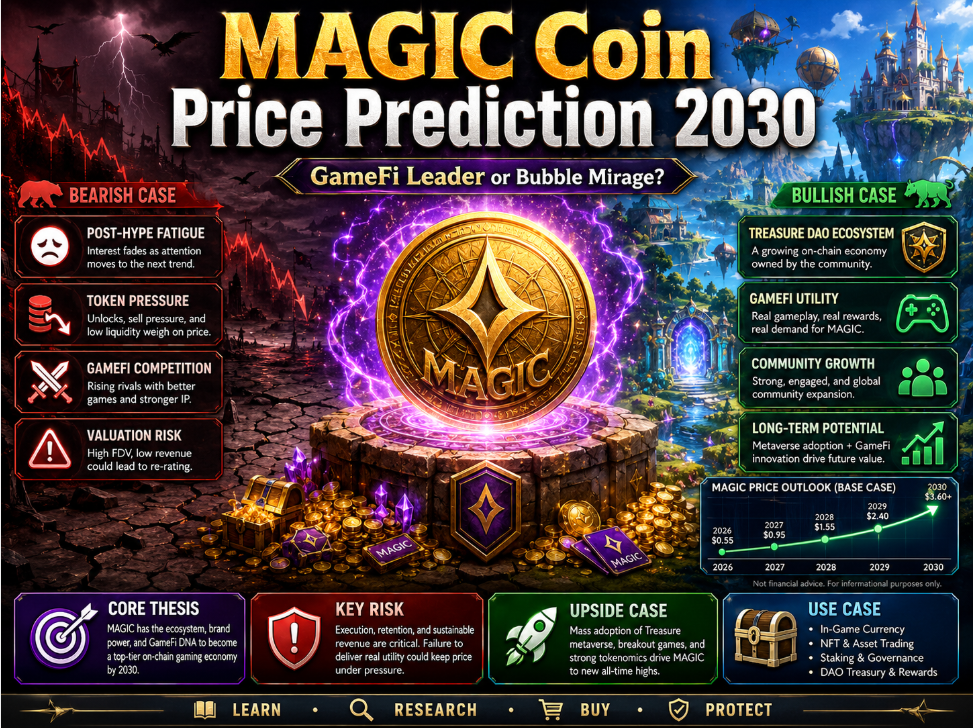
Skeptics, however, dismiss MAGIC as a relic of a legacy GameFi cycle. Following its deep market drawdown from historic peaks, the ecosystem has faced a series of headwinds: the decommissioning of Treasure Chain, strategic pivots, DAO treasury pressures, and persistent hurdles in long-term player retention. To this camp, MAGIC is not an "undervalued gem" but a value trap.
Compounding this confusion, major research firms and analytical models offer wildly divergent price targets for MAGIC by 2030:
- Conservative Models: Predict MAGIC may languish between $0.40 and $0.50.
- Neutral Baseline Forecasts: Place the token comfortably back within the $1.00–$3.00 territory.
- Optimistic Rallies: Forecast an expansion toward $8.00–$20.00.
- Hyper-Bullish Targets: Eye long-term milestones exceeding $25.00.
Why such a massive disparity for a single gaming token? The answer lies in how analysts weight critical project variables: the mass adoption curve of Web3 gaming, Treasure's strategic pivot toward AI protocols, structural halving mechanics, and macro crypto liquidity cycles.
Rather than feeding you a speculative price target, this guide breaks down the core structural variables driving these predictions so you can objectively evaluate where MAGIC stands on the spectrum between a structural turnaround and a legacy bubble illusion.
⚠️ Risk Disclaimer
This article is for educational, informational, and research purposes only and does not constitute financial, investment, or trading advice. Cryptocurrencies are exceptionally volatile, high-risk assets. MAGIC is a speculative altcoin, and investing in it carries a notable risk of total principal loss.
1. What Is MAGIC Coin? Understanding the Underlying Business Logic
Before evaluating complex pricing algorithms, an investor must grasp the foundational business architecture of the asset.
MAGIC is the native economic baseline asset of the Treasure ecosystem. Originally conceived as a decentralized gaming platform, Treasure functions as an open financial and infrastructure layer designed to connect various independent games, NFT projects, and communities through a shared economic framework.
Within this architecture, MAGIC does not act as isolated, single-game gold coins. Instead, it serves as the universal network currency. Its built-in utility pillars include:
- The default pricing currency across the ecosystem's digital marketplace.
- The core settlement asset for trading intra-game items and character collectibles.
- The governance routing tool for Treasure DAO resource allocation.
- The baseline economic asset used to power autonomous AI agents and digital personas.
[Treasure Ecosystem Platform Layer]
       /             |             \
[Game Asset DEX]  [AI Agents]  [DAO Governance]
       \             |             /
             [Universal Gas: MAGIC]
This structural positioning differentiates MAGIC from generic GameFi tokens. Most play-to-earn (P2E) tokens are completely isolated within a single game; if that game loses traction, the token's demand collapses to zero. MAGIC, by contrast, is engineered to act as an ecosystem-wide macro reserve currency, capturing value from an aggregated cross-game matrix.
Tokenomics: The Halving Mechanic
MAGIC features a hard cap on its maximum supply, limited to roughly 347.7 million tokens.
Crucially, its release schedule incorporates an aggressive annual halving mechanism modeled closely after Bitcoin's deflationary schedule. This layout ensures that new token emissions entering circulation drop structurally every year, rewarding long-term holders as network usage increases.
However, supply constraints are only half the equation. A deflationary issuance schedule cannot protect token valuation if the network's underlying application layer fails to drive organic consumer demand.
The Strategic Pivot: Shifting from P2E to AI Native Protocols
Recognizing that first-generation Play-to-Earn (P2E) economic loops—which were heavily dependent on unsustainable inflation and highly speculative users—could not support multi-year growth, Treasure implemented a major structural pivot toward AI-native protocols and AI-driven entertainment.
This architectural shift focuses on:
- Autonomous Gaming Personas: Intelligent, chain-native NPCs capable of developing unique traits and executing economic transactions independently.
- AI Companionship Layers: Digital characters deployed across social and interactive spaces using Treasure's base infrastructure.
- Decentralized Agent Marketplaces: Open platforms where users can configure, trade, and deploy algorithmic interactive characters utilizing MAGIC as the baseline settlement asset.
This pivot redefines MAGIC from a pure "gaming token" into a consumption-driven infrastructure asset tailored for AI entertainment economies. If this intersection captures organic traction, MAGIC's valuation model changes completely; if it fails to move past marketing hype, the asset risks prolonged stagnation.
To review the foundational background of this project, you can explore our introductory analysis on What is MAGIC Coin. This guide builds on those fundamentals to map out the asset's structural valuation trajectories up to 2030.
2. Price History: Historical Baselines and Macro Drawdowns
To evaluate a token's capacity to complete an extended turnaround by 2030, you must first study its structural coordinates across previous market cycles.
- The Narrative Peak: During the height of the previous market expansion, MAGIC rallied strongly as capital flooded into the Arbitrum network. The token became a primary vehicle for speculators betting on decentralized gaming networks and interoperable NFT metaverses.
- The Macro Capital Drain: As global liquidity contracted during the subsequent bear market, high-risk assets faced severe valuation compressions. The P2E sector experienced a major capital drain, and MAGIC suffered a deep drawdown from its historical highs.
- The Restructuring Phase: The closure of the standalone Treasure Chain and the subsequent migration of core liquidity pools back to optimized Ethereum and Arbitrum environments introduced structural volatility. This move reflected a deliberate effort by leadership to preserve capital runway, cut operational costs, and align the technology with more liquid, mature execution environments.
This price history underscores a clear reality: MAGIC possesses strong market memory and can generate considerable upside when a sector rally takes hold, but it is equally exposed to severe drawdowns when capital flows out of the altcoin market.
3. The Five Core Variables Driving the 2030 Horizon
Long-term pricing models differ dramatically because analysts use vastly different assumptions for five key ecosystem variables.
Variable 1: Player Retention vs. Speculative Mining Loops
First-generation Web3 games ran into a fundamental structural bottleneck: they attracted speculative yield-miners rather than actual players. These users were entirely focused on capital extraction timelines, leading to systemic dump cycles once token unlocks occurred.
MAGIC's long-term upside depends on whether the projects building on Treasure can deploy engaging games that capture organic player attention, shifting user behavior from speculative dumping to sustained on-chain consumption.
Variable 2: Practical Adoption of AI Agent Architectures
Treasure's pivot toward intelligent digital personas represents a large addressable market, but it introduces execution risks. For this narrative to translate into long-term value, the AI integrations must drive clear token utility—such as requiring MAGIC for character configuration, asset upgrades, or running agent transactions—rather than serving as a superficial marketing update.
Variable 3: Halving Constraints vs. Treasury unlocks
While MAGIC's annual emission halving structurally limits new token supply, investors must balance this against short-term distribution variables. The unlock schedules of ecosystem development funds, team allocations, and DAO treasury deployments must be carefully managed. If treasury liquidations to fund operational runway outpace network usage, the token faces persistent price suppression.
[Ecosystem Inflow: On-chain Consumption] <---> [Ecosystem Outflow: Treasury Liquidations / Unlocks]
Variable 4: Treasure DAO's Capital Runway
Surviving a multi-year development timeline requires a healthy treasury. Treasure's decision to downsize operational overhead and consolidate its multi-chain footprint directly addresses this risk. Investors must closely monitor the DAO's stablecoin reserves and protocol fee revenues to ensure the project has the financial runway needed to execute its goals heading into 2030.
Variable 5: Global Crypto Liquidity Cycles
As a high-beta altcoin, MAGIC is bound to global crypto market cycles. The upcoming 2028 Bitcoin halving will likely dictate the broader altcoin market's path toward 2030. If the post-2028 expansion rewards operational application layers and AI consumer applications, MAGIC could capture a strong narrative premium.
4. Multi-Scenario 2030 Price Forecasts
Evaluating long-term targets requires a structured, multi-scenario approach that charts potential outcomes across varying market conditions.
2026–2030 Structural Valuation Matrix

Consolidation of industry market share vs. sector irrelevance.
Skenario A: The Bearish Stagnation ($0.15 – $0.50)
In this scenario, the broader Web3 gaming space fails to capture mainstream adoption, and the AI agent transition fails to move past speculative concepts. Treasure DAO's treasury runs thin, forcing ongoing token liquidations to cover operational costs. Active developer retention drops as teams move to newer alternative gaming layers, keeping MAGIC under constant price pressure through 2030.
Skenario B: The Neutral Baseline ($1.00 – $3.00)
This represents a balanced, highly realistic path. Treasure successfully maintains its position within the Web3 gaming niche, and its AI companion protocols build a steady, loyal community. While it doesn't completely disrupt mainstream gaming giants, its network ecosystem generates consistent transaction fees, and the annual emission halving successfully stabilizes the supply side. Backed by broader post-2028 market cycles, MAGIC recovers into the $1.00 to $3.00 zone.
Skenario C: The Optimistic Breakout ($8.00 – $20.00)
A major sector rally takes hold, positioning autonomous AI networks and chain-governed gaming economies as central themes of the market cycle. Treasure emerges as a top-tier layer for AI consumer applications, causing on-chain interactions to spike and driving significant transaction fee revenue. This surge in utility, combined with an aggressive post-2028 macro bull run, triggers a structural supply squeeze that drives MAGIC into the $8.00 to $20.00 tier.
5. Primary Long-Term Bull Drivers
For investors looking at the bull case for MAGIC over the next few years, the project's thesis centers on three core fundamental drivers:
- A Deflationary Token Model: Unlike many first-generation GameFi tokens that suffer from unchecked supply inflation, MAGIC's strict hard cap and annual emission halving provide structural supply-side protection as the network grows.
- A High-Margin Narrative Pivot: Moving into AI entertainment and digital agent economies opens up a large, scalable addressable market. It shifts MAGIC's demand driver from simple game items to processing complex, automated agent transactions.
- Established Liquid Foundations: MAGIC enjoys a deep history of support across major digital asset exchanges, giving it a strong liquid foundation and high structural visibility. This positioning makes it a likely candidate for capital inflows whenever a sector rally takes hold.
When evaluating asset trends across multiple market cycles, studying historical examples can offer valuable perspective. For example, our research into the early growth phases of GMT Coin demonstrates how combining a highly viral narrative with real consumer consumption can create considerable upward price momentum over short horizons. MAGIC's long-term success depends on replication of that same organic user traction within its new AI-centric model.
6. Structural Risk Factors to Monitor
Investing in early-stage, mid-cap gaming networks requires a clear understanding of the underlying risk vectors.
- Fierce Platform Competition: Treasure faces intense competition from dedicated layer-1 gaming ecosystems like Ronin, enterprise networks like Immutable, and an array of newly deployed layer-2 scaling solutions.
- Treasury and Liquidation Risks: If protocol revenues can't keep pace with ecosystem development demands, the DAO may be forced to liquidate treasury assets to fund its operational runway, creating ongoing price friction.
- Execution Risks of Tech Migrations: Transitioning away from a standalone chain and migrating liquid assets back to core Arbitrum layouts creates short-term operational hurdles, network friction, and requires rebuilding user trust.
[Protocol Layer Adjustments] ---> Creates Technical/Liquidity Friction ---> Requires Rebuilding User Trust
Even projects with established foundations face deep drawdowns when market conditions shift or competitive pressures intensify. For instance, our deep dive into the historical performance of LTC illustrates how even highly secure, long-lasting digital assets can experience extended periods of price stagnation during broader structural adjustments. Investors should treat mid-cap utility tokens with a high degree of risk management.
7. How to Trade and Manage MAGIC on HiBT Exchange
For tactical spot investors looking to build a position in MAGIC based on its long-term AI-gaming turnaround thesis, the asset can be securely traded on the HiBT platform.
Step-by-Step Purchasing Process
- Account Onboarding: Go to the official HiBT web portal or download the mobile trading app. Register using a secure email address or mobile phone number, establish a strong password, and immediately set up Two-Factor Authentication (2FA).
- Identity Verification (KYC): Navigate to your user profile and upload clear images of your government-issued identification to pass standard security compliance. This step unlocks comprehensive trading, deposit, and asset withdrawal limits.
- Deposit USDT Capital: MAGIC is primarily liquid on the platform via the MAGIC/USDT spot trading pair. Go to your wallet overview, select Deposit, search for USDT, and choose your network configuration (e.g., TRC-20 for fast settlement and minimal fees). Copy the address and send your funds.
- Order Execution: Open the Spot Trading interface, use the search bar to find MAGIC, and choose the MAGIC/USDT pair.
- Market Order: Best for instant execution at the current market price.
- Limit Order: Ideal for long-term accumulation. This lets you specify a lower target price entry, and your order will only execute if market volatility pushes the token down to your exact target.
Structural Migration Warning
Because Treasure has executed infrastructure upgrades and moved away from its legacy standalone chain layout, you must verify your network parameters before sending transactions. Always check the deposit/withdrawal notices on HiBT to ensure your external wallet destinations match the platform's active network configuration. Sending tokens to deprecated chain addresses will result in permanent capital loss.
8. Strategic Position Sizing and Capital Rules
Given the structural shifts in the Web3 gaming sector, disciplined risk management is essential when handling an asset like MAGIC.
- Satellite Asset Allocation: MAGIC belongs strictly within the speculative satellite portion of a digital asset portfolio. It should represent a small fraction of your capital (typically limited to 1% to 3% for a balanced portfolio), ensuring your core wealth remains anchored in foundational blue-chip assets like BTC and ETH.
- Strategic Profit Taking: High-beta altcoins can experience parabolic moves during peak bull market conditions. Instead of trying to time the absolute top based on emotion, establish a clear, tiered limit order strategy to take profits in tranches (e.g., at $1.00, $3.00, and $5.00 milestones) to protect your capital.
9. Final Verdict: Turnaround Candidate or Legacy Phantom?
Treasure’s strategic pivot toward AI-driven digital agents, combined with MAGIC's deflationary tokenomics and deep liquidity on top-tier bursa platforms, gives the project a viable framework for a long-term turnaround.
However, the network must still overcome intense competition from rival gaming layers and deliver sustainable, non-speculative player engagement.
Approach MAGIC as a high-volatility, narrative-driven call option on the Web3 entertainment space. Use strict position sizing, monitor the DAO's financial runway metrics, and evaluate its progress based on hard data—such as active AI agent interactions and real protocol revenues—as it moves toward 2030.
FAQ: 2030 MAGIC Coin Price Prediction
What is the maximum realistic price target for MAGIC by 2030?
Under highly optimistic conditions—requiring Web3 gaming to capture mainstream interest, Treasure's AI agent protocol to win dominant market share, and a strong post-2028 bull run—MAGIC could challenge the $8.00 to $20.00 range. A data-supported baseline target sits closer to $1.00 to $3.00.
How does MAGIC's halving mechanism protect its long-term value?
Unlike typical inflationary P2E tokens that continuously dilute players by printing rewards, MAGIC's annual emission halving structurally reduces the influx of new supply over time. This model relies on growing ecosystem utility to drive demand against a shrinking emission rate.
Following the closure of Treasure Chain, what network does MAGIC utilize?
Core operations and liquidity pools have migrated back to optimized Ethereum and Arbitrum network layers. Always verify the active network channels displayed on your HiBT deposit portal before routing transfers.
Is MAGIC a safe asset for a long-term DCA strategy?
No mid-cap gaming altcoin is completely safe for unmanaged long-term accumulation. Any Dollar-Cost Averaging strategy should have a strict capital cap and be regularly reviewed against the project's fundamental progress.
What is the core difference between MAGIC and standard single-game tokens?
Standard gaming tokens are tied to the performance of a single game; if that game loses popularity, the token's value collapses. MAGIC functions as an ecosystem platform currency, capturing aggregate value across multiple independent games, NFT marketplaces, and AI agent frameworks within the broader Treasure network.
Disclaimer
This publication is intended strictly for educational and informational purposes and does not constitute investment, financial, or trading advice. Cryptocurrencies are speculative, high-risk assets subject to intense market volatility and sudden price shifts. Investors run the risk of losing their entire initial capital injection. Any financial actions should be taken independently based on extensive personal research, financial standing, and local regulatory laws.