
As an asset deeply anchored to the Bitcoin ecosystem, where exactly will STX Coin go by 2030?
This is a question that easily divides crypto newcomers and seasoned market participants alike.
Optimists view Stacks as the premier, most historically proven project within the Bitcoin Layer 2 sector. With the landmark Nakamoto Upgrade completed and sBTC successfully launched, they argue that if Bitcoin DeFi (BTCFi) experiences a true breakout over the next few years, STX will emerge as a vital, foundational collateral asset of the decentralized economy.
Skeptics, however, caution that despite a compelling technical narrative, STX has historically suffered deep, punishing market drawdowns. They point out that its current ecosystem scale remains small, and with a wave of heavily backed, aggressive competitors entering the space, STX risks becoming another "great story, weak price" long-term capital trap by 2030.
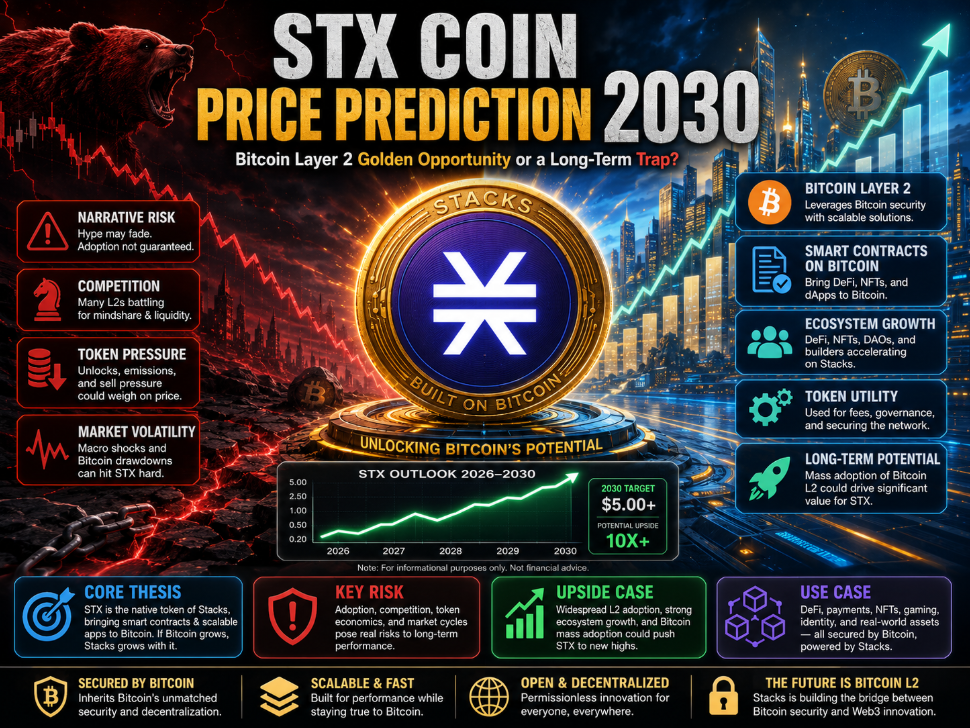
To make things even more confusing, different research institutions and analytical models offer widely divergent price targets for STX by 2030:
- Conservative Models: Predict STX may stagnate and fail to consistently break above the $1.00 threshold.
- Neutral Baseline Predictions: Place STX comfortably within the $2.00–$6.00 territory.
- Optimistic Targets: Call for a major multi-year expansion toward $10.00–$20.00.
- Hyper-Bullish Theories: Peg STX directly to the multi-trillion-dollar institutional financialization of Bitcoin, forecasting even higher ranges.
Why is there such a massive disparity for a single crypto project?
The root cause isn't that one analyst is inherently smarter than another; it's that they are using entirely different assumptions for a few critical, highly volatile macroeconomic and technical variables. The outcome depends on whether BTCFi can scale, whether sBTC captures true market trust, and how well the ecosystem absorbs underlying inflation.
Therefore, this guide will not simply hand you a random, definitive price target. Instead, it will provide a systematic evaluation framework so you can logically weigh which predictions are grounded in structural data and which are driven by speculative hype.
⚠️ Risk Disclaimer
This article is intended strictly for educational, informational, and market research purposes and does not constitute financial, trading, or investment advice. Cryptocurrencies are exceptionally volatile, high-risk assets. STX is a speculative altcoin, and investing in it carries a risk of losing your entire initial capital injection.
1. Ground Truth: Why Does STX Earn a Spot in the 2030 Conversation?
Before parsing through complex predictive pricing models, we must address the fundamental thesis: Why does Stacks even have the structural merit to be debated as a long-term asset through 2030?
STX is the native utility token powering the Stacks network. Stacks was not designed to alter or replace Bitcoin. Instead, it functions as an executable layer-2 network built directly on top of Bitcoin to introduce smart contracts, DeFi, NFTs, and scalable decentralized applications.
[Stacks L2 App Layer] ---> Clarity Contracts + sBTC Liquidity + Gas Fees (STX)
         |
[PoX Consensus Layer] ---> Anchors Stacks blocks natively to Bitcoin transactions
         |
[Bitcoin L1 Base Layer] -> Provides absolute security, decentralization, and settlement
Bitcoin is highly decentralized, incredibly secure, and the ultimate global digital monetary asset, but its base chain is intentionally restricted from processing high-throughput, complex smart contracts. This reality has left hundreds of billions of dollars worth of premium capital sitting entirely dormant in cold storage.
Stacks aims to transform Bitcoin from a purely passive "digital gold" store-of-value asset into an active, highly productive financial asset capable of generating yield, clearing decentralized loans, and facilitating multi-step financial operations. If this overarching macro direction is viable, STX carries an asymmetric long-term runway.
The Three Structural Pillars of STX Utility
- Gas Fee Settlement: Every time a user executes a smart contract, routes a trade through a decentralized exchange (DEX), or mints an asset on Stacks, they must cover execution fees using the native STX token.
- Consensus Stacking Yields: Unlike standard proof-of-stake protocols, STX holders can lock their tokens in the network's consensus via Stacking to earn security incentive rewards paid out in native BTC, supplied directly by Stacks miners.
- Governance & Collateral: As layer-2 financial apps expand, STX serves as core backing collateral and a governance tool for protocol optimization.
The Power of Proof of Transfer (PoX)
The economic loop underpinning Stacks is governed by a consensus mechanism called Proof of Transfer (PoX).
- Miners compete to mint new Stacks blocks by bidding and transferring native BTC to designated Bitcoin addresses.
- The protocol selects a winning miner based on the size of their BTC bid, awarding them newly minted STX and network gas transaction fees.
- Stackers who lock up their STX tokens to validate the network receive the incoming BTC directly from those miners.
This architecture forms a sustainable economic loop. The passive BTC yield earned by STX stackers is not generated out of thin air by an inflationary printing press; it represents a real-world, unforgeable opportunity cost paid by miners in premium native Bitcoin to secure block space.
If you want to compare this to another asset born from the Bitcoin lineage but running an entirely different evolutionary path, check out our piece on What is LTC. Litecoin remains a lightweight, payment-centric layer-1 fork of Bitcoin, whereas STX acts as a dedicated layer-2 smart contract execution environment servicing the core Bitcoin economy.
2. Market Cycles: Where Has STX Been, and Where is It Now?
To rationally map out a 2030 price forecast, we must chart the asset's historical market coordinates. A token's capacity to challenge higher valuation tiers depends heavily on its past behavior across multiple market cycles.
[2021 Narrative Peak (~$4.00)] ---> [2022 Bear Drawdown] ---> [2024-2026 Ecosystem Maturity] ---> [2030 Macro Target]
Historically, STX has rallied to an all-time high near the $4.00 territory during peak bull market conditions. However, during subsequent cyclical macro downturns, it experienced harsh, deep corrections, frequently trading at steep discounts relative to its historic peaks.
This price history reveals two critical market insights:
- Global capital is highly willing to pay a premium valuation for the "Bitcoin Smart Contract" and "Bitcoin Layer 2" narrative when market liquidity is ample.
- STX is fundamentally bound to altcoin market cycles; it does not possess natural immunity against severe bear market liquidity drains.
The Historical Phases of STX
- The 2021 Bull Run (Narrative-Driven): STX surged due to massive interest in emerging smart contract platforms. Investors sought out assets that could "activate Bitcoin." However, during this phase, Stacks' actual performance, transaction processing speeds, and core sBTC mechanisms were still in development. The price was driven by pure speculation rather than on-chain network data.
- The 2022 Bear Market (Liquidity Compression): As global central banks tightened liquidity, capital fled high-beta altcoins. STX experienced a painful drawdown, proving to investors that despite its deep connection to Bitcoin, it still carried standard altcoin volatility risks.
- The Post-Nakamoto Era: The market shifted from judging Stacks based on its marketing materials to judging it on hard operational data. Investors now closely evaluate net sBTC minting volumes, decentralized finance Total Value Locked (TVL), active developer retention, and real network gas consumption.
A low entry price relative to historical highs is not a standalone guarantee of value. The ultimate determinant of STX's trajectory to 2030 is whether the Stacks network can turn its infrastructural upgrades into sustainable, long-term token demand.
3. The Core Fundamentals: Nakamoto Upgrade and sBTC
If you are looking for the two most critical operational variables that will shape STX's 2030 outcome, they boil down to the structural rollout of the Nakamoto Upgrade and sBTC.
Solving the Legacy Bottleneck
Prior to these milestones, Stacks suffered from a clear performance limitation: its block production speeds were completely chained to Bitcoin's native 10-minute block execution times. For modern decentralized applications, this layout was highly restrictive. A user initiating a basic loan transaction or attempting to execute a trade on a decentralized exchange had to wait several minutes for confirmation, leading to an inefficient user experience.
The Nakamoto Upgrade: Fast Blocks with Bitcoin Security
The Nakamoto Upgrade overhauled Stacks' underlying block architecture. It decoupled Stacks' transaction processing from the slow 10-minute Layer 1 rhythm, enabling transaction confirmations to execute in seconds while still anchoring the final settlement block directly into the immutable history of the Bitcoin mainnet. This optimization transformed Stacks into a viable environment for high-throughput financial apps.
sBTC: The Trust-Minimized Bitcoin Bridge
sBTC provides a decentralized, programmable, non-custodial asset pegged 1:1 with native BTC.
[Native BTC on L1] <--- Locked via Decentralized Signers ---> [sBTC Minted on Stacks L2]
                                                                        |
                                                             DeFi, Lending, Yields
Instead of forcing institutional investors to trust highly centralized wrapped alternatives (like standard wrapped tokens) or navigate risky multi-chain bridges, sBTC allows holders to seamlessly migrate capital over to the Stacks application layer. This asset is critical to unlocking the hundreds of billions of dollars worth of passive capital currently sitting dormant in secure global wallets.
4. The Six Defining Variables for the 2030 Outlook
To evaluate long-term models objectively, you must understand the six key variables that analysts use to build their 2030 price projections.
1. Total Addressable Market of BTCFi
The ultimate upside for STX depends on the macro adoption of Bitcoin DeFi. If the core community of Bitcoin holders maintains a highly conservative outlook and refuses to interact with decentralized financial applications, Stacks' addressable market will remain restricted. However, given Bitcoin’s multi-billion-dollar market capitalization, even if a tiny fraction (such as 1% to 3%) of global circulating supply flows into BTCFi smart contracts, it would translate into billions of dollars in active on-chain liquidity.
2. sBTC Market Dominance
The protocol's long-term valuation depends on sBTC establishing itself as a trusted industry standard for programmable Bitcoin. sBTC faces active competition from traditional centralized custodial alternatives, cross-chain wrapped products, and emerging decentralized staking layers like Babylon. sBTC must prove its absolute security and decentralization over multiple market cycles to win institutional trust.
3. The Macro Bitcoin Halving Cycles
STX will always maintain a strong correlation to Bitcoin’s structural halving cycles. The upcoming 2028 Bitcoin halving will likely act as a major macro liquidity driver, setting the stage for the broader altcoin cycles heading into 2030. If the post-2028 market cycle centers heavily on the practical utility of the Bitcoin ecosystem, STX stands to capture a notable narrative premium.
4. Competitive Layer 2 Dynamics
Stacks is no longer the sole contender attempting to scale Bitcoin utility. The project faces a growing roster of competitors, including the payments-focused Lightning Network, older smart contract networks like Rootstock, asset protocols like RGB, and an array of new, venture-backed Layer 2 networks utilizing alternative technical frameworks like BitVM. Stacks must turn its early first-mover advantage into a sticky, compounding network effect.
5. Supply Inflation vs. Ecosystem Absorption
The token's long-term price performance is a function of supply and demand. The network's issuance schedule—including emission programs designed to fund developer grants and bootstrap early ecosystem liquidity—means STX holders experience a steady dilution profile (often averaging roughly 5.75% annually during growth phases).
This structural inflation is manageable if, and only if, the capital spent on ecosystem incentives generates an exponential increase in actual transaction fees, dApp usage, and sBTC minting demand. If it fails to drive real network activity, this issuance becomes pure overhead sell pressure.
6. Developer and User Retention Metrics
The true underlying value of a layer-2 network is determined by its active developer count. Stacks must continually attract Web3 engineers to deploy secure borrow-and-lend protocols, over-collateralized stablecoins, high-liquidity decentralized exchanges, and enterprise-grade custody management portals.
[Active Engineers Deploy Apps] ---> [Attracts On-Chain Users] ---> [Drives Gas Fee Volatility (STX)]
5. 2030 Price Projections: Multi-Scenario Analysis
Because predicting a precise token price years into the future is impossible, the most responsible analytical approach is to evaluate potential trajectories across three distinct economic scenarios.
The 2026–2030 Price Target Matrix

1. The Bearish Stagnation Scenario ($0.25 – $0.80)
In this scenario, BTCFi remains a niche market, as core Bitcoin holders choose to keep their capital in offline cold storage rather than interacting with smart contracts. Stacks faces an outflux of users to faster, venture-backed alternative Layer 2 chains or native scaling solutions like BitVM. The token rewards from emissions steadily outpace real demand, creating structural sell pressure that keeps the token's price below $1.00 through 2030.
2. The Neutral Baseline Scenario ($2.00 – $6.00)
This represents a balanced, data-supported baseline trajectory. In this scenario, Bitcoin preserves its upward macro trajectory, and the 2028 halving triggers a standard market expansion. Stacks secures a steady, respected share of the crypto financial sector, sBTC achieves moderate adoption among mid-tier institutional participants, and the network's steady growth comfortably absorbs supply emissions. Under these conditions, a valuation recovery between $2.00 and $6.00 is structurally supported.
3. The Optimistic Breakout Scenario ($10.00 – $20.00)
This aggressive forecast requires multiple conditions to line up perfectly: BTCFi evolves into a dominant sector in Web3, sBTC becomes a universally trusted asset for programmable Bitcoin, and billions of dollars in institutional capital stream into the Stacks ecosystem. Driven by high on-chain transaction volumes and a strong post-2028 bull market, STX experiences a major supply squeeze, pushing its price into the $10.00 to $20.00 tier.
A Note on Extreme Projections: If you encounter a source predicting that STX will inevitably hit $100 or more by 2030, always check their math. Calculate the implied market cap against the token's circulating supply at that time. Without an aggressive, systemic token burn mechanism, ungrounded targets remain purely speculative.
6. Three Structural Tailwinds for the Long-Term Bull Case
If you are tracking STX for your long-term portfolio, there are three main fundamental drivers supporting the bull case:
- The Inherent Demand for Productive Bitcoin: Bitcoin is the most secure digital asset on Earth, but holding it traditionally produces zero native yield. Stacks offers a trust-minimized framework for capital allocation, allowing users to put their assets to work within a secure, layer-2 smart contract environment.
- A Delivered Technical Foundation: Stacks has a strong track record of executing its technical roadmap. By successfully deploying major milestones like the Nakamoto Upgrade and launching sBTC, the team has proven its ability to transition from theoretical whitepapers to functional, live code.
- A Clear On-Ramp for Institutional Capital: Institutional investors require secure infrastructure, clear risk management parameters, predictable smart contract execution environments, and audited asset flows. Stacks' safety-first design architecture is well-suited to meet these compliance demands over the next decade.
Understanding how different network models accrue value over multi-year horizons is key to building a successful investment thesis. For instance, the gaming-focused architecture we discuss in our guide on What is MAGIC Coin relies on an entirely different economic driver than the institutional, Bitcoin-centric utility model powering STX.
7. Five Critical Operational Risk Factors
Even with its strong technical foundation and compelling narrative, STX is a high-risk asset. Investors should carefully monitor these five core risk vectors:
- Ecosystem Inflation Pressures: Token distribution and ecosystem emissions create ongoing inflation. If the network's actual user adoption and gas fee metrics fail to scale alongside this expanding supply, long-term token value will face downward pressure.
- Fierce Protocol Competition: Stacks does not hold a monopoly over Bitcoin scaling. If competing layer-2 networks or alternative scaling solutions manage to deliver faster transaction speeds, lower fees, or deeper liquidity pools, Stacks could lose its competitive edge.
- The Security Runway of sBTC: As the core economic bridge of the Stacks network, sBTC must prove its resilience against smart contract exploits, oracle failures, and economic stress testing during periods of extreme market volatility. Any security compromise would heavily impact investor confidence.
- Cultural Resistance from Bitcoin Purists: A notable segment of the core Bitcoin community is highly conservative, favoring simplicity and security over complex financial engineering. This cultural skepticism toward decentralized finance applications could slow down the adoption curve of BTCFi.
- Standard Altcoin Market Volatility: Despite its deep technical connection to Bitcoin, STX still behaves like an altcoin during macro market liquidations. During sharp market-wide corrections, speculative assets face much deeper percentage drawdowns than Bitcoin itself.
[Systemic Crypto Bear Market] ---> BTC drops 30% | STX can drop 60%+
As we have seen across many market cycles, a compelling narrative cannot insulate an asset from macro liquidity drawdowns. For example, our research covering the price history of GMT Coin highlights how even projects with large active user bases and strong initial hype can still experience deep corrections during broader market downturns.
8. Portfolio Construction and Risk Management
If your research leads you to allocate capital to the Stacks ecosystem, you should approach the asset with a disciplined, risk-managed framework.
Position Sizing Rules
Because of its underlying altcoin volatility profile, STX is best suited as a speculative satellite holding rather than a core portfolio pillar.
- Core Portfolio: Dedicated to blue-chip assets like BTC, ETH, or highly liquid stablecoins.
- Satellite Allocation: Small, controlled positions in high-beta growth assets like STX (typically restricted to 1% to 5% of a total crypto portfolio, depending on your risk tolerance).
Execution via Dollar-Cost Averaging (DCA)
When building a position for a multi-year horizon, executing a structured Dollar-Cost Averaging strategy is generally safer than making a single large purchase. This approach helps mitigate the risk of buying local tops during periods of short-term market hype.
However, your DCA program should have clear parameters: establish a maximum capital ceiling, set a target take-profit zone, and conduct regular reviews of the project's fundamental data. If Stacks' core metrics begin to structurally decline, adjust or pause your accumulation strategy accordingly.
9. Conclusion: Premium Opportunity or Speculative Trap?
STX occupies a highly unique position in the digital asset landscape. It isn't just another generic layer-1 token; it is a live, functional layer-2 platform designed to unlock the massive, dormant liquidity of the Bitcoin network through Stacking yields, smart contracts, and sBTC.
However, its long-term success is far from guaranteed. It remains exposed to technical implementation challenges, an intensifying competitive landscape, and the inherent volatility of altcoin market cycles.
                  [2030 Valuation Crossroads]
                              /   \
                             /     \
  [Ecosystem Success] ------/       \------ [Ecosystem Stagnation]
  sBTC captures trust                       Fails to gain traction
  Target: $2.00 - $6.00+                    Target: Under $1.00
Ultimately, STX behaves like a high-beta, long-term option on the financialization of Bitcoin. If you choose to allocate capital to it, base your decision on hard, verifiable metrics—such as developer retention, sBTC volume trends, and real gas consumption—rather than short-term price speculation.
FAQ: 2030 STX Coin Price Prediction
What is the maximum realistic price target for STX by 2030?
Optimistic market models suggest STX could reach $10.00 to $20.00 by 2030. However, this relies on perfect execution: BTCFi must become a mainstream global sector, sBTC must dominate as the default layer-2 standard, and the network must capture significant institutional inflows. A more conservative, data-supported baseline sits between $2.00 and $6.00.
Are Stacking yields paid out in STX or BTC?
Unlike standard proof-of-stake networks that print more of their own native token to reward validators, Stacks' PoX consensus model pays out rewards directly in native Bitcoin (BTC). This yield is funded by Stacks miners who bid in BTC for the right to validate blocks.
What is the difference between sBTC and traditional Wrapped Bitcoin (WBTC)?
WBTC relies on centralized custodial entities to hold the underlying Bitcoin, introducing counterparty risk. sBTC is designed as a decentralized, trust-minimized, non-custodial asset managed by an open network of signers and smart contracts, making it much more aligned with Web3 core principles.
Does the completion of the Nakamoto Upgrade guarantee a price increase?
No. The Nakamoto Upgrade was a major technical milestone that enabled faster block times and enhanced network security, but technical upgrades improve infrastructure rather than automatically driving price. Sustained price appreciation still requires actual user growth, increasing TVL, and consistent token demand.
Is STX a safe asset for infinite long-term Dollar-Cost Averaging?
No altcoin is completely safe for unmanaged, long-term accumulation. Because STX carries notable volatility and faces active platform competition, any DCA program should have clear capital limits, strict stop-loss parameters, and regular fundamental data reviews.
How do I store my STX safely if I want to participate in Stacking?
To participate in on-chain Stacking pools, move your tokens from centralized bursa platforms into native Stacks ecosystem wallets like Leather or Xverse. Always follow best practices for security: never screenshot your seed phrases, and keep your private keys offline.
Disclaimer
This article is for educational and market research purposes only and does not constitute investment, financial, or trading advice. Cryptocurrencies are highly volatile, speculative assets. Investors run a notable risk of losing their entire initial capital allocation. All financial actions should be taken independently based on extensive personal due diligence, financial standing, and local regulatory frameworks.